Translating The Dawn-Breakers
Rúḥíyyih Khánum, The Priceless Pearl, (1969), Bahá'í Publishing Trust
When in Bahá'í history
Haifa (today: Haifa, Israel)
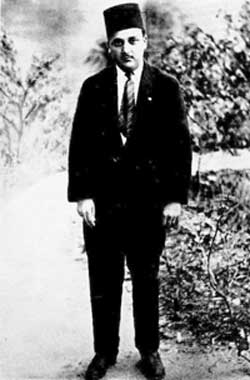
In The Priceless Pearl Rúḥíyyih Khánum describes the labour by which Shoghi Effendi gave the English-speaking Bahá'í world its principal book of early history, The Dawn-Breakers, published in 1932.
The chronicle had been compiled in Persian by Nabíl-i-Aʿẓam, a contemporary follower of both the Báb and Bahá'u'lláh. Shoghi Effendi translated the first part of it, which deals chiefly with the Báb. Although ostensibly a translation, Rúḥíyyih Khánum writes, he may be said to have re-created it in English, and she compares his rendering to FitzGerald's Rubáiyát of Omar Khayyám.
He described the work himself in a letter to Martha Root on 3 March 1931:
I have just completed, after eight months of continuous and hard labour, the translation of the history of the early days of the Cause and have sent the manuscript to the American National Assembly.
The work, he told her, came to about 600 pages, with 200 pages of additional notes he had gleaned during the summer months from different books. He had been so absorbed in it that he had been forced to delay his correspondence, and he was now so tired and exhausted that he could hardly write.
The translation was only part of the task. Rúḥíyyih Khánum says it took him almost two years of research, compilation and translation to complete the volume. In 1930 he sent an Australian Bahá'í photographer to Persia to retrace the footsteps of the Báb and to photograph the scenes of His life and of His followers' martyrdoms; without those pictures, she notes, all visual trace of many of those places in their original state might have been lost. He arranged for the original Tablets of the Báb to His nineteen disciples to be reproduced in facsimile, chose as his frontispiece a coloured reproduction of the interior of the Shrine of the Báb, and dedicated the book to the Greatest Holy Leaf, "the last survivor of a glorious and heroic age."
Prominent readers outside the Faith wrote to him in praise. The Orientalist Sir E. Denison Ross wrote that his English style "really could not be bettered, and never does it read like a translation."
For the Bahá'ís of the West, Rúḥíyyih Khánum writes, reading the book was a transfiguring experience. They caught a glimpse of the tradition behind them and saw that this was a Faith for which one carried one's life in one's hand. The seeds it planted in their hearts, she says, grew and matured in the Ten Year Crusade.
A retelling based on The Priceless Pearl (Rúḥíyyih Khánum, 1969). For the fuller account, see the original.
Cite this story
Khánum, R.. (1969). *The Priceless Pearl*. Bahá'í Publishing Trust.
Record yourself reading this story
Recording stays on this device only. Nothing is uploaded.
Related stories
Eight Months of Translation
Shoghi Effendi worked for eight months to translate Nabíl's Persian history of the Báb and His followers into English, and in 1932 it was published as The Dawn-Breakers.
Four Times Around the World
From 1919 until her death in Honolulu in 1939, Martha Root travelled four times around the world teaching the Bahá'í Faith, from South American cities to the palace of Queen Marie of Romania. Shoghi Effendi called her the foremost Hand of the first Bahá'í century.
Epilogue: The Faith from 1951 to 1979
Under the inspired guidance of Shoghi Effendi the Bahá’í Cause grew steadily in size and in the establishment of its Administrative Order, so that by 1951 there were eleven functioning National Spiritual Assemblies.
How God Passes By Was Written
During the Second World War the Guardian wrote God Passes By, his review of the first Bahá'í century, racing to finish it in time for the Centenary. Rúhíyyih Khánum, who proofread it with him late into the night, recorded what the work cost him.