The Guardian's Quiet Wedding
Rúḥíyyih Khánum, The Priceless Pearl, (1969), Bahá'í Publishing Trust
When in Bahá'í history
Haifa (today: Haifa, Israel)
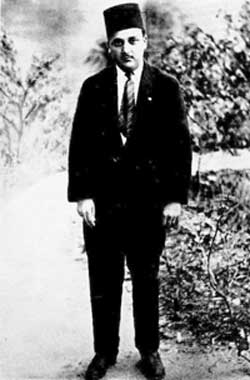
A retelling based on The Priceless Pearl by Rúḥíyyih Khánum (1969), in which she tells the story of her own marriage. Quotations are from the book.
Mary Maxwell of Montreal was the only child of May Bolles Maxwell and the architect William Sutherland Maxwell, whose home had received 'Abdu'l-Bahá in 1912. Her mother had first known Shoghi Effendi as a child, when she came to the Holy Land at the end of the nineteenth century. In January 1937 Mary arrived in Haifa with her mother on her third pilgrimage.
The Guardian wished the marriage kept secret, knowing from experience, she writes, how much trouble any major event in the Cause invariably stirred up. No one knew it was to take place except his parents, her parents, and a brother and two sisters of his living in Haifa. On the afternoon of 25 March his chauffeur drove the two of them to Bahjí, to the Shrine of Bahá'u'lláh. There he asked her for his ring, which she had been wearing concealed about her neck, and placed it on her finger. It was the only gesture he made. He entered the inner Shrine and gathered up in a handkerchief the dried petals and flowers that had been placed at the feet of Bahá'u'lláh, and chanted the Tablet of Visitation. They returned to Haifa, and the marriage took place in the room of the Greatest Holy Leaf, who had passed away in 1932.
"There was no celebration, no flowers, no elaborate ceremony, no wedding dress, no reception." His parents signed the marriage certificate to signify their consent. She went back across the street to the Western Pilgrim House and her parents, who had not been present at any of these events, and Shoghi Effendi went to attend to his own affairs. At dinner he came over as usual, showered his love and congratulations on her mother and father, and gave her mother the handkerchief of flowers from the inner Shrine of Bahá'u'lláh.
Only then did the news go out. A cable drafted by the Guardian and sent over his mother's signature told the American Bahá'ís of the honour conferred on "Ruhiyyih Khanum Miss Mary Maxwell," the new name he had given her, and declared: "Union of East and West proclaimed by Bahá'í Faith cemented."
The quietness, she writes, did not mean he thought the marriage unimportant. The most significant point was the stress he laid on its having drawn the Occident and the Orient closer to each other. Replying to the American National Spiritual Assembly, he wrote that the Guardianship was now reinforced through direct association with the West. After the marriage, she adds, his work went on exactly as before.
A retelling based on The Priceless Pearl (Rúḥíyyih Khánum, 1969). For the fuller account, see the original.
Cite this story
Khánum, R.. (1969). *The Priceless Pearl*. Bahá'í Publishing Trust.
Record yourself reading this story
Recording stays on this device only. Nothing is uploaded.
Related stories
Amatu’l-Bahá Rúḥíyyih Khánum
Mary Maxwell of Montreal married Shoghi Effendi on 25 March 1937 in a simple, private wedding; as Rúḥíyyih Khánum she later served as a Hand of the Cause and travelled to 185 countries and territories.
A Secret Wedding in Haifa
In 1937 Mary Maxwell of Montreal married Shoghi Effendi in Haifa. Almost no one knew beforehand, and there was no celebration, no wedding dress and no reception.
William Sutherland Maxwell
The Montreal architect William Sutherland Maxwell, husband of May Maxwell, spent his last years serving Shoghi Effendi in Haifa and designed the superstructure of the Shrine of the Báb.
Mary Maxwell's Quiet Wedding
Mary Maxwell, who grew up in Montreal, married Shoghi Effendi in Haifa in 1937 with no celebration and no elaborate ceremony. Known afterwards as Rúḥíyyih Khánum, she served the Faith for the rest of her life.