Amatu’l-Bahá Rúḥíyyih Khánum
Bahá'í Chronicles editors, Bahá'í Chronicles · Read original
When in Bahá'í history
Haifa (today: Haifa, Israel)
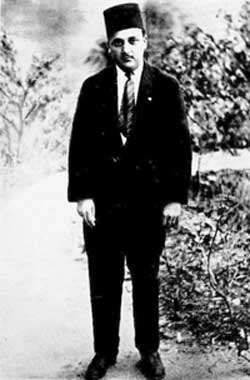
Mary Maxwell (later to be known as Amatu’l-Bahá Ruhiyyih Khanum, which means ‘Maidservant of Bahá, Lady Ruhiyyih’) was the only child of May Maxwell and William Sutherland Maxwell, a distinguished Canadian architect. She was born in New York City but grew up in Montreal, Canada.
Mary Maxwell’s only sorrows growing up were the periods of separation from her beloved mother, who travelled extensively for the Bahá’í Faith. Because the educational methods of the time tended to be rigid and authoritarian, May Maxwell established the first Montessori school in Canada in the Maxwell home.
Mary Maxwell became well read and knowledgeable, interested in a variety of subjects. Her thirst for knowledge was insatiable. She became involved in many youth activities, both within the Bahá’í community and elsewhere.
The marriage of Shoghi Effendi, the Guardian of the Bahá’í Faith, with Mary Maxwell of Canada took place on March 25, 1937 in Haifa. Many years later in her book about Shoghi Effendi, The Priceless Pearl, Ruhiyyih Khanum describes the circumstances surrounding her wedding and helps us appreciate the incredible simplicity of the event – reminiscent of the simplicity of ‘Abdu’l-Bahá’s own marriage in the prison-city of ‘Akká – and its thought-provoking example to Bahá’ís everywhere:
No one, with the exception of his parents, my parents and a brother and two sisters of his living in Haifa, knew it was to take place. He felt strongly urged to keep it a secret, knowing from past experience how much trouble any major event in the Cause invariably stirred up. It was therefore a stunning surprise to both the servants and the local Bahá’ís when his chauffeur drove him off, with me beside him, to visit the Holy Tomb of Bahá’u’lláh on the afternoon of 25 March 1937. His heart drew him to that Most Sacred Spot on earth at such a moment in his life. . . . When we arrived at Bahji and entered the Shrine he requested me to give him his ring, which I was still wearing concealed about my neck, and this he placed on the ring-finger of my right hand, the same finger that corresponded to the one of his own on which he himself had always worn it. This was the only gesture he made. He entered the inner Shrine, beneath the floor of which Bahá’u’lláh is interred, and gathered up in a handkerchief all the dried petals and flowers that the keeper of the Shrine used to take from the threshold and place in a silver receptacle at the feet of Bahá’u’lláh. After he had chanted the Tablet of Visitation we came back to Haifa and in the room of the Greatest Holy Leaf our actual marriage took place . . . Except for this visit, the day he told me he had chosen to confer this great honour on me, and one or two brief moments in the Western Pilgrim House when he came over for dinner, I had never been alone with the Guardian. There was no celebration, no flowers, no elaborate ceremony, no wedding dress, no reception. His mother and father, in compliance with the laws of Bahá’u’lláh, signified their consent by signing our marriage certificate and then I went back to the Western Pilgrim House across the street and joined my parents (who had not been present at any of these events), and Shoghi Effendi went to attend to his own affairs. At dinner-time, quite as usual, the Guardian appeared, showering his love and congratulations on my mother and father. He took the handkerchief, full of such precious flowers, and with his inimitable smile gave them to my mother, saying he had brought them for her from the inner Shrine of Bahá’u’lláh. My parents also signed the marriage certificate and after dinner and these events were over I walked home with Shoghi Effendi, my suitcases having been taken across the street by Fujita while we were at dinner. We sat for a while with the Guardian’s family and then went up to his two rooms which the Greatest Holy Leaf had had built for him so long ago. The quietness, the simplicity, the reserve and dignity with which this marriage took place did not signify that the Guardian considered it an unimportant event – on the contrary. Over his mother’s signature, but drafted by the Guardian, the following cable was sent to America: “Announce Assemblies celebration marriage beloved Guardian. Inestimable honour conferred upon handmaid of Bahá’u’lláh Ruhiyyih Khanum Miss Mary Maxwell. Union of East and West proclaimed by Bahá’í Faith cemented. Ziaiyyih mother of Guardian.” A telegram similar to this was sent to Persia. This news, so long awaited, naturally produced great rejoicing amongst the Bahá’ís and messages flooded in to Shoghi Effendi from all parts of the world.
In 1951, Shoghi Effendi appointed her to the Bahá’í International Council, a nine-member body that served as custodian of the Bahá’í World Centre until the election of the Universal House of Justice in 1963. In 1952, she was elevated to the rank of Hand of the Cause, in which capacity she attended to matters related to the expansion and protection of the Bahá’í Faith, in addition to representing Shoghi Effendi at a number of important events in different parts of the world.
Following the passing of Shoghi Effendi in 1957, Ruhiyyih Khanum initiated efforts that maintained the unity of the Bahá’í community until the first election of the Universal House of Justice in 1963.
Her travels took her to 185 countries and territories. She was received by many prominent figures, including Emperor Haile Selassie of Ethiopia, Malietoa Tanumafili II of Western Samoa, President Houphouet-Boigny of Côte d’Ivoire, President Carlos Menem of Argentina, Prime Minister Indira Gandhi of India, Prime Minister Edward Seaga of Jamaica, and Javier Pérez de Cuellar, Secretary-General of the United Nations.
Sources: Rúḥíyyih Rabbani, The Priceless Pearl (London: Bahá’í Publishing Trust, 1969), pp. 151–152 (the account of the wedding); Canadian Bahá’í News Service, “Amatu’l-Bahá Rúḥíyyih Khánum (1910–2000)” (news.bahai.ca); as compiled by Bahá’í Chronicles (https://bahaichronicles.org/amatul-baha-ruhiyyih-khanum/).
Cite this story
editors, B. C.. *Bahá'í Chronicles*. https://bahaichronicles.org/amatul-baha-ruhiyyih-khanum/
Record yourself reading this story
Recording stays on this device only. Nothing is uploaded.
Related stories
The Guardian's Quiet Wedding
Rúḥíyyih Khánum recalls her marriage to Shoghi Effendi on 25 March 1937: a visit to the Shrine of Bahá'u'lláh, a simple ceremony in the room of the Greatest Holy Leaf, and no celebration at all.
Mary Maxwell's Quiet Wedding
Mary Maxwell, who grew up in Montreal, married Shoghi Effendi in Haifa in 1937 with no celebration and no elaborate ceremony. Known afterwards as Rúḥíyyih Khánum, she served the Faith for the rest of her life.
A Secret Wedding in Haifa
In 1937 Mary Maxwell of Montreal married Shoghi Effendi in Haifa. Almost no one knew beforehand, and there was no celebration, no wedding dress and no reception.
William Sutherland Maxwell
The Montreal architect William Sutherland Maxwell, husband of May Maxwell, spent his last years serving Shoghi Effendi in Haifa and designed the superstructure of the Shrine of the Báb.