The Guardian's Passing in London
Rúḥíyyih Khánum, The Priceless Pearl, (1969), Bahá'í Publishing Trust
When in Bahá'í history
London (today: London, United Kingdom)
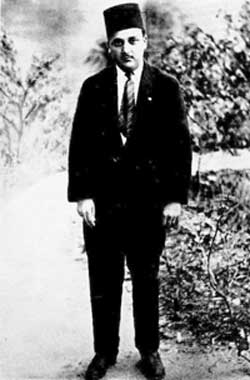
A retelling based on The Priceless Pearl by Rúḥíyyih Khánum, who was with her husband in London during his last days.
In the autumn of 1957, before returning to Haifa in November, Shoghi Effendi went to London to buy a few more things for the furnishing of the newly completed International Archives building. While they were there, the great epidemic of Asiatic influenza was sweeping Europe, and he and Rúḥíyyih Khánum both fell ill with it. They had an excellent physician, whom the Guardian liked and trusted. The attack was not a particularly severe one, though he had quite a high fever for a few days, and the doctor insisted he should not arrange to leave London until he had been free of fever for a week.
In spite of the fever he read a great deal in bed and attended to his mail and cables. When a week had passed he was at work on his last map, the one he called “the half-way point of the Ten Year Crusade.” He had a large table put in his room and worked at it for hours, checking figures with her against his notes. When she begged him to wait a few days until he felt stronger, he said: “No, I must finish it, it is worrying me.” While he worked he repeated words she had often heard from him in those last years: “This work is killing me!” When it was done he went back to bed and sat reading reports.
Early in the morning of 4 November he suffered a coronary thrombosis. She writes: “Death must have come to him so gently and so suddenly that he died without even knowing he was ascending to another realm.” When she went to his room in the morning to ask how he was, she did not recognize that he was dead. His eyes were half-open, with no look of pain, alarm or surprise in them.
She thought of the old, the ill and the weak, for whom the news would be an unbearable blow. Hoping to cushion it, she first cabled the members of the International Bahá’í Council in Haifa that the Guardian was desperately ill with Asiatic flu and asked the believers to pray. Later that day she cabled Haifa the news of his death, to be relayed from the World Centre to all National Assemblies. Her fellow Hands of the Cause came to her side in London, first those who lived there and then others from Europe, Haifa and every continent.
The laws of the Kitáb-i-Aqdas require that burial take place not more than an hour’s journey from the place of death, so there could be no question of taking his remains back to the Holy Land. On Saturday, 9 November, he was laid to rest in the Great Northern London Cemetery (now New Southgate Cemetery), in the presence, as her cable to the Bahá’í world reported, of believers from more than twenty-five countries. In 1958 his grave was built of white Carrara marble: a single column surmounted by a globe, and on the globe a large gilded bronze eagle.
The grief the news released, Rúḥíyyih Khánum writes, was like that which had flooded the hearts of the Bahá’ís thirty-six years earlier, when they lost the Master.
A retelling based on The Priceless Pearl (Rúḥíyyih Khánum, 1969), chapter 16. For the fuller account, see the original.
Cite this story
Khánum, R.. (1969). *The Priceless Pearl*. Bahá'í Publishing Trust.
Record yourself reading this story
Recording stays on this device only. Nothing is uploaded.
Related stories
The Guardian's Last Days in London
In London in 1957, Shoghi Effendi fell ill with the flu, kept working until he had finished his last map, and passed away peacefully in his sleep.
The Letters That Reached the World
Letters poured in to Shoghi Effendi from all over the world. He decided to keep writing back to individual believers, and he wrote and typed his own books himself.
The Guardian's Quiet Wedding
Rúḥíyyih Khánum recalls her marriage to Shoghi Effendi on 25 March 1937: a visit to the Shrine of Bahá'u'lláh, a simple ceremony in the room of the Greatest Holy Leaf, and no celebration at all.
The Guardian's Correspondence
Faced with a flood of letters from all over the world, Shoghi Effendi chose to keep answering individual believers. He kept copies of his cables to the end and typed his own manuscripts with two fingers.