Shoghi Effendi at Balliol
Rúḥíyyih Khánum, The Priceless Pearl, (1969), Bahá'í Publishing Trust
When in Bahá'í history
Oxford (today: Oxford, United Kingdom)
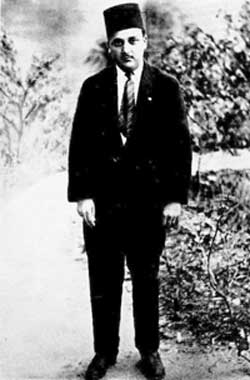
A retelling based on The Priceless Pearl by Rúḥíyyih Khánum.
Shoghi Effendi left ‘Abdu’l-Bahá in the spring of 1920, after less than two years spent constantly in His service. It had been decided that he should go to England and enter Oxford, his avowed purpose being, in Rúḥíyyih Khánum’s words, “to perfect his English in order to better translate the Tablets of ‘Abdu’l-Bahá, as well as the other sacred writings.” At the Master’s insistence he first rested for about two months in a sanatorium at Neuilly, near Paris. In July he went on to England, carrying Tablets from ‘Abdu’l-Bahá for Lady Blomfield, Lord Lamington and Major Tudor Pole.
He was admitted to Balliol College, where the college register of 1920 records him, in his own handwriting, as aged twenty-three. A list in his notebook gives the dates in October 1920 when he began his lectures: political science, social and industrial questions, political economy, English economic history, logic, the Eastern Question and others. On 18 October he wrote to a believer in the East:
My hope is that I may speedily acquire the best that this country and this society have to offer and then return to my home and recast the truths of the Faith in a new form, and thus serve the Holy Threshold.
Rúḥíyyih Khánum has no doubt that he meant his future translations of the teachings. In a Persian letter of the period he wrote that he was engaged “day and night, in perfecting myself in the art of translation.”
His tutor, A. D. Lindsay, who later became Master of Balliol, told one of the Bahá’ís that Shoghi Effendi’s idea of education was to find somebody whose opinions he valued and question him, and then write the answers in a small black book. Lindsay had posted his schedule, and Shoghi Effendi came to ask him what he did between seven and half past eight. “Why man,” Lindsay replied, “I dine!” Shoghi Effendi asked whether he must have all that time. “I had not found so much eagerness for knowledge at Oxford,” Lindsay said. “So I gave him another quarter-hour and went with less dinner.”
From his Beirut days until nearly the end of his life, Rúḥíyyih Khánum records, he kept notebooks of English words and phrases. He was a great reader of the King James Bible and of the historians Carlyle and Gibbon, whose style he greatly admired. She writes that Gibbon’s influence can be seen throughout his writings, and the biblical English in his translations of Bahá’u’lláh’s prayers, The Hidden Words and Tablets.
While at Oxford he took part in the activities of the British Bahá’í community. A letter of May 1921 records him reading a paper on economic problems at one of its meetings, and he also read a paper on the Faith at one of the leading societies in Oxford. He belonged to a debating society and liked to play tennis. But he seems to have kept himself apart from most people, perhaps, she thought, out of shyness; she never heard him name anyone from those days as a friend, and she thought few of his Oxford memories were really happy ones.
He had left the Master fully believing he would return to His side better equipped to serve Him. On 29 November 1921 the cable announcing ‘Abdu’l-Bahá’s passing reached Major Tudor Pole’s office in London, and his studies came to an end. In 1927 he wrote to Lindsay of his “sudden and deeply-regretted recall from Balliol.”
A retelling based on The Priceless Pearl (Rúḥíyyih Khánum, 1969), chapters 1 and 2. For the fuller account, see the original.
Cite this story
Khánum, R.. (1969). *The Priceless Pearl*. Bahá'í Publishing Trust.
Record yourself reading this story
Recording stays on this device only. Nothing is uploaded.
Related stories
Shoghi Effendi's School Years in Beirut
Unhappy at school in Haifa and Beirut, the young Shoghi Effendi was moved by 'Abdu'l-Bahá to the Syrian Protestant College, where he aimed all his studies at serving the Master and translating His letters into English.
Shoghi Effendi at Oxford
At Oxford, the young Shoghi Effendi worked day and night to perfect his English so that he could translate the holy writings, until the news of 'Abdu'l-Bahá's passing called him home.
The Master and the Coachman
Shoghi Effendi told how a coachman at Ramleh demanded an exorbitant fare from ‘Abdu’l-Bahá and pulled Him roughly by His sash. The Master stayed calm, refused to give in, and paid exactly what He owed, without the tip.
Young Shoghi Effendi Greets the Master
In 'Akká in 1899 the American pilgrim Ella Goodall Cooper watched the small Shoghi Effendi walk up to 'Abdu'l-Bahá, who greeted him with a silent nod; the boy kissed the hem of His robe and ran off to play.