Shoghi Effendi's School Years in Beirut
Rúḥíyyih Khánum, The Priceless Pearl, (1969), Bahá'í Publishing Trust
When in Bahá'í history
Beirut (today: Beirut, Lebanon)
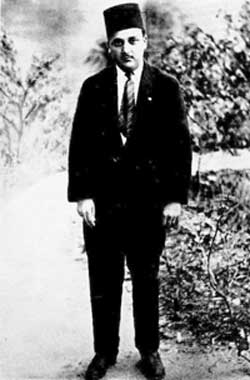
In The Priceless Pearl Rúḥíyyih Khánum gives an account of her husband’s school years. Of his early years she admits, “It is very difficult to trace the exact course of events in these years,” but letters and notebooks from his student days survive.
Shoghi Effendi was born on 1 March 1897 in the prison-city of ‘Akká, the eldest grandchild of ‘Abdu’l-Bahá. While he was still a young child he was sent to live in Haifa with his nurse; French was his first foreign language. He attended the best school in Haifa, the Collège des Frères, and was very unhappy there. Because of this ‘Abdu’l-Bahá sent him to Beirut, where he boarded at another Catholic school and was equally unhappy. A trusted Bahá’í woman sent to look after him wrote that he sometimes refused to go to school for days and was growing thin and run down. When his father showed the letter to ‘Abdu’l-Bahá, the Master had arrangements made for him to enter the Syrian Protestant College, which had a school as well as a university and later became the American University of Beirut.
Rúḥíyyih Khánum gathered from him that he was never really happy at school or university; his sensitivity and his background, so different from that of others, set him apart. His purpose, though, was clear: “The entire course of Shoghi Effendi’s studies was aimed by him at fitting himself to serve the Master, interpret for Him and translate His letters into English.” He spent his vacations at home in Haifa, as often as possible in the presence of the grandfather he idolized.
His letters from these years show how closely he followed the Master’s work. He asked to be sent every issue of Star of the West reporting ‘Abdu’l-Bahá’s travels in America. In March 1914 he wrote from Beirut that he had nearly finished a map of the United States and asked for the list of cities the Master had visited, in order, so that he could mark them on it. In May of that year he wrote that the Bahá’í students’ meetings at the college had been reorganized. His notebooks of 1917 record the Bahá’í calendar, copies of Tablets, notes in French, and even the days ice was delivered to the house where he lived. In February 1915 he won first prize in the Freshman–Sophomore Prize Contest. He was a good student, but he never claimed to have been a brilliant one.
On 15 January 1918, back in Beirut after a holiday in Haifa, he wrote to ‘Abdu’l-Bahá:
I have resumed my studies, directing and concentrating all my efforts on them and doing my utmost to acquire that which will benefit and prepare me to serve the Cause in the days to come.
The war years, with famine in Lebanon and danger to the Master, laid a deep shadow of anxiety on him. In 1918 he received his Bachelor of Arts degree and returned to serve at ‘Abdu’l-Bahá’s side.
Shoghi Effendi later told Rúḥíyyih Khánum that when he was about nine or ten, at a time when the Master was in great danger, ‘Abdu’l-Bahá had written one of His Wills appointing him Guardian. No one in the Bahá’í world knew this until the Master’s Will and Testament was found and read after His passing in November 1921.
A retelling based on The Priceless Pearl by Rúḥíyyih Khánum. For the fuller account, see the original.
Cite this story
Khánum, R.. (1969). *The Priceless Pearl*. Bahá'í Publishing Trust.
Record yourself reading this story
Recording stays on this device only. Nothing is uploaded.
Related stories
Shoghi Effendi at Balliol
In 1920 Shoghi Effendi went to Balliol College, Oxford, to perfect his English so that he could translate the sacred writings. His studies ended in November 1921 with the news of 'Abdu'l-Bahá's passing.
Shoghi Effendi at Oxford
At Oxford, the young Shoghi Effendi worked day and night to perfect his English so that he could translate the holy writings, until the news of 'Abdu'l-Bahá's passing called him home.
Young Shoghi Effendi Greets the Master
In 'Akká in 1899 the American pilgrim Ella Goodall Cooper watched the small Shoghi Effendi walk up to 'Abdu'l-Bahá, who greeted him with a silent nod; the boy kissed the hem of His robe and ran off to play.
Shoghi Effendi at School in Beirut
Shoghi Effendi, the grandson of 'Abdu'l-Bahá, was often unhappy at school in Beirut, but he studied hard so that one day he could serve his grandfather and translate His letters into English.