The Cable in London
Rúḥíyyih Khánum, The Priceless Pearl, (1969), Bahá'í Publishing Trust
When in Bahá'í history
London (today: London, United Kingdom)
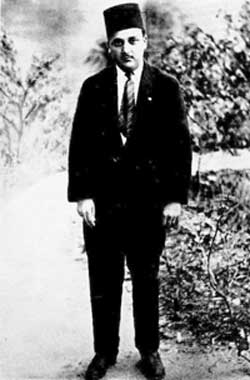
In the second chapter of The Priceless Pearl Rúḥíyyih Khánum describes the weeks that followed 29 November 1921, when Shoghi Effendi, then a twenty-four-year-old student at Oxford, learned that ‘Abdu’l-Bahá had passed away, and soon afterwards that he had been appointed Guardian of the Cause of God.
He had left the Master in the spring of 1920, expecting to return better equipped to serve Him, and was studying at Balliol College. The London office of Major Wellesley Tudor Pole, at 61 St James’s Street, was often used as the distributing point for cables and letters to the Bahá’ís. At 9.30 on the morning of 29 November a cable from the Greatest Holy Leaf reached it: His Holiness ‘Abdu’l-Bahá ascended Abha Kingdom. Inform friends.
Rúḥíyyih Khánum believed Tudor Pole telephoned Shoghi Effendi and asked him to come at once, without breaking the news at a distance. At about noon he arrived and was shown into the private office. Tudor Pole was not in the room. Standing there, Shoghi Effendi saw the name of ‘Abdu’l-Bahá on the open cablegram lying on the desk, and read it. When Tudor Pole came in a moment later he found him in a state of collapse. He was taken to the home of Miss Grand, one of the London believers, and put to bed for a few days, while his sister Rouhangeze, Lady Blomfield and others did all they could to comfort him.
Passport difficulties delayed him. He sailed from England on 16 December with Lady Blomfield and his sister, and reached Haifa by train on the evening of 29 December, so overcome that he had to be helped up the steps. The Master’s family had found His Will while searching His papers for burial instructions. It was addressed to Shoghi Effendi, and the Greatest Holy Leaf, and probably a few others, already knew at least its gist. A few days after his arrival it was read to him. He said more than once that he had had no foreknowledge of the institution of the Guardianship, least of all that he himself was appointed; the most he had expected was that the Master might have left instructions for electing the Universal House of Justice. Until the Will was read, Rúḥíyyih Khánum writes, no one in the Bahá’í world knew that Shoghi Effendi was the “unique pearl” of its first part, the priceless pearl that doth gleam from out the Twin Surging Seas.
On 6 February 1922 he wrote to a friend from his Oxford days, Mrs Whyte:
The task is so overwhelmingly great, the realization of the inadequacy of my efforts and myself so deep that I cannot but give way and droop whenever I face my work...
On 5 March, in a postscript to a letter to the American believers, he asked the friends to refer to him always as Shoghi Effendi:
I desire to be known by no other name save the one our Beloved Master was wont to utter...
It was the name by which ‘Abdu’l-Bahá had always addressed him.
On 5 April 1922 he left Haifa for Europe, placing the affairs of the Faith under the headship of the Greatest Holy Leaf. In the autumn she sent members of the family to find him and plead with him to return. Coming back one evening from an all-day walk, he found, to his great surprise, his mother in the street of a small mountain village, looking for him; she had come all the way from Palestine. He returned to Haifa on 15 December 1922 and took up the work he led until his passing in November 1957.
A retelling based on The Priceless Pearl by Rúḥíyyih Khánum. For the fuller account, see the original.
Cite this story
Khánum, R.. (1969). *The Priceless Pearl*. Bahá'í Publishing Trust.
This story shares quotes with 1 other story
“The task is so overwhelmingly great, the realization of the”
Also in
- Sad News in London— Rúḥíyyih Khánum, The Priceless Pearl
“inadequacy of my efforts and myself so deep that I cannot but give”
Also in
- Sad News in London— Rúḥíyyih Khánum, The Priceless Pearl
“I desire to be known by no other name save the one our Beloved”
Also in
- Sad News in London— Rúḥíyyih Khánum, The Priceless Pearl
Record yourself reading this story
Recording stays on this device only. Nothing is uploaded.
Related stories
The Appointment of Shoghi Effendi as Guardian
In November 1921 Shoghi Effendi, a student at Oxford, learned in London that 'Abdu'l-Bahá had passed away. In January 1922 the Master's Will was read, naming him Guardian of the Cause of God.
The Young Guardian
Shoghi Effendi was a student in England when 'Abdu'l-Bahá passed away. He hurried home to Haifa, and his grandfather's Will named him Guardian of the Bahá'í Faith.
Our Only Consolation
This dire calamity, this great affliction, the passing of ‘Abdu’l-Bahá, may our lives be sacrificed for His meekness, has shaken us to the very depths.
Staunch and Firm as the High Mountains
Although that supreme calamity, that great ordeal, the ascension of ‘Abdu’l-Bahá, put the torch to the harvest of our hearts, and brought down both our outer and inner beings, wedding us to grief and ceaseless pain, yet praised be God …