The Appointment of Shoghi Effendi as Guardian
Shoghi Effendi, God Passes By, (1944), Bahá'í Publishing Trust · Read original
When in Bahá'í history
Haifa (today: Haifa, Israel)
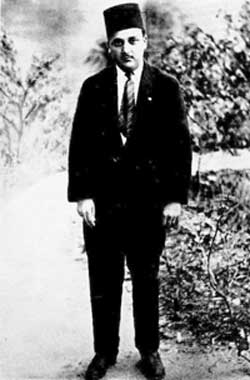
In God Passes By, Shoghi Effendi tells of the passing of 'Abdu'l-Bahá in November 1921 and then describes the Master's Will and Testament, "signed and sealed by 'Abdu'l-Bahá; entirely written with His own hand," as the document that established the Administrative Order, "the Charter of a future world civilization." He writes of the Guardianship it established as an institution and says almost nothing of himself. The personal side of the story is told by his widow, Rúhíyyih Khánum, in The Priceless Pearl.
'Abdu'l-Bahá passed away in the early hours of 28 November 1921 at His house in Haifa. His grandson Shoghi Effendi, then twenty-four, was a student at Oxford. At 9.30 on the morning of 29 November a cable from the Greatest Holy Leaf, Bahíyyih Khánum, reached the London office of Major Tudor Pole, which often served as the distributing point for cables and letters to the Bahá'ís. Shoghi Effendi arrived there at about noon. Tudor Pole was out of the room; Shoghi Effendi saw the Master's name on the open cablegram lying on the desk, and read it. Tudor Pole found him in a state of collapse. He was taken to the home of Miss Grand, one of the London believers, and put to bed there for a few days.
Delayed by passport difficulties, he sailed from England on 16 December with Lady Blomfield and his sister Rouhangeze, and reached Haifa by train on the evening of 29 December. Bahíyyih Khánum was waiting for him in the house.
The Master had left a Will, written entirely in His own hand. The Greatest Holy Leaf, and probably a few members of the family, already knew at least its gist, for it had been examined to see whether He had left instructions for His burial. On 21 December she had cabled the American believers: "Master left full instructions in His Will and Testament." But its provisions were not made known until it had first been read to Shoghi Effendi. On 3 January 1922, in the home of his aunt but not in his presence, it was read aloud to nine men, most of them members of 'Abdu'l-Bahá's family, and its seals, signatures and handwriting were shown to them.
The Will named Shoghi Effendi the Guardian of the Cause of God. It established the Guardianship as a hereditary office, made the Guardian the interpreter of the Bahá'í Writings, and named him the head of the Universal House of Justice once that body should be elected.
Shoghi Effendi set to work at once. On 16 January he wrote his first letter to the Bahá'ís of Persia and a letter to the High Commissioner for Palestine, Sir Herbert Samuel, and he began translating the Will into English. But he was crushed and ill. On 5 April 1922 he left Haifa for Europe, and spent much of his time away in the mountains of Switzerland. He named Bahíyyih Khánum to administer the affairs of the Faith, in consultation with the family and a chosen assembly, during his absence. He returned to Haifa on 15 December 1922.
He served as Guardian for thirty-six years, until his passing in November 1957. In those years he translated many of the principal Writings of the Faith into English, built up the Bahá'í Administrative Order, oversaw the building of the superstructure of the Shrine of the Báb on Mount Carmel, and led the Ten Year Crusade, which carried the Faith to most of the countries of the earth.
A retelling based on God Passes By (Shoghi Effendi, Bahá'í Publishing Trust, 1944) and The Priceless Pearl (Rúhíyyih Rabbani, 1969). For the fuller account, see the originals.
Cite this story
Effendi, S.. (1944). *God Passes By*. Bahá'í Publishing Trust. https://www.bahai.org/library/authoritative-texts/shoghi-effendi/god-passes-by/
Record yourself reading this story
Recording stays on this device only. Nothing is uploaded.
Related stories
The Cable in London
In November 1921 Shoghi Effendi, a student at Oxford, learned from a cable in a London office that 'Abdu'l-Bahá had passed away; back in Haifa, the Master's Will told him he had been appointed Guardian.
The Young Guardian
Shoghi Effendi was a student in England when 'Abdu'l-Bahá passed away. He hurried home to Haifa, and his grandfather's Will named him Guardian of the Bahá'í Faith.
The Guardian's Chosen Name
In His Will 'Abdu'l-Bahá named His grandson Shoghi Effendi "the sign of God, the chosen branch, the Guardian of the Cause of God." Shoghi Effendi asked the believers to call him only by the name his Grandfather had used.
Our Only Consolation
This dire calamity, this great affliction, the passing of ‘Abdu’l-Bahá, may our lives be sacrificed for His meekness, has shaken us to the very depths.