Young Shoghi Effendi Greets the Master
Rúḥíyyih Khánum, The Priceless Pearl, (1969), Bahá'í Publishing Trust
When in Bahá'í history
'Akká (today: 'Akká, Israel)
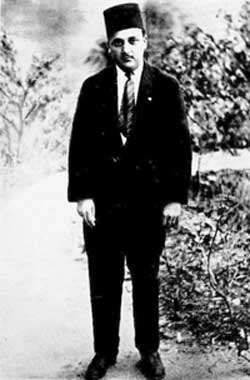
In The Priceless Pearl Rúḥíyyih Khánum preserves an eyewitness account of a meeting between ‘Abdu’l-Bahá and the young Shoghi Effendi. It was written by Ella Goodall Cooper, one of the earliest Western believers, who saw it during her pilgrimage in March 1899, in the house of ‘Abdu’lláh Páshá in ‘Akká.
Early one morning she had joined the ladies of the Family for tea in the room of the Greatest Holy Leaf. The Master sat in His favourite corner of the divan, busy writing Tablets, with a window on His right looking over the ramparts to the blue Mediterranean. The quiet was broken only by the bubbling of the samovar. Presently He looked up from His writing with a smile and asked Ḍíyá’íyyih Khánum — His daughter, and Shoghi Effendi’s mother — to chant a prayer.
As she finished, a small figure appeared in the open doorway, directly opposite ‘Abdu’l-Bahá. The boy dropped off his shoes and stepped into the room, his eyes on the Master’s face. ‘Abdu’l-Bahá returned his gaze with such a look of loving welcome that it seemed to beckon him closer. Shoghi — that beautiful little boy, with his cameo face and his soulful appealing, dark eyes, in Mrs Cooper’s words — walked slowly toward the divan until he stood close in front of Him.
There he paused. The Master did not offer to embrace him. He sat perfectly still, only nodding His head two or three times, slowly and impressively — as if to say, Mrs Cooper wrote:
You see? This tie connecting us is not just that of a physical grandfather but something far deeper and more significant.
While the ladies watched breathlessly, the little boy reached down, picked up the hem of ‘Abdu’l-Bahá’s robe, touched it reverently to his forehead and kissed it, then gently replaced it — never taking his eyes from the Master’s face. The next moment he turned away and scampered off to play, like any normal child. He was, at that time, ‘Abdu’l-Bahá’s only grandchild.
Rúḥíyyih Khánum adds her own reflection. She believed the Master had to keep His love for this child within bounds, lest the very blaze of that love endanger the boy through the hatred and envy of His many enemies — and she felt that Shoghi Effendi, looking back, was aware that ‘Abdu’l-Bahá had veiled the passion of His love for him in order to protect him and to safeguard the Cause of God.
A retelling based on The Priceless Pearl by Rúḥíyyih Khánum. For the fuller account, see the original.
Cite this story
Khánum, R.. (1969). *The Priceless Pearl*. Bahá'í Publishing Trust.
This story shares quotes with 1 other story
“You see? This tie connecting us is not just that of a physical”
Also in
- The Boy in the Doorway— Rúḥíyyih Khánum, The Priceless Pearl
“grandfather but something far deeper and more significant.”
Also in
- The Boy in the Doorway— Rúḥíyyih Khánum, The Priceless Pearl
Record yourself reading this story
Recording stays on this device only. Nothing is uploaded.
Related stories
The Boy in the Doorway
In 'Akká a small boy, Shoghi, walked up to his grandfather 'Abdu'l-Bahá, who greeted him with a quiet nod; the boy kissed the hem of His robe and ran off to play.
Shoghi Effendi's School Years in Beirut
Unhappy at school in Haifa and Beirut, the young Shoghi Effendi was moved by 'Abdu'l-Bahá to the Syrian Protestant College, where he aimed all his studies at serving the Master and translating His letters into English.
The Master and the Coachman
Shoghi Effendi told how a coachman at Ramleh demanded an exorbitant fare from ‘Abdu’l-Bahá and pulled Him roughly by His sash. The Master stayed calm, refused to give in, and paid exactly what He owed, without the tip.
Stories from the Childhood of Shoghi Effendi
Shoghi Effendi's boyhood in the household of his grandfather 'Abdu'l-Bahá: his name, morning prayers and breakfast with the Master, the Tablet telling him to memorize and chant prayers, and the surname Rabbani.