An Instrument, Not a Substitute
Shoghi Effendi, The World Order of Bahá'u'lláh, (1938), Bahá'í Publishing Trust
When in Bahá'í history
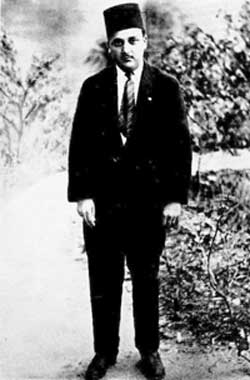
On February 27, 1929, Shoghi Effendi wrote to the National Spiritual Assembly of the Bahá'ís of the United States and Canada. Doubts had been publicly expressed, by one he described as "wholly misinformed as to the true precepts of the Cause," about the validity of the Bahá'í institutions. The Guardian took the occasion to explain to the elected representatives of the believers the origin and character of those institutions. The letter opens the collection later published as The World Order of Bahá'u'lláh.
He began with their sources. The system of Bahá'í administration, he wrote, was not an innovation imposed arbitrarily upon the Bahá'ís of the world since the Master's passing. It derived its authority from the Will and Testament of 'Abdu'l-Bahá, was specifically prescribed in unnumbered Tablets, and rested in some of its essential features upon the explicit provisions of the Kitáb-i-Aqdas. From this he drew a conclusion:
To dissociate the administrative principles of the Cause from the purely spiritual and humanitarian teachings would be tantamount to a mutilation of the body of the Cause, a separation that can only result in the disintegration of its component parts, and the extinction of the Faith itself.
Later in the same letter, turning to the purpose of these institutions, he recalled what he had already reiterated and emphasized:
the administration of the Cause is to be conceived as an instrument and not a substitute for the Faith of Bahá'u'lláh, that it should be regarded as a channel through which His promised blessings may flow, that it should guard against such rigidity as would clog and fetter the liberating forces released by His Revelation.
A retelling based on The World Order of Bahá'u'lláh, "The World Order of Bahá'u'lláh" (letter of February 27, 1929). For the fuller account, see the original.
Cite this story
Effendi, S.. (1938). *The World Order of Bahá'u'lláh*. Bahá'í Publishing Trust.
Record yourself reading this story
Recording stays on this device only. Nothing is uploaded.
Related stories
A Token of Our Deep Mourning
The Guardian trusts that the explanation he has given by wire regarding the suspension for a period of nine months of Bahá’í religious festivity has been made clear.
Reunited on Mount Carmel
BLESSED REMAINS PUREST BRANCH AND MASTER’S MOTHER SAFELY TRANSFERRED HALLOWED PRECINCTS SHRINES MOUNT CARMEL.
A Far-Flung Arc
The raising of this Edifice will in turn herald the construction, in the course of successive epochs of the Formative Age of the Faith, of several other structures...
The Steps, Columns and Dome of Her Resting-Place
The steps of her holy resting-place represent Local Spiritual Assemblies, not individual believers.