Sad News in London
Rúḥíyyih Khánum, The Priceless Pearl, (1969), Bahá'í Publishing Trust
When in Bahá'í history
A retelling for children, based on The Priceless Pearl by Rúḥíyyih Khánum.
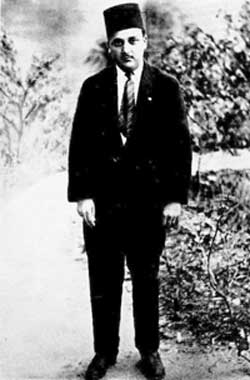
In 1921 Shoghi Effendi was twenty-four years old and a student at Oxford University in England, far from his home in the Holy Land. He was studying so that he could go home and help his grandfather, 'Abdu'l-Bahá, with His work.
On the morning of 29 November 1921 a cable, a short message sent by wire, arrived at the London office of a Bahá'í named Major Tudor Pole. Many messages for the Bahá'ís came to his office. That day Shoghi Effendi came there too. Major Tudor Pole was out of the room, and while Shoghi Effendi waited, he saw his grandfather's name on the cable lying open on the desk. He read it. It said that 'Abdu'l-Bahá had passed away.
When Major Tudor Pole came back into the room, he found Shoghi Effendi overcome with grief. Friends took him to a Bahá'í home, where he rested in bed for a few days, while his sister and others tried to comfort him.
Then he made the long journey home by ship and train, arriving in Haifa on 29 December. He was so full of sorrow that he had to be helped up the steps of the house.
'Abdu'l-Bahá had left a Will and Testament, and it was addressed to Shoghi Effendi. A few days after he arrived, it was read to him. In it 'Abdu'l-Bahá named the one who would guide the Faith after Him: His grandson Shoghi Effendi, the Guardian of the Cause of God. Shoghi Effendi said later that he had never expected this.
The task felt almost too big to carry. A few weeks later he wrote to a friend:
The task is so overwhelmingly great, the realization of the inadequacy of my efforts and myself so deep that I cannot but give way and droop whenever I face my work...
He asked the Bahá'ís to call him simply "Shoghi Effendi," writing:
I desire to be known by no other name save the one our Beloved Master was wont to utter...
That was the name 'Abdu'l-Bahá had always called him.
In April 1922 he went away for a time to Europe to rest and gather his strength. Some months later his mother travelled all the way from the Holy Land to find him and ask him to come home. He came back to Haifa in December 1922 and served as Guardian for the rest of his life.
This is a retelling for children. For the fuller account, see "The Cable in London".
Cite this story
Khánum, R.. (1969). *The Priceless Pearl*. Bahá'í Publishing Trust.
This story shares quotes with 1 other story
“The task is so overwhelmingly great, the realization of the”
Also in
- The Cable in London— Rúḥíyyih Khánum, The Priceless Pearl
“inadequacy of my efforts and myself so deep that I cannot but give”
Also in
- The Cable in London— Rúḥíyyih Khánum, The Priceless Pearl
“I desire to be known by no other name save the one our Beloved”
Also in
- The Cable in London— Rúḥíyyih Khánum, The Priceless Pearl
Record yourself reading this story
Recording stays on this device only. Nothing is uploaded.
Related stories
The Cable in London
In November 1921 Shoghi Effendi, a student at Oxford, learned from a cable in a London office that 'Abdu'l-Bahá had passed away; back in Haifa, the Master's Will told him he had been appointed Guardian.
The Appointment of Shoghi Effendi as Guardian
In November 1921 Shoghi Effendi, a student at Oxford, learned in London that 'Abdu'l-Bahá had passed away. In January 1922 the Master's Will was read, naming him Guardian of the Cause of God.
The Young Guardian
Shoghi Effendi was a student in England when 'Abdu'l-Bahá passed away. He hurried home to Haifa, and his grandfather's Will named him Guardian of the Bahá'í Faith.
The Guardian's Chosen Name
In His Will 'Abdu'l-Bahá named His grandson Shoghi Effendi "the sign of God, the chosen branch, the Guardian of the Cause of God." Shoghi Effendi asked the believers to call him only by the name his Grandfather had used.