Shoghi Effendi Translates The Hidden Words
Rúḥíyyih Khánum, The Priceless Pearl, (1969), Bahá'í Publishing Trust
When in Bahá'í history
Haifa (today: Haifa, Israel)
Tablets and Writings referenced (1)
- hidden-words
Full text expansion will appear inline once the Bahá'í Reference Library text database is integrated.
The Hidden Words is a collection of short passages, partly in Arabic and partly in Persian, revealed by Bahá'u'lláh in Baghdád in 1274 A.H. (1857–58). Shoghi Effendi wrote in God Passes By that Bahá'u'lláh was inspired with them "as He paced, wrapped in His meditations, the banks of the Tigris." The verses are addressed O Son of Spirit, O Son of Man, O My Friends and in other ways.
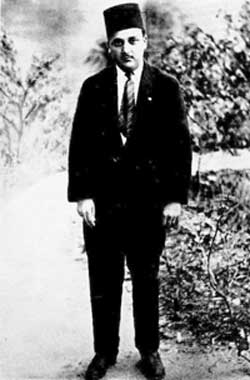
The English in which most Bahá'ís know them is Shoghi Effendi's. In The Priceless Pearl Rúḥíyyih Khánum writes that one of the earliest acts of his ministry was to begin circulating his translations of the holy Writings. One year and ten days after the reading of 'Abdu'l-Bahá's Will, he sent the American National Assembly translations of some of the Master's prayers and Tablets. A month later he wrote to America again: "I am also enclosing my revised translation of The Hidden Words of Bahá'u'lláh, both Arabic and Persian, and hope to send you more of His Words and Teachings in future."
Rúḥíyyih Khánum also describes how he prepared for this work. From his Beirut days until practically the end of his life he wrote down English vocabularies and typical English phrases in notebooks, and hundreds of words and sentences were recorded in them. He was a great reader of the King James version of the Bible and of the historians Carlyle and Gibbon. Gibbon's influence can be seen throughout his own writings, she says, "just as the biblical English is reflected in his translations of Bahá'u'lláh's Prayers, The Hidden Words and Tablets."
The first of the Arabic Hidden Words, in his translation, reads: O Son of Spirit! My first counsel is this: Possess a pure, kindly and radiant heart, that thine may be a sovereignty ancient, imperishable and everlasting.
He was, in her words, "tolerant and practical" about his own work. For years he sent his translations and manuscripts to George Townshend, whose command of English he greatly admired, and in one letter thanked him for "the very valuable, detailed and careful suggestions you have given me." Among the translations that followed were Gleanings from the Writings of Bahá'u'lláh and Prayers and Meditations.
Bayard Dodge of the American University of Beirut, one of his former professors, wrote to him when the translation of The Hidden Words reached him: "I realize how exceedingly difficult it is to translate beautiful Oriental thoughts into English and I congratulate you for the quality of the language which you have used."
A retelling based on The Priceless Pearl (Rúḥíyyih Khánum, 1969), with a passage from God Passes By. For the fuller account, see the original.
Pair this story with
From the Writings
Once the prayer database is connected (Bahá'í Reference Library), prayer text will appear inline.
Cite this story
Khánum, R.. (1969). *The Priceless Pearl*. Bahá'í Publishing Trust.
This story shares quotes with 3 other stories
“as He paced, wrapped in His meditations, the banks of the Tigris.”
Also in
- Hidden Word, Arabic 1: A Pure, Kindly and Radiant Heart— Bahá'u'lláh, The Hidden Words
- Hidden Word, Arabic 22: Noble Have I Created Thee— Bahá'u'lláh, The Hidden Words
- Hidden Word, Arabic 59: Thy Heart Is My Home— Bahá'u'lláh, The Hidden Words
Record yourself reading this story
Recording stays on this device only. Nothing is uploaded.
Related stories
The Hidden Words in English
Shoghi Effendi translated The Hidden Words of Bahá'u'lláh into English, and worked hard all his life to make his English as good as it could be.
The Guardian Translates the Gleanings
Shoghi Effendi went to Oxford to perfect his English for translating the sacred Writings. In 1935 he published Gleanings from the Writings of Bahá'u'lláh, a selection of passages he had translated, which Professor Norman Bentwich and Queen Marie of Romania, among others, praised.
Fast-Rooted in the Divine Covenant
In this day, those holy souls are divinely confirmed who stand firm in the most sacred Cause of the Abhá Beauty, those who are steadfast, and loyal to the Covenant and Testament of ‘Abdu’l-Bahá.
The Key of the Holy Tomb
It is not unknown to those who stand firm in the Covenant and Testament of God that the centre of violation and his associates, from the day of the ascension of the Ancient Beauty, may His Great Name be ever exalted …