Dr. Esslemont Writes His Book
J. E. Esslemont, Bahá'u'lláh and the New Era, (1923), George Allen & Unwin · Read original
When in Bahá'í history
Haifa (today: Haifa, Israel)
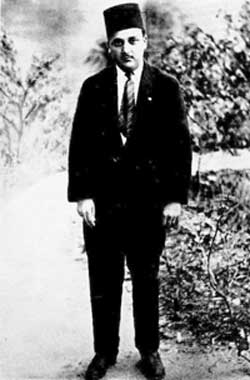
A retelling based on Dr. J. E. Esslemont's own introduction to Bahá'u'lláh and the New Era, with details of his friendship with Shoghi Effendi from Rúḥíyyih Khánum's The Priceless Pearl. Words in quotation marks are quoted from those books.
John Esslemont was a Scottish physician working at a sanatorium in Bournemouth, on the south coast of England. In the introduction to his book he describes how he came to the Faith: "In December 1914, through a conversation with friends who had met 'Abdu'l-Bahá, and the loan of a few pamphlets, I first became acquainted with the Bahá'í teachings. I was at once struck by their comprehensiveness, power and beauty." They seemed to him to meet "the great needs of the modern world more fully and satisfactorily than any other presentation of religion which I had come across--an impression which subsequent study has only served to deepen and confirm."
He found it hard to obtain the literature he wanted, and "soon conceived the idea of putting together the gist of what I learned in the form of a book, so that it might be more easily available for others."
When communication with Palestine reopened after the First World War, he wrote to 'Abdu'l-Bahá and sent Him the first nine chapters of the draft. He received "a very kind and encouraging reply," with an invitation to come to Haifa and bring the whole manuscript. He spent two and a half months as 'Abdu'l-Bahá's guest in the winter of 1919–1920. 'Abdu'l-Bahá discussed the book with him on several occasions, gave suggestions for improving it, and proposed that the revised manuscript be translated into Persian so that He could read it through and correct it. 'Abdu'l-Bahá, Esslemont wrote, "found time, amid His busy life, to correct some three and a half chapters (Chapters I, II, V and part of III) before He passed away." A committee of the National Bahá'í Assembly of England revised the rest, and Bahá'u'lláh and the New Era was published in 1923.
During that visit to Haifa Esslemont also worked with Shoghi Effendi and others on the translation of a Tablet of 'Abdu'l-Bahá. When Shoghi Effendi came to study at Oxford, he visited Esslemont at the sanatorium more than once, and he later wrote of "the pleasant hours we spent together while taking our meals in the sanatorium." When news of 'Abdu'l-Bahá's passing reached England in November 1921, Esslemont wrote to him at once: "It must be very hard for you, away from your family and even away from all Bahá'í friends." He invited him to come to Bournemouth.
In January 1923 Shoghi Effendi, now the Guardian, asked the London Bahá'ís to send an English friend to help him with his translation work in Haifa. Rúḥíyyih Khánum writes that Esslemont seems to have been the one who answered this appeal. His health had not been good for some time, but he remained in Haifa, working with the Guardian, until his death on 22 November 1925.
Shoghi Effendi called him "the warmest of friends, a trusted counsellor, an indefatigable collaborator, a lovable companion," said that his book "would inspire generations yet unborn," and raised him after his death to the rank of Hand of the Cause. By 1969, Rúḥíyyih Khánum noted, the book had been translated into about a hundred languages.
This is a retelling. For the fuller account, see the introduction to Bahá'u'lláh and the New Era by J. E. Esslemont and chapters 1–2 of The Priceless Pearl by Rúḥíyyih Khánum.
Cite this story
Esslemont, J. E.. (1923). *Bahá'u'lláh and the New Era*. George Allen & Unwin. https://www.gutenberg.org/ebooks/19241
Record yourself reading this story
Recording stays on this device only. Nothing is uploaded.
Related stories
Hippolyte Dreyfus, the First French Bahá'í
A Paris lawyer who heard of the Faith in 1901 became the first French Bahá'í. He left the law to study Persian and Arabic, translated the Writings into French, travelled widely for the Faith and served 'Abdu'l-Bahá in Paris.
Jináb-i-Fáḍil, a Gift to America
Mírzá Asadu’lláh Fáḍil of Mázindarán, a scholar who became a Bahá’í in Tihrán, carried out a dangerous mission for ‘Abdu’l-Bahá in Najaf, taught across America, India and Persia, and wrote a nine-volume history of the Faith.
Shoghi Effendi's Year at Balliol
In 1920 Shoghi Effendi entered Balliol College, Oxford, to perfect his English so that he could better translate the Tablets of 'Abdu'l-Bahá. The Master's passing in November 1921 cut his studies short.
Dr. Esslemont Brings His Book to Haifa
A Scottish doctor who learned of the Bahá'í teachings in 1914 wrote a book about them and brought it to 'Abdu'l-Bahá in Haifa. The Master discussed it with him and later corrected part of it. It became Bahá'u'lláh and the New Era.