John Esslemont: A Doctor at the Master's Side
Bahá'í Chronicles editors, Bahá'í Chronicles · Read original
When in Bahá'í history
Haifa (today: Haifa, Israel)
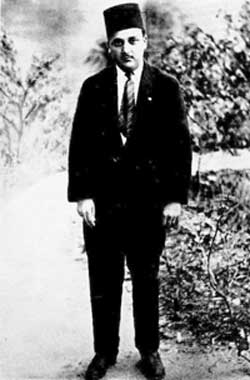
John Ebenezer Esslemont was born in 1874 in Cults, near Aberdeen, into a Scottish family of modest means but high character. He took his medical degree at Aberdeen University in 1898, served as a physician in South Africa during the Boer War and afterwards, and returned to Britain in poor health himself — he suffered from chronic tuberculosis, which would shorten his life and shape its disciplines.
He came to the Bahá'í Faith in late 1914 through a small pamphlet that reached him at the Home Sanatorium in Bournemouth, where he was at that time the resident physician. He read the pamphlet, the chronicle records, and was immediately attracted. He began correspondence with the small British Bahá'í community. He attended his first Bahá'í meeting in 1915. He declared himself a Bahá'í that year.
The work for which he is most remembered followed soon. He recognised, in 1915, that the small introductory literature then available to English-speaking inquirers was inadequate to the questions Western seekers were beginning to bring. He set himself to write, in clear and accessible English, a single-volume introduction to the Cause that would set out its history, its teachings, and its practices for the ordinary intelligent reader.
He worked at the manuscript for seven years. He corresponded with the Master Himself, who reviewed sections of the book and sent him substantial corrections through the household at Haifa. The book was published in 1923 under the title Bahá'u'lláh and the New Era. It would prove, the chronicle observes, the most widely-read introductory work in the English-language Bahá'í literature for the next century. It has been translated into more than forty languages.
In 1924 he travelled to Haifa, at Shoghi Effendi's invitation, to serve as the Guardian's English-language secretary in the years immediately after the Master's passing. He took up residence in the Master's house. He worked on translation, on correspondence, on the careful early correspondence by which the young Guardian was building the international structure of the Cause.
He died, of his old illness, in Haifa on the twenty-second of November 1925. He was fifty-one years old.
Shoghi Effendi cabled the Bahá'í world. He named Esslemont, posthumously, a Hand of the Cause of God. He was the second Westerner to be so named — and the first to receive the honour from Shoghi Effendi himself. He was buried in the Bahá'í cemetery on Mount Carmel.
The Aberdeen physician who had read a small pamphlet in a sanatorium in 1914 had, in the eleven years that remained to him, written the book by which the Cause would be introduced to the English-speaking world.
Source: Bahá'í Chronicles (https://bahaichronicles.org/john-esslemont/).
Cite this story
editors, B. C.. *Bahá'í Chronicles*. https://bahaichronicles.org/john-esslemont/
Record yourself reading this story
Recording stays on this device only. Nothing is uploaded.
Related stories
The Doctor Who Wrote a Little Book
A doctor who was often sick spent seven whole years writing one clear little book about the Faith — and it went on to travel farther than he ever could.
The Doctor Who Read His Way to Certainty: John Esslemont
An Aberdeen physician in failing health, trained to weigh evidence and trust nothing he could not examine, found a small pamphlet about the Bahá'í Faith in a sanatorium. He did not simply believe it. He studied for years, learned Persian late in life to read the Writings in the original, and wrote the careful introduction by which the English-speaking world would come to know the Cause.
The Physician Who Did His Homework: Dr. Esslemont and the New Era
A Scottish doctor heard of the Bahá'í Faith in 1914 and did what a careful physician does with any new claim: he investigated it methodically. He read, he learned Persian, he wrote out what he understood — and then he travelled to Haifa and laid his manuscript before 'Abdu'l-Bahá Himself for correction. The book that resulted, Bahá'u'lláh and the New Era, has since carried answers to seekers in some sixty languages.
May Maxwell: A Mother of the Western Bahá'í Community
Bahá'í Chronicles preserves the biographical record of May Bolles Maxwell — one of the first pilgrims to 'Akká, the woman who established the Bahá'í community of Paris and of Montreal, the mother of Rúḥíyyih Khánum, and the travel-teacher whom Shoghi Effendi would name a martyr of the Faith after her death in Buenos Aires in 1940.