Dr. Esslemont Brings His Book to Haifa
J. E. Esslemont, Bahá'u'lláh and the New Era, (1923), George Allen & Unwin · Read original
When in Bahá'í history
Haifa (today: Haifa, Israel)
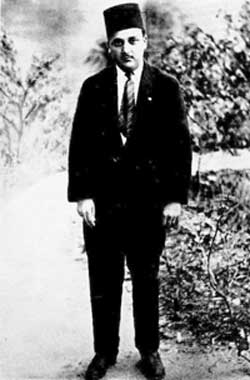
A retelling drawn from Dr. J. E. Esslemont's own introduction to Bahá'u'lláh and the New Era and from Shoghi Effendi's letter on his passing, published in Bahá'í Administration. Words in quotation marks are from those two texts.
John Ebenezer Esslemont was a Scottish physician. "In December 1914," he later wrote, "through a conversation with friends who had met 'Abdu'l-Bahá, and the loan of a few pamphlets, I first became acquainted with the Bahá'í teachings. I was at once struck by their comprehensiveness, power and beauty."
He found the literature he wanted hard to obtain, and "soon conceived the idea of putting together the gist of what I learned in the form of a book, so that it might be more easily available for others."
When communication with Palestine reopened after the First World War, he wrote to 'Abdu'l-Bahá and sent Him the first nine chapters of the draft. The reply invited him to visit Haifa and bring the whole manuscript. Esslemont spent two and a half months as the guest of 'Abdu'l-Bahá in the winter of 1919–1920. 'Abdu'l-Bahá discussed the book with him on various occasions and gave several suggestions for improving it. He proposed that, once the manuscript was revised, it be translated into Persian so that He could read it through and correct it.
This was done, and 'Abdu'l-Bahá corrected some three and a half chapters before His passing in 1921. The rest of the manuscript was revised by a committee of the National Bahá'í Assembly of England, which approved its publication. The book appeared under the title Bahá'u'lláh and the New Era.
Esslemont later went to Haifa to work with Shoghi Effendi. He suffered from a chronic illness, and he died there on 22 November 1925. He was buried in the Bahá'í burial ground at the foot of Mount Carmel. In his letter announcing the loss, Shoghi Effendi wrote: "His book, however--an abiding monument to his pure intention--will, alone, inspire generations yet unborn to tread the path of truth and service as steadfastly and as unostentatiously as was trodden by its beloved author." He called Esslemont "the warmest of friends, a trusted counsellor, an indefatigable collaborator, a lovable companion," and wrote that he had "deserved to rank as one of the Hands of the Cause of God."
This is a retelling. For the fuller account, see the introduction to Bahá'u'lláh and the New Era by J. E. Esslemont, and Shoghi Effendi's letter of November 1925 in Bahá'í Administration.
Cite this story
Esslemont, J. E.. (1923). *Bahá'u'lláh and the New Era*. George Allen & Unwin. https://www.gutenberg.org/ebooks/19241
Record yourself reading this story
Recording stays on this device only. Nothing is uploaded.
Related stories
Jináb-i-Fáḍil, a Gift to America
Mírzá Asadu’lláh Fáḍil of Mázindarán, a scholar who became a Bahá’í in Tihrán, carried out a dangerous mission for ‘Abdu’l-Bahá in Najaf, taught across America, India and Persia, and wrote a nine-volume history of the Faith.
Dr. Esslemont Writes His Book
A doctor at a Bournemouth sanatorium first met the Bahá'í teachings in December 1914 and set out to write a book about them. 'Abdu'l-Bahá corrected part of the manuscript, and Bahá'u'lláh and the New Era appeared in 1923.
The Life of ‘Abdu’l-Bahá
A biography of ‘Abdu’l-Bahá, from His childhood in Tehran and long years of exile and imprisonment to His ministry as Center of the Covenant, His journeys to the West, His writings and His passing in Haifa in 1921.
Louis George Gregory
Born in Charleston to formerly enslaved parents, Louis G. Gregory became a Bahá'í in 1909, was seated by 'Abdu'l-Bahá at His right in Washington, gave decades to teaching and race unity, and was posthumously named a Hand of the Cause.