The Doctor Who Wrote a Little Book
Bahá'í Chronicles editors, Bahá'í Chronicles · Read original
When in Bahá'í history
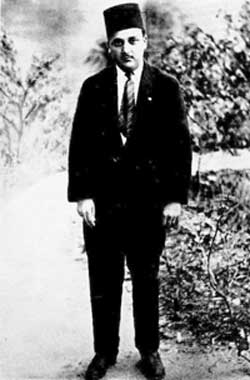
A retelling for children, based on the account of John Esslemont in Bahá'í Chronicles.
In a quiet hospital in England, in the year 1914, a doctor named John Esslemont picked up a small pamphlet that someone had passed along to him.
John was a Scottish doctor, born near the city of Aberdeen. He had studied medicine and worked hard at it, even traveling far away to South Africa to care for the sick. But John himself was not a strong man. He had an illness in his lungs that never really went away. It made him tired, and it would follow him for the rest of his life. By 1914 he was living and working at a sanatorium — a special hospital where people went to rest and try to get well.
That day, the little pamphlet he was reading was about the Bahá'í Faith. And the moment he read it, something inside him said yes. He wanted to know more. So he began writing letters to the small group of Bahá'ís in Britain, asking his questions. The very next year he went to his first Bahá'í meeting, and there he declared that he, too, was a Bahá'í.
Now, John could have stopped right there, happy just to have found something true. But he noticed a problem, and he could not stop thinking about it.
People all around him were curious about the Faith. They had real questions: Where did it come from? What does it teach? How do Bahá'ís live and pray? But when those seekers looked for a book that explained it all clearly, in plain English, there really wasn't one. The few little books that existed simply weren't enough.
So John decided to write that book himself.
He wanted it to be the kind of book an ordinary, thoughtful person could pick up and actually understand — one volume that told the whole story: the history, the teachings, the way of life, all set out simply and clearly. It was a big dream for a man who was so often unwell.
And it was not quick. John worked on that book for seven years. Seven years of writing, and crossing out, and writing again, always trying to make each idea as clear as he could — and all of it while his illness kept tugging at his strength.
But here is the wonderful part. John did not write the book all alone. He sent parts of it across the world to 'Abdu'l-Bahá Himself, who read what John had written and sent back careful corrections to help make it right. Imagine that — a doctor in England and the Master in Haifa, working together, page by page, on one little book.
At last, in 1923, the book was finished and printed. It was called Bahá'u'lláh and the New Era. And it did exactly what John had hoped, and far more. For a hundred years after, it would be the book that more English-speaking seekers read than almost any other. It has been carried into more than forty languages, traveling to lands and people John would never meet.
The next year, the young Guardian of the Faith, Shoghi Effendi, invited John to come to Haifa and help him. So John packed up and went. He lived in the Master's own house, and he worked at Shoghi Effendi's side — translating, writing letters, and helping with the careful work of caring for the growing Bahá'í community all over the world.
John did not get to do this work for very long. His old illness finally caught up with him, and he passed away in Haifa in 1925. He was buried on Mount Carmel. To honor everything he had given, Shoghi Effendi named him a Hand of the Cause of God — one of the special helpers and protectors of the Faith.
Think of it. A doctor who was tired and often sick, who could not travel the world himself, sat down and patiently wrote one clear little book — and that book went on to journey across the whole earth, into more than forty languages, telling people about the Faith long after he was gone. You do not have to be strong, or famous, or have lots of time to do something lasting. You only have to do one good thing, carefully and with love, and let it carry on from there.
This is a retelling for children. For the fuller account, see "John Esslemont: A Doctor at the Master's Side".
Cite this story
editors, B. C.. *Bahá'í Chronicles*. https://bahaichronicles.org/john-esslemont/
Record yourself reading this story
Recording stays on this device only. Nothing is uploaded.
Related stories
John Esslemont: A Doctor at the Master's Side
Bahá'í Chronicles preserves the biographical record of John Ebenezer Esslemont — the Aberdeen physician who, after encountering the Cause in 1914, wrote the introductory work *Bahá'u'lláh and the New Era,* moved to Haifa to serve at the Master's side, and was named by Shoghi Effendi a Hand of the Cause after his early death in 1925.
The Doctor Who Read His Way to Certainty: John Esslemont
An Aberdeen physician in failing health, trained to weigh evidence and trust nothing he could not examine, found a small pamphlet about the Bahá'í Faith in a sanatorium. He did not simply believe it. He studied for years, learned Persian late in life to read the Writings in the original, and wrote the careful introduction by which the English-speaking world would come to know the Cause.
The Physician Who Did His Homework: Dr. Esslemont and the New Era
A Scottish doctor heard of the Bahá'í Faith in 1914 and did what a careful physician does with any new claim: he investigated it methodically. He read, he learned Persian, he wrote out what he understood — and then he travelled to Haifa and laid his manuscript before 'Abdu'l-Bahá Himself for correction. The book that resulted, Bahá'u'lláh and the New Era, has since carried answers to seekers in some sixty languages.
May Maxwell: A Mother of the Western Bahá'í Community
Bahá'í Chronicles preserves the biographical record of May Bolles Maxwell — one of the first pilgrims to 'Akká, the woman who established the Bahá'í community of Paris and of Montreal, the mother of Rúḥíyyih Khánum, and the travel-teacher whom Shoghi Effendi would name a martyr of the Faith after her death in Buenos Aires in 1940.