Shoghi Effendi's Year at Balliol
Rúḥíyyih Khánum, The Priceless Pearl, (1969), Bahá'í Publishing Trust
When in Bahá'í history
Oxford (today: Oxford, United Kingdom)
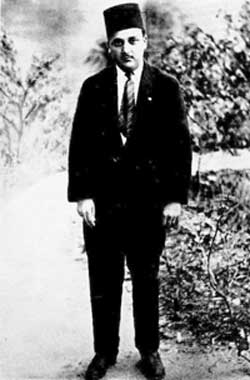
A retelling based on the first chapter of The Priceless Pearl by Rúḥíyyih Khánum, her biography of Shoghi Effendi. Words in quotation marks are quoted from that book.
From his student years in Beirut, Rúḥíyyih Khánum writes, "the entire course of Shoghi Effendi's studies was aimed by him at fitting himself to serve the Master, interpret for Him and translate His letters into English." After the war he worked at 'Abdu'l-Bahá's side as one of His secretaries. Then it was decided that he should go to England and enter Oxford University, "his avowed purpose being to perfect his English in order to better translate the Tablets of 'Abdu'l-Bahá, as well as the other sacred writings, into this language."
He left Haifa in the spring of 1920. At 'Abdu'l-Bahá's insistence he first rested for about two months at a sanatorium in Neuilly, near Paris, and reached England in July. That autumn he entered Balliol College, signing the college register in his own hand as "Shawqi Hadi Rabbani," aged 23. A list in one of his notebooks records the classes he began in October 1920, among them political science, political economy, logic, English economic history and the Eastern Question.
On 18 October 1920 he explained his purpose in a letter to a believer in the East: "My hope is that I may speedily acquire the best that this country and this society have to offer and then return to my home and recast the truths of the Faith in a new form, and thus serve the Holy Threshold."
His tutor was A. D. Lindsay, who later became Master of Balliol. Years afterwards Lindsay recalled: "Shoghi Effendi's idea of education was to discover somebody whose opinions he valued and then question him." Once, seeing Lindsay's posted schedule, Shoghi Effendi asked what he did between seven and half past eight. Lindsay said he dined. "Oh," Shoghi Effendi replied, "but must you have all that time?" Lindsay remembered: "I had not found so much eagerness for knowledge at Oxford. So I gave him another quarter-hour and went with less dinner."
From his Beirut days until nearly the end of his life Shoghi Effendi wrote English vocabularies and phrases in notebooks, and Rúḥíyyih Khánum says that hundreds of words and sentences were recorded in them. He read the King James Bible and the historians Carlyle and Gibbon, and kept a volume of Gibbon's Decline and Fall of the Roman Empire near him for the rest of his life. Rúḥíyyih Khánum writes that Gibbon's influence can be seen in his writings, "just as the biblical English is reflected in his translations of Bahá'u'lláh's Prayers, The Hidden Words and Tablets."
By November 1921 he was "revising many translations," as he told an English believer, and had sent off his version of Bahá'u'lláh's Tablet to Queen Victoria. In a Persian letter of the same period he wrote, "I am engaged in this land, day and night, in perfecting myself in the art of translation." Only his Sundays, he added, were free. He had left 'Abdu'l-Bahá, Rúḥíyyih Khánum writes, "fully believing he would return to His side better equipped to serve Him."
On 29 November 1921 a cable reached the London office of Major Tudor Pole with the news that 'Abdu'l-Bahá had passed away. Shoghi Effendi, arriving there about noon, saw the Master's name on the open cablegram lying on the desk and read it. He later said that he "had had no foreknowledge of the existence of the Institution of Guardianship, least of all that he was appointed as Guardian." He sailed from England on 16 December.
In 1927, writing to Lindsay, the Guardian spoke of "my sudden and deeply-regretted recall from Balliol," and added: "The invaluable assistance I have received under your tutorship has proved of great benefit in my arduous and responsible task and I welcome this opportunity to express my grateful appreciation of all that you have done for me."
This is a retelling. For the fuller account, see The Priceless Pearl by Rúḥíyyih Khánum.
Cite this story
Khánum, R.. (1969). *The Priceless Pearl*. Bahá'í Publishing Trust.
Record yourself reading this story
Recording stays on this device only. Nothing is uploaded.
Related stories
Dr. Esslemont Writes His Book
A doctor at a Bournemouth sanatorium first met the Bahá'í teachings in December 1914 and set out to write a book about them. 'Abdu'l-Bahá corrected part of the manuscript, and Bahá'u'lláh and the New Era appeared in 1923.
Hippolyte Dreyfus, the First French Bahá'í
A Paris lawyer who heard of the Faith in 1901 became the first French Bahá'í. He left the law to study Persian and Arabic, translated the Writings into French, travelled widely for the Faith and served 'Abdu'l-Bahá in Paris.
Jináb-i-Fáḍil, a Gift to America
Mírzá Asadu’lláh Fáḍil of Mázindarán, a scholar who became a Bahá’í in Tihrán, carried out a dangerous mission for ‘Abdu’l-Bahá in Najaf, taught across America, India and Persia, and wrote a nine-volume history of the Faith.
Shoghi Effendi at Oxford
At Oxford, the young Shoghi Effendi worked day and night to perfect his English so that he could translate the holy writings, until the news of 'Abdu'l-Bahá's passing called him home.