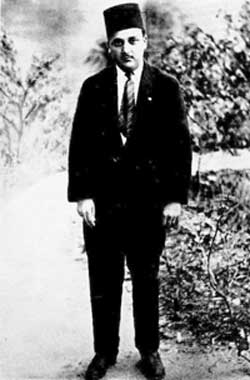
Nothing but the Best: Shoghi Effendi and Excellence as Worship
Rúḥíyyih Khánum, The Priceless Pearl, (1969), Bahá'í Publishing Trust · Read original
When in Bahá'í history
Haifa (today: Haifa, Israel)

A retelling based on The Priceless Pearl by Rúḥíyyih Khánum, the biography of Shoghi Effendi written by his wife, who worked at his side for two decades. The narrative is retold in our own words; short phrases in quotation marks are words preserved in that book.
The Feast of Kamál — Perfection — invites us to think about excellence of character. We often picture that excellence in dramatic forms: courage before an enemy, generosity in a famine, forgiveness of a great wrong. But there is a quieter excellence that may be just as demanding and just as spiritual: the excellence of doing one's work superbly well — of refusing to let anything leave one's hands that is less than the best one can make it, even when no one is watching and no reward is waiting. In the life of Shoghi Effendi, the Guardian of the Bahá'í Faith, this quiet excellence was raised almost to the level of an act of worship. And his wife and biographer, Rúḥíyyih Khánum, has left us a portrait of how it began and what it cost.
It began with a private discipline, undertaken purely for love. In the autumn of 1920, a young man of twenty-three arrived at Balliol College, in the old English university city of Oxford, after earlier study at the American University of Beirut. His name was Shoghi Effendi, and he was the grandson of 'Abdu'l-Bahá. He had, at that point, no notion of the great office that would fall to him a little over a year later; in his own mind he was simply a student, come to England with a long-cherished hope. He was enrolled in the formal university programme, reading economics and political science. But, as Rúḥíyyih Khánum is careful to record, his real work at Oxford was something no professor had set him and no examination would ever test.
In his own rooms at Balliol, away from the lecture halls, he sat with the great books of English literature open before him — and beside them, always, a dictionary and a notebook. He had set himself a single, demanding goal: to master the English language so exactly, so beautifully, that he could one day serve 'Abdu'l-Bahá as a translator. He had carried this wish, his biographer notes, since boyhood; Oxford was where he meant at last to make it real. So he read, and read, and read — Carlyle, Gibbon, Shakespeare, the King James Bible — and he did not merely read. He underlined the words that struck him; he copied them out by hand; whenever he met a word he did not know, he looked it up. Page after page, day after day, he taught himself the music and the meaning of English with such relentless care that, Rúḥíyyih Khánum records, he taught himself the language "to a precision that surprised even his English tutors."
Consider the temper of that labour. There were no crowds to applaud it, no prizes attached to it, no deadline forcing it. It was one young man, alone with his books, doing the same patient, humble work over and over — for the sake of a service he merely hoped to render someday, quietly, in Haifa, under his Grandfather's eye, for many years to come. That was the whole of his plan. He was perfecting an instrument, with no idea of the magnitude of the music it would one day be asked to play.
Then, in late November of 1921, a cablegram changed everything. 'Abdu'l-Bahá had passed from this world, and the responsibility of Guardian of the Cause — an office he had never expected — descended upon Shoghi Effendi's shoulders. And the very English he had been so patiently perfecting, word by word, for one quiet purpose, was suddenly required for something incomparably greater. It became the English in which the Bahá'í teachings themselves would be carried to the entire Western world.
Here the pursuit of excellence moved from preparation to a lifetime of performance, and Rúḥíyyih Khánum's account of it is, between the lines, a portrait of holy exactitude. Among the great labours the Guardian took upon himself was the translation into English of the principal chronicle of the Faith's early days, the vast Persian narrative composed in the 1880s by Nabíl-i-A'ẓam — the book the English-speaking world now knows as The Dawn-Breakers. The manuscript was huge, intricate, and written in a classical Persian idiom thick with allusion. The Guardian determined, in the late 1920s, that it must be made accessible to the West, and he took the work upon himself.
His wife describes the method, and it is the method of a man who would settle for nothing but the best. He sat at his desk in the house of the Master in Haifa late into the night, the Persian text before him, the English-Persian dictionaries he had compiled at Oxford within reach, and his own deep knowledge of both literatures held, page by page, in the same disciplined mind. He rendered each passage into the formal, slightly archaic, faintly Biblical English he had quietly chosen as the fitting register for the Sacred Writings — and he wrote, as well, the long, careful footnotes that would let a Western reader follow the unfamiliar background. He shortened where shortening served, selected what would carry, preserved the central thread of the narrative. The labour stretched, in spells, across several years; other Tablets, other letters, the whole administration of a worldwide Faith were attended to in the daylight hours, and the translation was the work of the time "when Haifa was quiet." The result, published in 1932, was a chronicle of nearly seven hundred pages that remains to this day the principal record of the Faith's heroic age.
Rúḥíyyih Khánum's chapter is also, she says plainly, a portrait of the Guardian's "working asceticism." In those years, she records, "he did not travel; he did not entertain; he wrote and translated." The lamp burned in his small room until the early hours. And out of that disciplined, self-denying excellence came the very books — The Dawn-Breakers, The Hidden Words, the Kitáb-i-Aqdas — by which generation after generation of Western believers would come to know their Faith. The cadenced, dignified English in which they would read the Word of God had been forged, first, in the silence of Oxford rooms, and then, night after night, at a desk in Haifa, by a man who would not let it be less than beautiful.
There is a teaching that runs beneath this whole life. The Bahá'í Writings hold that work done in the spirit of service is itself a form of worship, and that to carry one's labour to its highest excellence is acceptable and pleasing in the sight of God. Shoghi Effendi did not merely affirm that teaching; he embodied it to an almost severe degree. He treated the perfecting of a translation — the right word, the true cadence, the exact footnote — as a sacred trust, worthy of his whole strength and the best hours of his life. He gave his finest care to work that began as a private hope, and he gave it before he could possibly know how much it would one day matter.
That is the perfection the Feast of Kamál sets before us, in one of its most quietly searching forms. Most of us will never face a firing squad or a famine. But every one of us has work to do — and a choice, daily, between doing it carelessly and doing it as well as we possibly can. Shoghi Effendi's life answers that choice. It tells us that excellence pursued patiently, humbly, for love and for service, is not vanity and not mere perfectionism; it can be a form of devotion — a way of offering to God the very best of what we are able to make. The beautiful English by which countless souls have drawn near to the Sacred Writings was first the fruit of a young man, alone with his dictionary, deciding that for this service nothing but the best would do.
This is a retelling. For the fuller account, see The Priceless Pearl by Rúḥíyyih Khánum.
Cite this story
Khánum, R.. (1969). *The Priceless Pearl*. Bahá'í Publishing Trust. https://bahai-library.com/khanum_priceless_pearl
Record yourself reading this story
Recording stays on this device only. Nothing is uploaded.
Related stories
A Dictionary at His Elbow: Shoghi Effendi, Scholar and Translator
Before the world knew he would be the Guardian, Shoghi Effendi went to Oxford with one private purpose: to perfect his English so that he might serve 'Abdu'l-Bahá as His translator. In quiet rooms at Balliol, with English literature, a dictionary, and a notebook, he forged the very instrument by which the Sacred Writings would later reach the Western world — a lifetime's labour of learning poured out in service.
A number of times during his life, particularly in the years
A number of times during his life, particularly in the years immediately following the Ascension of ‘Abdu’l-Bahá, Shoghi Effendi retired to Switzerland to regain health, energy and self-confidence. He lived a very physically rigorous life…
At the time my father was invited by the Guardian to come and live
At the time my father was invited by the Guardian to come and live with us in the Holy Land, after my mother's unexpected death in Argentina in March 1940, Shoghi Effendi decided, for reasons of his own, to go to England. For those who…
Amatu’l-Bahá Ruhiyyih Khanum
Over his mother's signature, but drafted by the Guardian, the following cable was sent to America: “Announce Assemblies celebration marriage beloved Guardian. Inestimable honour conferred upon handmaid of Baha'u'llah Ruhiyyih Khanum Miss…