The First Western Pilgrims Reach 'Akká
Lady Blomfield, The Chosen Highway, (1940), Bahá'í Publishing Trust
When in Bahá'í history
'Akká (today: Acre, Israel)
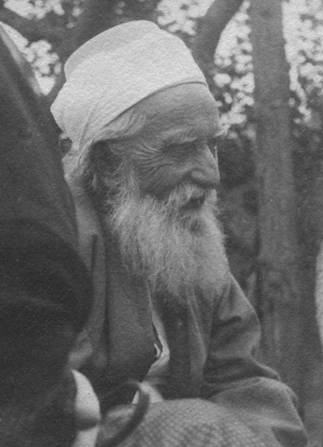
A retelling based on Mrs. Thornburgh-Cropper's letter to Lady Blomfield, printed in The Chosen Highway, with the dates and names of the pilgrims taken from Shoghi Effendi's God Passes By, chapter XVI.
By 1898 the philanthropist Mrs. Phoebe Hearst, wife of Senator George F. Hearst, had come to the Faith through Lua Getsinger and had decided to visit 'Abdu'l-Bahá, then a prisoner of the Ottoman government in 'Akká. She invited several believers to travel with her, among them Dr. and Mrs. Getsinger. In Paris others joined the party, among them May Ellis Bolles (later May Maxwell) and two nieces of Mrs. Hearst, and more were added in Egypt.
Shoghi Effendi records that fifteen pilgrims came in three successive parties. The first, which included Dr. and Mrs. Getsinger, reached 'Akká on 10 December 1898. 'Abdu'l-Bahá Himself took the pilgrims into the innermost chamber of the Tomb of Bahá'u'lláh.
One of the party, Mrs. Thornburgh-Cropper, a lifelong friend of Mrs. Hearst, later wrote down her memories for Lady Blomfield. Early in 1898 Mrs. Hearst had written to her from California about "a wonderful new religious teaching." When she heard of 'Abdu'l-Bahá and of the station of His Father, she arranged to go with Mrs. Hearst to 'Akká.
The two women reached Cairo after a terrible storm at sea and stayed a few days while the journey into the prison-city was explained to them. A small steamer took them on to Haifa through another storm. It was too dangerous, for the visitors and for 'Abdu'l-Bahá, for strangers to be seen entering 'Akká, so they waited at a hotel until nightfall and then drove by carriage along the sand to the city gates. Their driver arranged for them to go in. Friends were waiting inside, and someone carrying a small piece of candle led them up the uneven stairs.
"Suddenly the light caught a form that at first seemed a vision of mist and light," she wrote. "It was the Master which the candle-light had revealed to us."
The visitors tried to tell Him how grateful they were to be received. "No," He answered, "you are kind to come." She noted that He said it in very careful English.
Mrs. Hearst wrote afterwards: "Those three days were the most memorable days of my life." Her butler, Robert Turner, was also among the pilgrims. Shoghi Effendi calls him the first member of his race to embrace the Cause of Bahá'u'lláh in the West, and writes that his faith held firm even when Mrs. Hearst later drew away from the Cause.
The pilgrims returned, some to France and others to the United States, and began to teach. Shoghi Effendi writes that the activity they started grew so much that 'Abdu'l-Bahá resolved to travel to the West Himself as soon as He was released from His confinement.
This is a retelling. For Mrs. Thornburgh-Cropper's own account, see The Chosen Highway by Lady Blomfield; for the pilgrimage of 1898–99, see God Passes By, chapter XVI.
Cite this story
Blomfield, L.. (1940). *The Chosen Highway*. Bahá'í Publishing Trust.
Record yourself reading this story
Recording stays on this device only. Nothing is uploaded.
Related stories
The First Western Pilgrims to 'Akká
In December 1898 the first of fifteen Western pilgrims, travelling in three parties arranged by Phoebe Hearst, reached 'Akká and met 'Abdu'l-Bahá. Shoghi Effendi saw in their visit the opening of a new epoch for the Faith in the West.
Where Is Robert?
On pilgrimage to 'Akká, 'Abdu'l-Bahá noticed that Robert Turner, Phoebe Hearst's butler, was absent, asked for him, and rose to greet him with words of love. Shoghi Effendi later praised the tenacity of his faith.
The Covenant as an Ark of Salvation
On her 1905 pilgrimage to 'Akká, Julia Grundy wrote down a talk of 'Abdu'l-Bahá on obedience, in which He likened the Covenant of God to a Lifeboat and an Ark of Salvation, and the believers to fishes in the sea.
Lua Getsinger, Herald of the Covenant
While Juliet Thompson was painting 'Abdu'l-Bahá's portrait in New York on June 19, 1912, the Master suddenly appointed Lua Getsinger the Herald of the Covenant and declared that He was the Covenant appointed by Bahá'u'lláh.