'Abdu'l-Bahá in Philadelphia
Mírzá Maḥmúd-i-Zarqání, Mahmúd's Diary: The Diary of Mírzá Maḥmúd-i-Zarqání, (1998), George Ronald
When in Bahá'í history
Philadelphia (today: Philadelphia, Pennsylvania, USA)
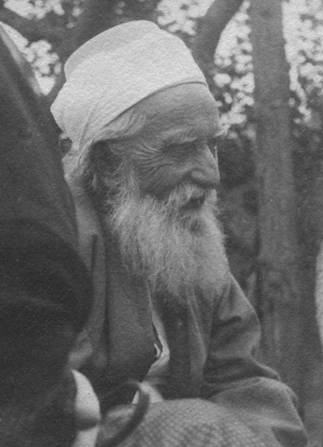
In June 1912 'Abdu'l-Bahá accepted an invitation from church leaders in Philadelphia. Mahmúd records that He left New York for the city even though He was exhausted and greatly grieved, and that because of His exhaustion He had to send His apologies to some of the meetings arranged for Him. In a Tablet written just afterward, He explained that He had visited Philadelphia "for a few days, at the invitation of two ministers and at the request of the friends of God."
On Sunday, June 9, He spoke in two churches. (Mahmúd's diary places both meetings on Saturday, June 8; the published transcripts of the talks give Sunday, June 9.) In the morning, at the Unitarian Church at Fifteenth Street and Girard Avenue, He spoke on the reality of divine existence and on the meaning of Christ's words that "the Father is in the Son," gave the glad tidings of Bahá'u'lláh, and closed with a prayer chanted in Persian. Mahmúd writes that everyone in the audience wanted to be near Him, if only for a moment, though that was impossible for all.
In the evening He spoke at the Baptist Temple at Broad and Berks Streets, whose pastor was Dr Russell H. Conwell. Mahmúd notes that the pastor had announced the visit in advance and had invited dignitaries and statesmen from Washington and its vicinity, so that the meeting was of great significance.
The address, preserved in The Promulgation of Universal Peace, began: "I am greatly pleased to be present this evening. Truly this is a spiritual gathering." 'Abdu'l-Bahá described two pathways that have existed in the world of humanity since the time of Adam: the natural pathway, which is the way of the animal, captive of the senses; and the religious, or spiritual, pathway. Every other created thing, He said, is a captive of nature, but man rules over it. He soars above the mountains, dives beneath the sea and imprisons electricity in a small lamp, because God has placed within him a power that surpasses nature. For a human being to deny the spiritual world, and to believe only what the senses report, is to descend to the level of the animal.
He then set out the teachings of Bahá'u'lláh one after another: the investigation of reality; the oneness of humankind; that religion must be a cause of love and unity; the agreement of religion and science; the abandonment of religious, racial, patriotic and political prejudice; the readjustment of the economic condition of humanity; an equal standard of human rights; universal education; a universal auxiliary language; the equality of women and men; and the world's need for the Holy Spirit.
Of religion He said: "The third teaching of Bahá'u'lláh is that religion must be the source of fellowship, the cause of unity and the nearness of God to man." If it rouses hatred and strife instead, He said, it would be better to be without it.
Mahmúd records that His explanations made a great impression, that His listeners appeared happy and honoured to be in His presence, and that the Master's heart was elated by the Philadelphia meetings, which He often mentioned afterwards. The next day He returned to New York; many friends came to the railway station, saddened by His departure, to see Him off.
A retelling based on Mahmúd's Diary: The Diary of Mírzá Maḥmúd-i-Zarqání (George Ronald, 1998), with the texts of the talks in The Promulgation of Universal Peace and the account in Star of the West, vol. 5, no. 6. For the fuller account, see the originals.
Cite this story
Maḥmúd-i-Zarqání, M.. (1998). *Mahmúd's Diary: The Diary of Mírzá Maḥmúd-i-Zarqání*. George Ronald.
This story shares quotes with 1 other story
“The third teaching of Bahá'u'lláh is that religion must be the source of fellowship, the cause of unity and the nearness of God to man.”
Also in
- Two Pathways— Mírzá Maḥmúd-i-Zarqání, Mahmúd's Diary: The Diary of Mírzá Maḥmúd-i-Zarqání
Record yourself reading this story
Recording stays on this device only. Nothing is uploaded.
Related stories
Two Pathways
In a large church in Philadelphia, 'Abdu'l-Bahá spoke about two pathways, the way of nature and the way of religion, and said that religion must bring people together.
'Abdu'l-Bahá in Boston
'Abdu'l-Bahá visited Boston three times in 1912. He addressed the Unitarian conference at Tremont Temple and the Free Religious Association at Ford Hall, spoke to journalists about peace, and later stayed a week at Malden.
The Answer at Ford Hall
In Boston in 1912, a speaker warned a large audience that a false Christ had come to America. 'Abdu'l-Bahá, speaking next, told them of the truth of all the Prophets of God, and especially of Christ.
A Question at Temple Emanu-El
In a San Francisco synagogue, 'Abdu'l-Bahá spoke about Moses and then asked His Jewish listeners why they should not also praise Christ and Muḥammad.