Nettie Tobin's Stone
Mírzá Maḥmúd-i-Zarqání, Mahmúd's Diary: The Diary of Mírzá Maḥmúd-i-Zarqání, (1998), George Ronald
When in Bahá'í history
Wilmette (today: Wilmette, Illinois, USA)
A retelling based on Mahmúd's Diary, with Nettie Tobin's own account as given in Honnold's Vignettes from the Life of 'Abdu'l-Bahá.
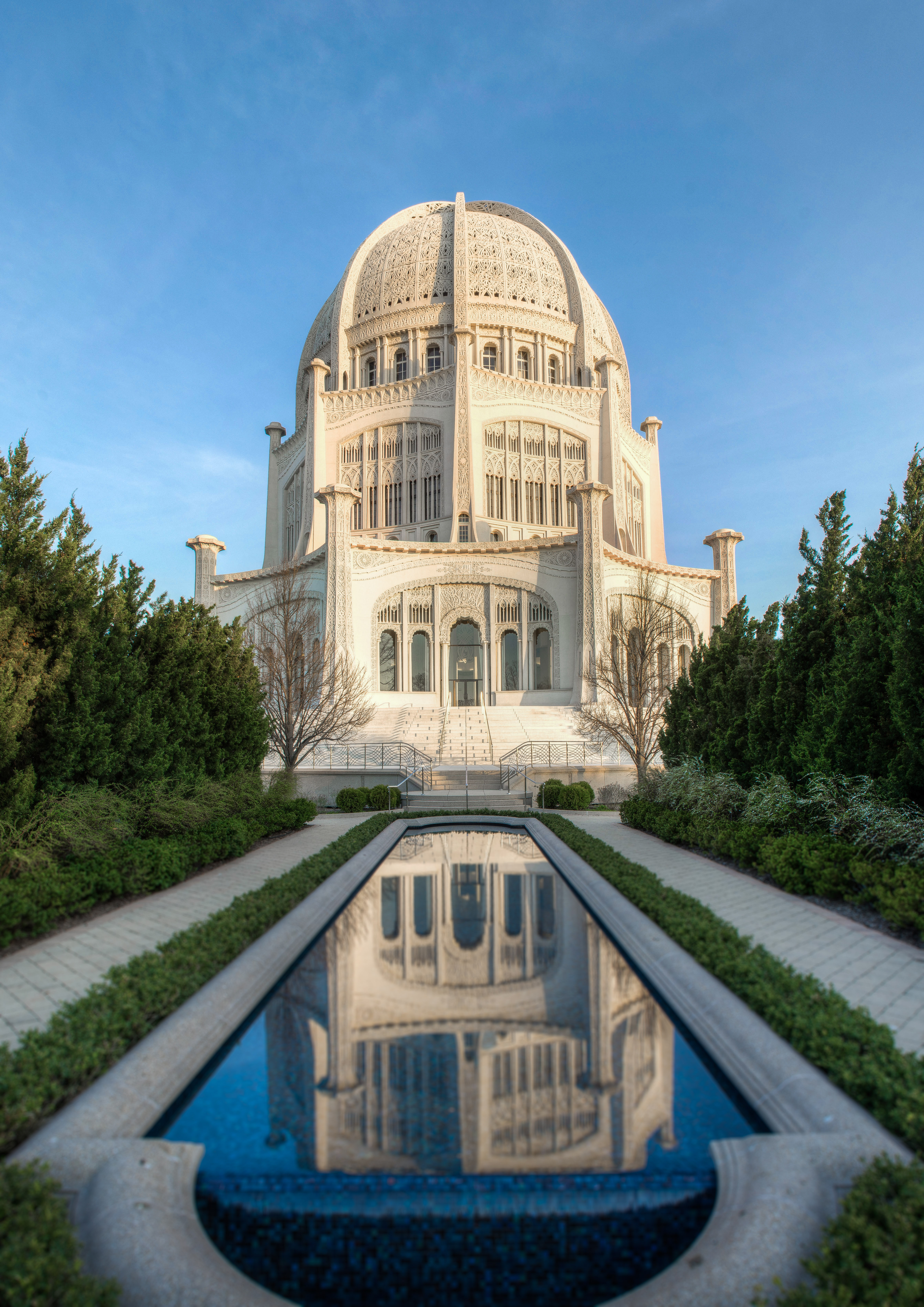
On 1 May 1912 'Abdu'l-Bahá went out from Chicago to the lakefront land north of the city, in Wilmette, that the American Bahá'ís had bought for the first House of Worship in the West. Mírzá Maḥmúd-i-Zarqání records that by the time He arrived the friends had assembled and pitched a large tent. The Master first drove around the site, inspecting its boundaries, and then entered the tent and spoke. His talk, as published, begins: "The power which has gathered you here today notwithstanding the cold and windy weather is, indeed, mighty and wonderful."
He then went to the spot where the cornerstone was to be laid. Irene Holmes presented Him with a golden trowel made for the occasion, and He dug the earth Himself. After Him the delegates of the American assemblies took their turn, followed by representatives of the Eastern friends: Mihtar Ardishír Bahrám Surúsh for the Bahá'ís of Pársí background, Siyyid Asadu'lláh for the Bahá'ís of Muslim origin, Zia Bagdadi for the Arabian friends, and Ghodsieh Khánum Ashraf for the Bahá'í women of the East. When the digging was done, Mahmúd writes, the Master set the stone in place with His own hand.
Mahmúd does not say where the stone came from. H. M. Balyuzi, in his biography of 'Abdu'l-Bahá, records that the Master chose for the cornerstone "a fragment of rock brought by Mrs Nettie Tobin as her offering."
Nettie Tobin lived in Chicago and was not well off, but she wanted to contribute something. In her own account she writes that she had heard the Master would be at the Temple site on 1 May and thought He should have a suitable stone to mark the location of the Temple. She went to a building under construction near her home, saw a pile of stones by a wall, and asked the builder whether she could have one. He told her to help herself, since those stones had been rejected. She loaded one into an old baby carriage and wheeled it home. Early the next morning, with the help of a Persian friend, she wheeled the carriage to the streetcar line and, against the conductor's protests, got it onto the car. After two changes and many delays they reached the corner of Central Street and Sheridan Road, where the carriage collapsed on a broken pavement. The hour set for the service had already passed. Two boys came by with an express wagon and lent it to them, and so the stone reached the grounds. "Imagine my joy," she wrote, "when 'the stone refused by the builder' was received and used by the Master!"
According to Bruce Whitmore's history of the House of Worship, The Dawning Place, 'Abdu'l-Bahá said as He set the stone in the ground, "The Temple is already built."
The day before, at the Drill Hall in Chicago, speaking at the close of the convention of the Bahá'í Temple Unity, He had spoken of the oneness of humanity and of peace among the nations. "These are the institutions of God and the foundations of His temple, the Mashriqu'l-Adhkár," He said.
The outer edifice is a symbol of the inner.
Nettie Tobin's stone was not built into the walls of the Temple. It is kept at the House of Worship in Wilmette.
A retelling based on Mahmúd's Diary: The Diary of Mírzá Maḥmúd-i-Zarqání (entry for 1 May 1912 and the editors' notes), The Promulgation of Universal Peace (talks of 30 April and 1 May 1912), H. M. Balyuzi's 'Abdu'l-Bahá: The Centre of the Covenant (pp. 186–7), and Nettie Tobin's account in Annamarie Honnold's Vignettes from the Life of 'Abdu'l-Bahá (pp. 42–3). Mahmúd's Diary itself does not mention Nettie Tobin. For the fuller account, see the originals.
Cite this story
Maḥmúd-i-Zarqání, M.. (1998). *Mahmúd's Diary: The Diary of Mírzá Maḥmúd-i-Zarqání*. George Ronald.
Record yourself reading this story
Recording stays on this device only. Nothing is uploaded.
Related stories
Nettie's Stone
Nettie Tobin wanted to give something for the new temple, so she brought a rejected stone from Chicago in an old baby carriage. 'Abdu'l-Bahá chose it as the cornerstone.
A Stone for the Mother Temple
On May 1, 1912, 'Abdu'l-Bahá dug the ground for the House of Worship at Wilmette with a golden trowel, American delegates and Eastern believers continued the digging, and He set in place the stone Nettie Tobin had brought.
Nettie Tobin's Stone
Nettie Tobin had no money to give, so she brought a stone the builders did not want to the land for a House of Worship. On May 1, 1912, 'Abdu'l-Bahá set her stone in the ground with His own hands.
The Stone Refused by the Builder
Nettie Tobin, who was not well off, brought a builder's rejected stone to the Wilmette Temple site by baby carriage, streetcar and a borrowed wagon, and the Master used it at the dedication of the land.