The Laying of the Wilmette Temple Cornerstone
Shoghi Effendi, God Passes By, (1944), Bahá'í Publishing Trust · Read original
When in Bahá'í history
Wilmette (today: Wilmette, Illinois, USA)
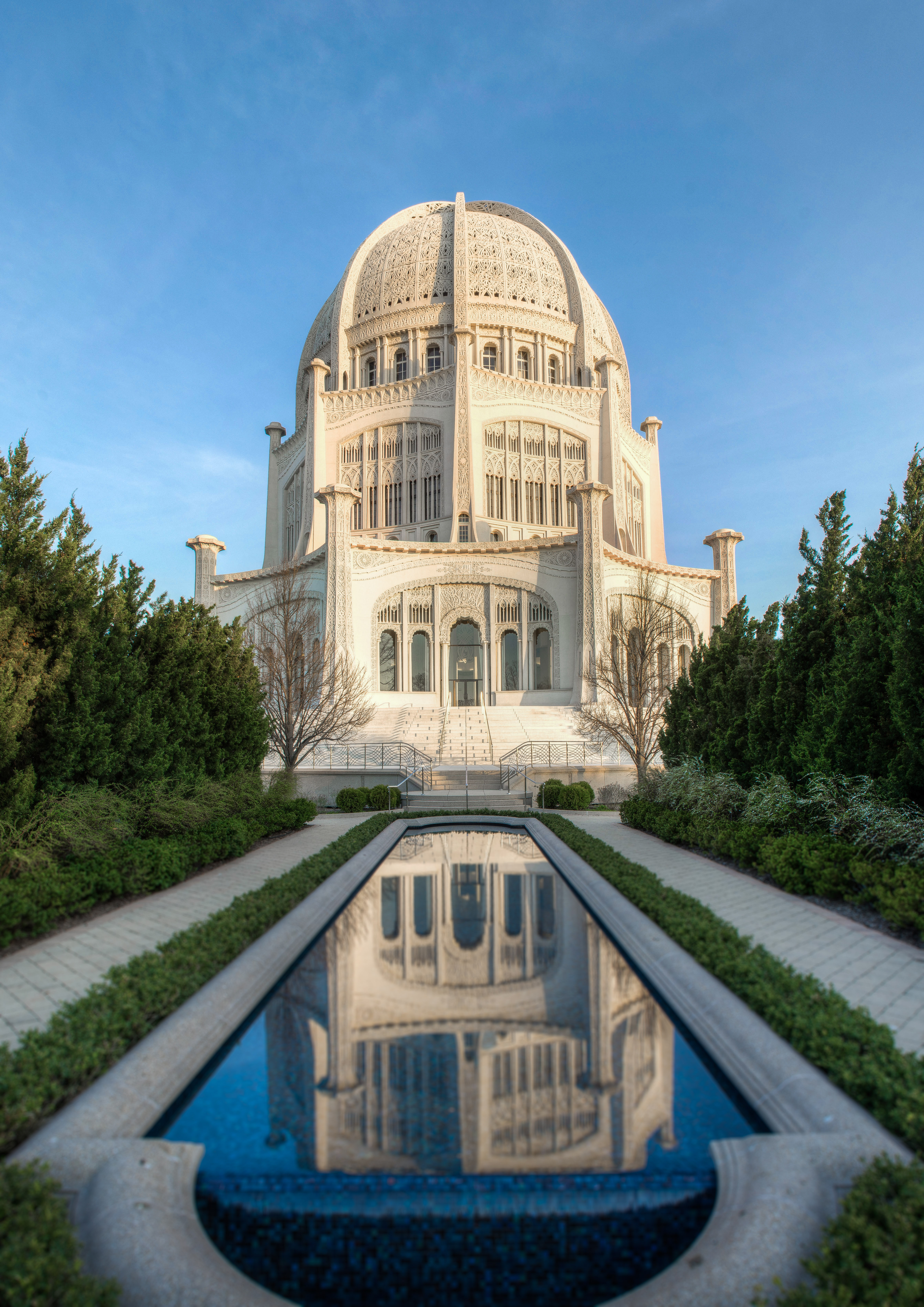
In God Passes By, Shoghi Effendi lists the acts by which 'Abdu'l-Bahá showed the importance He attached to His visit to America, and he names first among them "the laying, with His own hands, of the dedication stone of the Mashriqu'l-Adhkár, by the shore of Lake Michigan, in the vicinity of Chicago, on the recently purchased property, and in the presence of a representative gathering of Bahá'ís from East and West." The ceremony took place on 1 May 1912, on the site at Wilmette.
The Guardian traces the story of that site. In March 1903 the House of Spirituality of the Bahá'ís of Chicago, inspired by the believers of 'Ishqábád who had begun the first Mashriqu'l-Adhkár of the Bahá'í world, asked 'Abdu'l-Bahá for permission to build a House of Worship in America. In a Tablet revealed in June of that year He gave His "ready and enthusiastic approval." In November 1907 representatives of the American believers appointed a committee of nine to find a site, and by April 1908 two building lots near the shore of Lake Michigan had been bought. In March 1909 a national convention established the Bahá'í Temple Unity to hold the property and carry the work forward. By 1910 contributions had come from India, Persia, Turkey, Syria, Palestine, Russia, Egypt, Germany, France, England, Canada, Mexico, the Hawaiian Islands and even Mauritius, as well as from no less than sixty American cities.
On the day, the friends had put up a large tent on the land. 'Abdu'l-Bahá first drove around the site to see its boundaries, then spoke in the tent: "Thousands of Mashriqu'l-Adhkárs, dawning points of praise and mention of God for all religionists will be built in the East and in the West, but this, being the first one erected in the Occident, has great importance."
Irene Holmes then presented Him with a golden trowel made for the occasion. Star of the West reported that, because the soil was gravelly, He put the trowel back in its case and called for an axe and then a shovel. With these He and Bahá'ís of many nations and backgrounds, each taking a turn, dug a resting place for the stone, and the Master set it in place with His own hands.
The stone He used had been brought by Nettie Tobin, a Chicago believer who was not well off. Her own account, quoted in Annamarie Honnold's Vignettes from the Life of 'Abdu'l-Bahá, tells how she got it. Hearing that the Master would be at the Temple site on 1 May, she asked a builder near her home for a stone, and he told her to help herself from a pile of rejected ones. She wheeled it home in an old baby carriage. Early the next morning, with a Persian friend, she took it by streetcar, changing twice, to the corner of Central Street and Sheridan Road, where the carriage collapsed on a broken pavement. Two boys with an express wagon carried it the rest of the way. "Imagine my joy," she wrote, "when 'the stone refused by the builder' was received and used by the Master!"
The work that followed was long. The purchase of the Temple property was completed at the 1914 convention. In 1920 the design of Louis Bourgeois was chosen. The superstructure was completed by 1 May 1931, the nineteenth anniversary of the Master's dedication of the grounds, and the ornamentation of the exterior was finished in 1942, ahead of the centenary of the Faith in 1944. In God Passes By, written for that centenary, Shoghi Effendi calls the building "the Mother Temple of the West, the forerunner of a divine, a slowly maturing civilization." The House of Worship was dedicated in 1953.
A retelling based on God Passes By by Shoghi Effendi, with details of the day from Mahmúd's Diary, Star of the West (vol. 3, no. 4), 'Abdu'l-Bahá's talk in The Promulgation of Universal Peace, and Nettie Tobin's account in Honnold's Vignettes from the Life of 'Abdu'l-Bahá. For the fuller account, see the originals.
Cite this story
Effendi, S.. (1944). *God Passes By*. Bahá'í Publishing Trust. https://www.bahai.org/library/authoritative-texts/shoghi-effendi/god-passes-by/
Record yourself reading this story
Recording stays on this device only. Nothing is uploaded.
Related stories
Nettie's Stone
In 1912 'Abdu'l-Bahá laid the first stone of the House of Worship at Wilmette. The stone He used was one that builders had thrown away, brought there by a Chicago Bahá'í named Nettie Tobin.
Corinne True and the Temple Fund
As financial secretary of Bahai Temple Unity, Corinne True of Chicago gathered gifts from across America and the East for the House of Worship at Wilmette. She lived to see it dedicated in 1953 and was known as the Mother of the Temple.
The Founding of Bahá'í Temple Unity
In March 1909 thirty-nine delegates from thirty-six cities met in Chicago and formed Bahá'í Temple Unity, the national body that would hold the land and raise the funds for the first House of Worship in the West.
Louis Bourgeois and the Temple Design
In 1920 the American Bahá'ís chose Louis Bourgeois's design for the House of Worship at Wilmette. He then showed his drawings to 'Abdu'l-Bahá, who called the design "the most beautiful in the world."