The Long Walk Up the Mountain
Shoghi Effendi, God Passes By, (1944), Bahá'í Publishing Trust · Read original
When in Bahá'í history
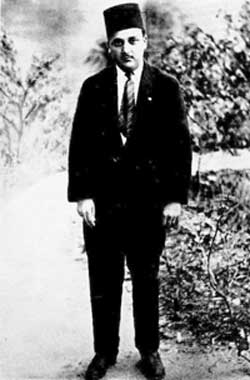
A retelling for children of "The Funeral of 'Abdu'l-Bahá", based on Shoghi Effendi's account in God Passes By and on a letter of Sir Herbert Samuel printed in The Chosen Highway by Lady Blomfield.
'Abdu'l-Bahá passed away in His home in Haifa, by the sea, in the early hours of 28 November 1921. He had not been well for a few days. On His last night, before He went to bed, He asked how everyone in His household was, and the pilgrims, and the friends.
The news spread very fast through the town, and messages carried it to Bahá'ís in faraway countries.
The funeral was held the very next morning, and about ten thousand people came. They came from every religion and every kind of home. There were Muslims, Christians, Jews and Druze. There were Arabs and Kurds, Greeks and Turks and Egyptians, Europeans and Americans, men, women and children.
Above the town rises Mount Carmel, and on its slope stands the Shrine of the Báb. That is where everyone was going.
'Abdu'l-Bahá's coffin was carried up the mountain on the shoulders of people who loved Him. The long line of mourners followed it slowly up the slopes, and many of them were weeping.
When they reached the Shrine, the coffin was set on a plain table. Nine speakers, from the Muslim, Jewish and Christian Faiths, spoke about 'Abdu'l-Bahá, one after another. Then the coffin was taken into the Shrine, and 'Abdu'l-Bahá was laid to rest in a vault next to the one where the Báb was buried.
The High Commissioner for Palestine, Sir Herbert Samuel, walked behind the coffin that day. Later he wrote: "A great throng had gathered together, sorrowing for His death, but rejoicing also for His life."
'Abdu'l-Bahá had always cared for the poor. For a whole week after He passed away, between fifty and a hundred poor people were given meals at His house every day. On the seventh day, grain was given out in His memory to about a thousand of them, whatever their religion or race.
This is a retelling for children. For the fuller account, see "The Funeral of 'Abdu'l-Bahá".
Cite this story
Effendi, S.. (1944). *God Passes By*. Bahá'í Publishing Trust. https://www.bahai.org/library/authoritative-texts/shoghi-effendi/god-passes-by/
Record yourself reading this story
Recording stays on this device only. Nothing is uploaded.
Related stories
The Funeral of 'Abdu'l-Bahá
'Abdu'l-Bahá passed away in Haifa on 28 November 1921. At His funeral some ten thousand people of every religion and race followed His coffin up Mount Carmel to the Shrine of the Báb, where He was laid to rest.
Esslemont's Account of the Master's Funeral
Dr J. E. Esslemont, who had been 'Abdu'l-Bahá's guest in Haifa, describes His peaceful passing and a funeral attended by about ten thousand people of many faiths, which he saw as proof that His life's work had not been in vain.
A Blessing for the Springfield Convention
In November 1921 the Bahá'ís of Springfield, Massachusetts, cabled 'Abdu'l-Bahá for approval of a second race amity convention. He answered, "Approved; God confirms." The convention met on 5 and 6 December, a week after His passing.
A Reflection of the Heavenly Concourse
On 13 September 1911, nine days after arriving in London, 'Abdu'l-Bahá spoke at the home of Mrs. Thornburgh-Cropper and described the meeting as a reflection of the heavenly concourse.