The Funeral of 'Abdu'l-Bahá
Shoghi Effendi, God Passes By, (1944), Bahá'í Publishing Trust · Read original
When in Bahá'í history
Haifa (today: Haifa, Israel)
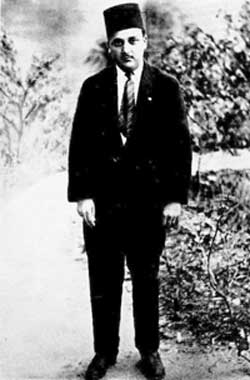
'Abdu'l-Bahá passed away at His home in Haifa in the early hours of 28 November 1921, in the seventy-eighth year of His age. On the Friday before, despite great fatigue, He had given alms to the poor as was His custom. The next day He felt feverish, and on the Sunday, unable to leave the house, He sent the believers to the Tomb of the Báb to attend a feast while He remained at home. That night, before He retired, He asked after the health of every member of His household, of the pilgrims and of the friends in Haifa. The news of His passing spread like wildfire through the town and was flashed over the wires to distant parts of the globe.
Shoghi Effendi describes the funeral, held the next morning, in God Passes By. No less than ten thousand people took part, representing every class, religion and race in Palestine.
The coffin containing the remains of 'Abdu'l-Bahá was borne to its last resting-place on the shoulders of His loved ones.
The procession was led by the city police as a guard of honour, followed by Muslim and Christian Boy Scouts, Muslim choristers chanting verses from the Qur'án, the chiefs of the Muslim community headed by the Muftí, and Christian priests, Latin, Greek and Anglican. Behind the coffin walked His family, the High Commissioner for Palestine, Sir Herbert Samuel, the Governor of Jerusalem, Sir Ronald Storrs, and notables Muslim, Jewish, Christian and Druze, with Egyptians, Greeks, Turks, Arabs, Kurds, Europeans and Americans, men, women and children.
The long train of mourners, amid the sobs and moans of many a grief-stricken heart, wended its slow way up the slopes of Mt. Carmel to the Mausoleum of the Báb.
Near the eastern entrance of the Shrine the casket was placed on a plain table, and nine speakers, who represented the Muslim, the Jewish and Christian Faiths, among them the Muftí of Haifa, gave their funeral orations. The High Commissioner then came close to the casket and, with bowed head, paid his last homage, and the other officials followed him.
The coffin was then removed to one of the chambers of the Shrine, and there lowered, sadly and reverently, to its last resting-place in a vault adjoining that in which were laid the remains of the Báb.
Sir Herbert Samuel later wrote, in a letter printed in Lady Blomfield's The Chosen Highway:
A great throng had gathered together, sorrowing for His death, but rejoicing also for His life.
Sir Ronald Storrs wrote:
I have never known a more united expression of regret and respect than was called forth by the utter simplicity of the ceremony.
During the week after His passing, from fifty to a hundred of the poor of Haifa were fed each day at His house, and on the seventh day corn was distributed in His memory to about a thousand of them, irrespective of creed or race.
Bahá'ís observe the Ascension of 'Abdu'l-Bahá at one o'clock in the morning on 28 November. It is one of the two Holy Days on which work need not be suspended.
A retelling based on Shoghi Effendi's account of the funeral in God Passes By (Bahá'í Publishing Trust, 1944), chapter 21, and on the letters of Sir Herbert Samuel and Sir Ronald Storrs printed in The Chosen Highway (Lady Blomfield); the indented passages are quoted from those texts. For the fuller account, see the originals.
Cite this story
Effendi, S.. (1944). *God Passes By*. Bahá'í Publishing Trust. https://www.bahai.org/library/authoritative-texts/shoghi-effendi/god-passes-by/
Record yourself reading this story
Recording stays on this device only. Nothing is uploaded.
Related stories
Esslemont's Account of the Master's Funeral
Dr J. E. Esslemont, who had been 'Abdu'l-Bahá's guest in Haifa, describes His peaceful passing and a funeral attended by about ten thousand people of many faiths, which he saw as proof that His life's work had not been in vain.
A Blessing for the Springfield Convention
In November 1921 the Bahá'ís of Springfield, Massachusetts, cabled 'Abdu'l-Bahá for approval of a second race amity convention. He answered, "Approved; God confirms." The convention met on 5 and 6 December, a week after His passing.
The World's Condolences at the Master's Passing
When 'Abdu'l-Bahá passed away in Haifa in November 1921, messages of sympathy came from Winston Churchill, Viscount Allenby and the ministers of 'Iráq, and the High Commissioner for Palestine walked in His funeral procession among ten thousand mourners.
Laid to Rest Beside the Báb
In 1909 'Abdu'l-Bahá laid the remains of the Báb in the Shrine He had built on Mount Carmel. Twelve years later, after His own funeral, His coffin was lowered into a vault beside that of the Báb in the same Shrine.