At the Eighth Street Temple, Washington
'Abdu'l-Bahá, The Promulgation of Universal Peace, (1922), Bahá'í Publishing Trust · Read original
When in Bahá'í history
Washington, D.C. (today: Washington, D.C., USA)
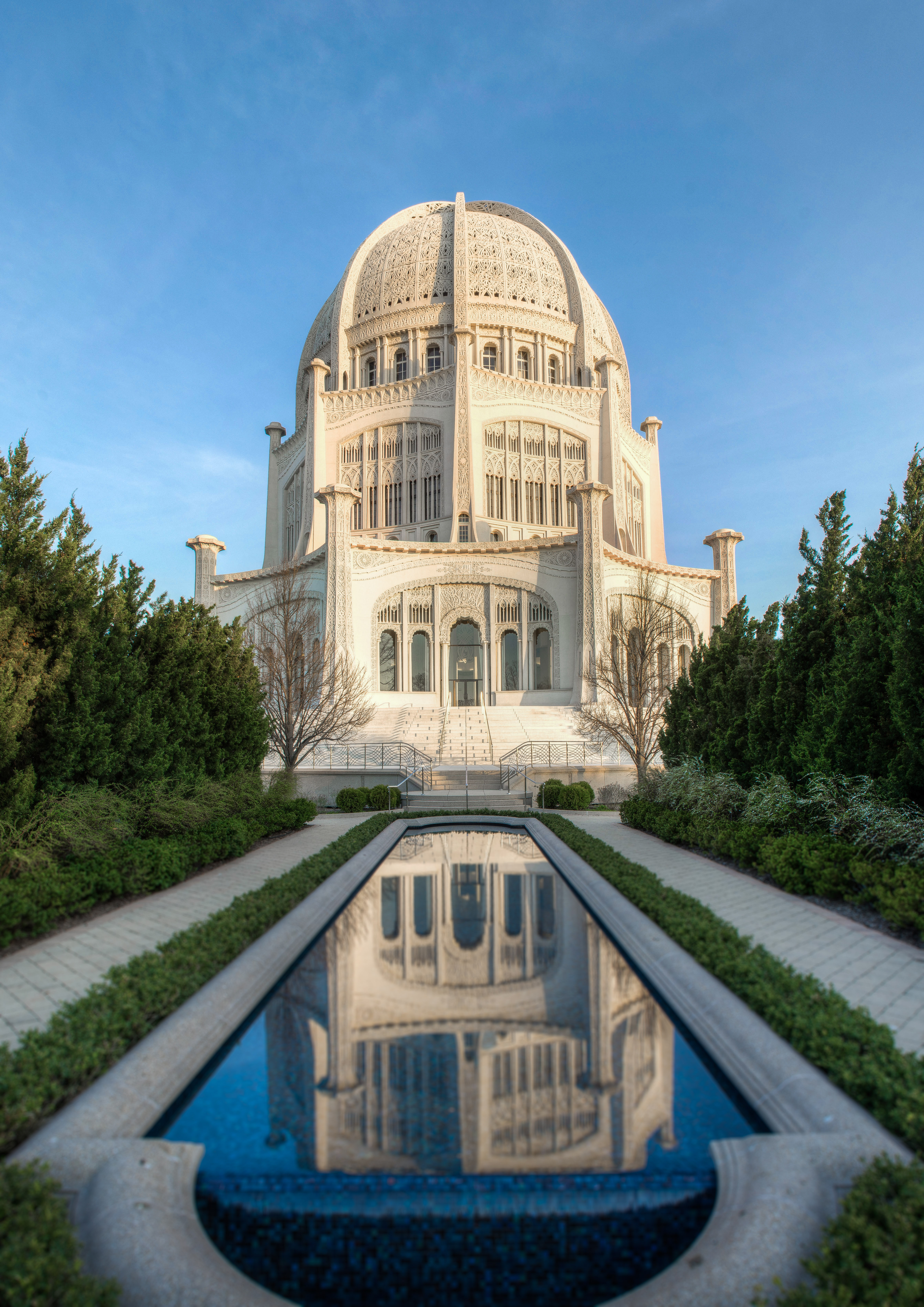
On 8 November 1912 ‘Abdu’l-Bahá spoke at the Eighth Street Temple, a synagogue in Washington, D.C. On His arrival He said that He would repeat what He had spoken on in the synagogue of San Francisco, and would set out more clearly the proofs of the reality of Christ and the truth of Islam.
He began with the oneness of God and of humanity, and with the estrangement that had grown up between people in the name of religion. The foundations of the divine religions, He said, are one; the differences came from blind imitation of dogma and of ancestral forms of worship.
Abraham was the founder of reality. Moses, Christ, Muhammad were the manifestations of reality. Bahá’u’lláh was the glory of reality.
He then described two kinds of ordinances in the divine religions. The first are the essential, spiritual teachings: faith in God, the virtues, morals and ethics. These never change, and Abraham, Moses, Christ and all the Prophets upheld them. The second concern human transactions and change with the needs of time and place. He gave examples from the Torah, such as cutting off the hand of a thief and the death penalty for breaking the Sabbath, and asked whether such laws could be enforced today. They could not; human conditions had changed.
The Prophets, He went on, are the Educators of the human race, and this is the proof of their mission. Moses found the children of Israel captive and helpless in Egypt. He led them into the Holy Land, united and taught them, and raised them until, in the days of Solomon, they were renowned throughout the ancient world.
Then He came to Christ. When Jesus appeared, the Jews of His day pronounced Him an enemy of Moses and a destroyer of the Mosaic law. ‘Abdu’l-Bahá asked His hearers to look at the facts. Christ declared Moses a Prophet of God and the Torah the Book of God. For fifteen hundred years the name and history of Moses had been confined to the boundaries of Palestine.
But through Christ, through the blessing of the New Testament of Jesus Christ, the Old Testament, the Torah, was translated into six hundred different tongues and spread throughout the world.
It was through Christianity, He said, that the Torah reached Persia.
Christians and Jews should have the greatest love for each other because the Founders of these two great religions have been in perfect agreement in Book and teaching.
The Christians, He pointed out, had lost nothing by acknowledging Moses as a Prophet of God. What harm could come to the Jews from saying that Jesus, too, was a Manifestation of the Word of God? He added that Muḥammad had praised Moses and the prophets of Israel in the Qur’án. He ended:
For God is one and humanity is one, and the only creed of the Prophets is love and unity.
Maḥmúd’s diary records that the address caused a stir. Some of the Jews sitting near the pulpit signalled to the interpreter that the time was over, but the Master went on and completed His proofs. Afterwards the chairman, a rabbi, came to the pulpit to thank Him and asked the congregation not to be perplexed by what went against their own convictions, but to investigate the truth with composure and sincerity. The next day ‘Abdu’l-Bahá called on the rabbi and spoke with him about harmony among Jews, Christians and Muslims.
A retelling based on The Promulgation of Universal Peace ('Abdu'l-Bahá), talk of 8 November 1912 at the Eighth Street Temple, Washington, D.C. (notes by Joseph H. Hannen), with details from Mahmúd's Diary (8–9 November 1912). For the fuller account, see the originals.
Cite this story
'Abdu'l-Bahá. (1922). *The Promulgation of Universal Peace*. Bahá'í Publishing Trust. https://www.bahai.org/library/authoritative-texts/abdul-baha/promulgation-universal-peace/
Record yourself reading this story
Recording stays on this device only. Nothing is uploaded.
Related stories
At Temple Emanu-El in San Francisco
On October 12, 1912, 'Abdu'l-Bahá spoke at Temple Emanu-El in San Francisco. He praised Moses and asked His Jewish hearers why they, in turn, should not acknowledge Christ and Muḥammad.
America and the Banner of Peace
At the International Peace Forum in New York on May 12, 1912, 'Abdu'l-Bahá expressed the hope that America would be first to raise the banner of peace, since a nation with no colonies to protect could not be suspected of selfish motives.
Religion and Civilization
The greatest bestowal of God in the world of humanity is religion; for assuredly the divine teachings of religion are above all other sources of instruction and development to man.
Religion Is Progressive
Religion is the outer expression of the divine reality. Therefore it must be living, vitalized, moving and progressive.