At Temple Emanu-El in San Francisco
'Abdu'l-Bahá, The Promulgation of Universal Peace, (1922), Bahá'í Publishing Trust · Read original
When in Bahá'í history
San Francisco (today: San Francisco, California, USA)
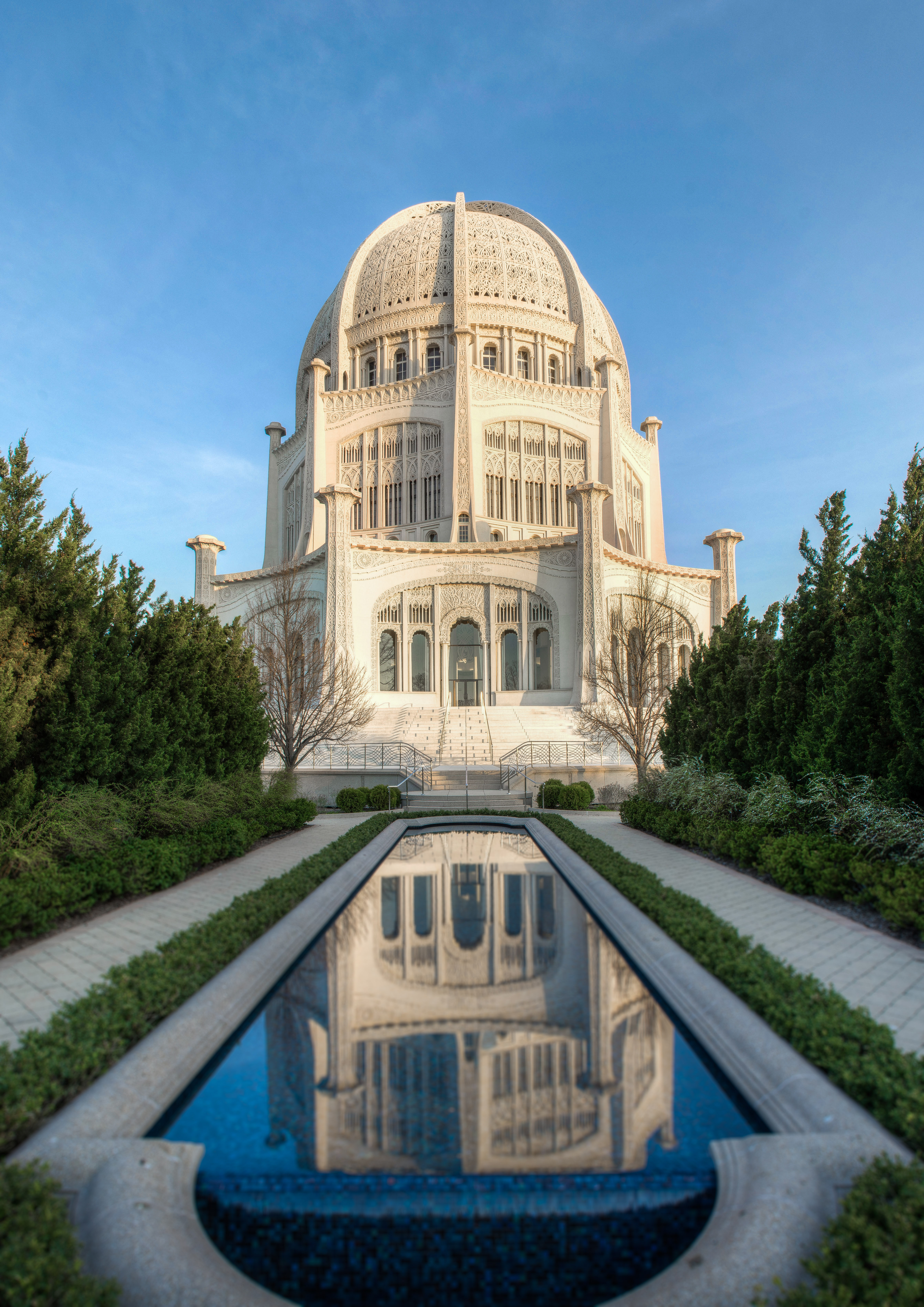
On Saturday morning, the twelfth of October, 1912, ‘Abdu’l-Bahá spoke at Temple Emanu-El, the Reform Jewish congregation on Sutter Street in San Francisco. Mahmúd’s diary puts the audience at some two thousand. The chairman introduced Him as a great teacher of the age, who would speak through an interpreter on “The Fundamental Unity of Religious Thought.”
He began by calling religion the greatest bestowal of God in the world of humanity, and proposed to test that claim not by tradition but by history. Abraham, banished from His native land for proclaiming the oneness of God, founded a house from which came Isaac, Jacob, Joseph, Moses, David and Solomon. Moses, a shepherd, rescued the children of Israel from bondage in Egypt and led them to the Holy Land, where they founded a great civilization. When the essential foundation of that religion was obscured by dogma and blind imitation, He said, decline followed.
The purpose of the religion of God, He told them, is the education of humanity and the unity and fellowship of mankind, and the foundations of the religions of God are one.
He then spoke of Christ, Who proclaimed the validity of Moses and through Whom the Torah was spread throughout the world, and of Muḥammad, Who told His people to believe in Moses and the prophets of Israel. Christians and Muslims, He pointed out, accept Moses. What harm would come to the Jewish people if they, in turn, accepted Christ and acknowledged Muḥammad?
Christians and Muslims believe and admit that Moses was the Interlocutor of God. Why do you not say that Christ was the Word of God?
He then did Himself what He was asking of them:
Verily, I now declare to you that Moses was the Interlocutor of God and a most noteworthy Prophet …
He closed with these words:
The age has dawned when human fellowship will become a reality.
The century has come when all religions shall be unified.
The dispensation is at hand when all nations shall enjoy the blessings of international peace.
The cycle has arrived when racial prejudice will be abandoned by tribes and peoples of the world.
The epoch has begun wherein all native lands will be conjoined in one great human family.
For all mankind shall dwell in peace and security beneath the shelter of the great tabernacle of the one living God.
Mahmúd records that afterward many came to express their gratitude, while a very few left in dismay.
A retelling based on The Promulgation of Universal Peace (talk of 12 October 1912 at Temple Emanu-El, 450 Sutter Street, San Francisco), with details of the occasion from Mahmúd’s Diary. For the fuller account, see the original.
Cite this story
'Abdu'l-Bahá. (1922). *The Promulgation of Universal Peace*. Bahá'í Publishing Trust. https://www.bahai.org/library/authoritative-texts/abdul-baha/promulgation-universal-peace/
Record yourself reading this story
Recording stays on this device only. Nothing is uploaded.
Related stories
At the Eighth Street Temple, Washington
At a Washington synagogue on 8 November 1912, 'Abdu'l-Bahá argued that Christ had spread the Torah and the name of Moses throughout the world, and that Christians and Jews should therefore love one another.
America and the Banner of Peace
At the International Peace Forum in New York on May 12, 1912, 'Abdu'l-Bahá expressed the hope that America would be first to raise the banner of peace, since a nation with no colonies to protect could not be suspected of selfish motives.
The Collective Center of Mankind
On June 2, 1912, speaking for the second time at the Church of the Ascension in New York, 'Abdu'l-Bahá described the church as a collective center and the Manifestations of God as the real Collective Centers of mankind.
Yet He Loved Them All
In Julia Grundy's pilgrim notes from 'Akká, 'Abdu'l-Bahá is asked how we can love someone whose personality is unpleasant. His answer points to Christ, who loved even those who crucified Him, and to the tree whose fruit is love.