A Black Rose
Howard Colby Ives, Portals to Freedom, (1937), George Ronald · Read original
When in Bahá'í history
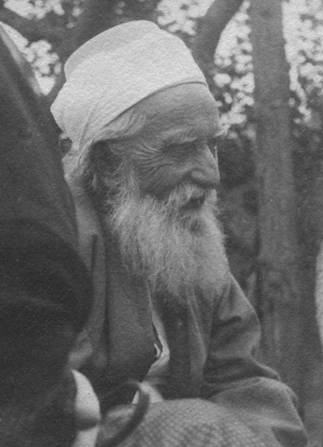
A retelling based on Portals to Freedom by Howard Colby Ives (George Ronald, 1937), chapter 4. Words in quotation marks are verbatim from the book.
In April 1912 'Abdu'l-Bahá went to the Bowery Mission to speak to several hundred of New York's poorest men. As usual a large party of Persian and American friends went with Him. As the party made its way through the East Side, the Persians in flowing robes and Eastern headgear, a number of boys gathered behind them. Some became rowdy. As Ives remembered it, a few called names and threw sticks.
Mrs. Kinney, one of the party, dropped behind to speak to the boys. She told them, as she later recounted, that He "was a very Holy Man who had spent many years in exile and prison because of His love for Truth and for men," and that He was on His way to speak to the poor men at the Mission. One boy, who seemed to be their leader, asked whether they could come too. She told them that would not be possible, but that if they came to her home the next Sunday she would arrange for them to see Him, and she gave them the address.
Late that Sunday afternoon Howard Colby Ives was standing at a window of the Kinney home when twenty or thirty boys came up the front steps, stamping and talking loudly. They were not well dressed, but they were spruce and clean as if for an occasion. Mrs. Kinney told Ives she had invited them but had hardly expected them to come. The boys were taken upstairs to 'Abdu'l-Bahá's own room, and Ives followed.
'Abdu'l-Bahá stood at the door and greeted each boy as he came in, sometimes with a handclasp, sometimes with an arm around a shoulder, and always with such smiles and laughter that He seemed almost a boy among them.
Among the last to enter was a Black boy of about thirteen. He was the only boy of his race in the group, and he evidently feared he might not be welcome. When 'Abdu'l-Bahá saw him, His face lit up with a smile. He raised His hand in a gesture Ives called princely and exclaimed, loudly enough for everyone to hear, that here was a black rose.
The room went silent. The boy's face shone with happiness, and the other boys looked at him with new eyes. Ives wrote that the boy had surely been called many things before, but never a black rose. Watching, Ives wondered what would happen in New York if these boys remembered that afternoon all their lives and came to think of people of every race and color as "different colored flowers in the Garden of God."
When the boys arrived, 'Abdu'l-Bahá had sent out for candy. Now it came: a five-pound box of expensive chocolates. He carried it around the circle Himself and put a large handful into each boy's hands, with a word and a smile for each. When He went back to His table only a few pieces were left. He picked out a long chocolate nougat, very black, looked at it for a moment, and then looked around at the boys, who were watching Him closely.
Without a word He crossed the room to the boy. With a humorously piercing glance that took in the whole group, He laid the chocolate against the boy's cheek and put His arm around his shoulders. Ives was sure every boy understood. As he put it, the Master seemed to be saying that this boy was not only a black flower but a black sweet. They ate black chocolates and found them good; perhaps they would find this black brother of theirs good too, once they tasted his sweetness.
Again the room fell quiet, and the boys looked at the Black boy as if they had never really seen him before. The boy himself seemed aware of no one but 'Abdu'l-Bahá. His eyes were fixed on Him with a look Ives said he had never seen on any face.
A retelling based on Portals to Freedom (Howard Colby Ives, George Ronald, 1937), chapter 4. For the fuller account, see the original.
Cite this story
Ives, H. C.. (1937). *Portals to Freedom*. George Ronald. https://bahai-library.com/ives_portals_freedom
Record yourself reading this story
Recording stays on this device only. Nothing is uploaded.
Related stories
The Black Rose
Boys who had shouted and thrown sticks at 'Abdu'l-Bahá's party in New York came to meet Him. He welcomed each one, called the only black boy a black rose, and gave them all chocolates.
The Black Rose
A boy of about thirteen, the only Black boy in a group visiting 'Abdu'l-Bahá in New York, was afraid he might not be welcome. 'Abdu'l-Bahá called him "a black rose" in front of everyone.
A Black Rose
A crowd of boys came to meet 'Abdu'l-Bahá in New York. The only Black boy among them was afraid he would not be welcome, but 'Abdu'l-Bahá greeted him, loud enough for all to hear, as a black rose.
The Bowery Boys and the Black Rose
Howard Colby Ives recalls a Sunday in New York in April 1912 when some twenty or thirty boys from the East Side came to see 'Abdu'l-Bahá, and He welcomed the only Black boy among them, before them all, as a black rose.