The Hidden Words in English
Rúḥíyyih Khánum, The Priceless Pearl, (1969), Bahá'í Publishing Trust
When in Bahá'í history
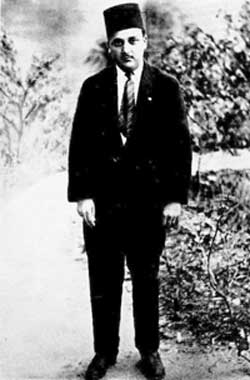
A retelling for children, based on The Priceless Pearl by Rúḥíyyih Khánum.
Long ago, in the city of Baghdád, Bahá'u'lláh used to walk beside a great river called the Tigris. As He walked, deep in thought, He was inspired with a book of holy words. It is full of short lines that begin O Son of Spirit and O Son of Man. Some of the lines are in Arabic and some are in Persian. The book is called The Hidden Words.
Many years later, Bahá'u'lláh's great-grandson, Shoghi Effendi, became the Guardian of the Bahá'í Faith. He translated The Hidden Words into English. He did not stop at his first try. Soon after he became Guardian, he sent the Bahá'ís in America a revised translation, one he had gone over again to make it better.
How did he learn to write such fine English? From his student days in Beirut until almost the end of his life, Shoghi Effendi kept notebooks. In them he wrote down English words and phrases, hundreds of them. He loved to read, too, and one of the books he read most was the King James Bible. Rúḥíyyih Khánum, who later became his wife, wrote that the English of that Bible can be heard in his translation of The Hidden Words.
Here is the very first of the Arabic Hidden Words in his English: O Son of Spirit! My first counsel is this: Possess a pure, kindly and radiant heart, that thine may be a sovereignty ancient, imperishable and everlasting.
Even though his English was very good, Shoghi Effendi still asked for help. For years he sent his translations to George Townshend, a man who knew English very well, and thanked him for his careful suggestions.
Shoghi Effendi went on to translate many more holy books.
This is a retelling for children. For the fuller account, see "Shoghi Effendi Translates The Hidden Words".
Cite this story
Khánum, R.. (1969). *The Priceless Pearl*. Bahá'í Publishing Trust.
Record yourself reading this story
Recording stays on this device only. Nothing is uploaded.
Related stories
Shoghi Effendi Translates The Hidden Words
Rúḥíyyih Khánum records that early in his ministry Shoghi Effendi sent the American believers his revised translation of The Hidden Words, and describes the long study of English behind his translations.
The Guardian Translates the Gleanings
Shoghi Effendi went to Oxford to perfect his English for translating the sacred Writings. In 1935 he published Gleanings from the Writings of Bahá'u'lláh, a selection of passages he had translated, which Professor Norman Bentwich and Queen Marie of Romania, among others, praised.
The Trust of Bahá'u'lláh Amongst Us
Indeed, the Greatest Holy Leaf, the Trust of Bahá’u’lláh amongst us, was the emblem of His boundless grace, a luminary shining in the heaven of tender mercy and gracious providence …
A Token of Our Deep Mourning
The Guardian trusts that the explanation he has given by wire regarding the suspension for a period of nine months of Bahá’í religious festivity has been made clear.