The Guardian Who Walked the Mountains
Rúḥíyyih Khánum, The Priceless Pearl, (1969), Bahá'í Publishing Trust
When in Bahá'í history
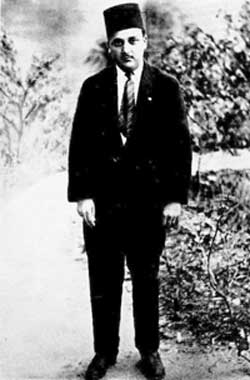
A retelling for children, based on The Priceless Pearl by Rúḥíyyih Khánum.
Shoghi Effendi was a student at Oxford University in England when news came that his grandfather, 'Abdu'l-Bahá, had passed away. He hurried home to the Holy Land.
There he learned that in His Will 'Abdu'l-Bahá had chosen him to be the Guardian of the Bahá'í Faith. He was twenty-four years old, and he had never expected it.
He began the work. But his grief was very deep, and there were many troubles caused by enemies of the Faith. After a few months he felt he could not go on in Haifa just then.
So in April 1922 he left Haifa for Europe. He wrote a short letter explaining that he was leaving the affairs of the Faith, for a time, in the care of the Holy Family and of the Greatest Holy Leaf, until he had regained his health, strength and spiritual energy.
The Greatest Holy Leaf was Bahíyyih Khánum, the sister of 'Abdu'l-Bahá. She wrote to the Bahá'ís that Shoghi Effendi had gone away to find quiet, so that he could think about the great task ahead of him. With members of the family and a group he had chosen, she looked after the affairs of the Faith while he was away.
Shoghi Effendi went first to see doctors in Germany. In those early years he went again and again to the mountains of Switzerland. In a town called Interlaken he rented a tiny room at the top of an old mountain guide's house, right under the roof. The ceiling was so low that when his uncle-in-law, a big man, came to visit, he could not stand up straight. There was a small bed, a basin, and a pitcher of cold water for washing.
Often, long before the sun came up, Shoghi Effendi would set out. He took a train to the foot of a mountain or a high pass, and then he walked, often ten to sixteen hours in a day, usually alone. Sometimes he climbed the higher mountains, tied by a rope to a guide. If it rained, he kept on walking until his clothes dried on him. At night he came back to his little room so tired that he fell straight asleep.
Rúḥíyyih Khánum, who later became his wife and wrote the story of his life, believed that those long days in the mountains helped to heal, a little, the deep wound in his heart left by the passing of 'Abdu'l-Bahá.
In December 1922 he came home to Haifa, and the next day he began writing letters to the Bahá'ís in many countries. He called that part of Switzerland his "second home," and he served as Guardian for the rest of his life.
This is a retelling for children. For the fuller account, see "The Guardian Withdraws to Switzerland".
Cite this story
Khánum, R.. (1969). *The Priceless Pearl*. Bahá'í Publishing Trust.
Record yourself reading this story
Recording stays on this device only. Nothing is uploaded.
Related stories
The Guardian Withdraws to Switzerland
Overwhelmed by grief and by his appointment as Guardian, Shoghi Effendi left Haifa in April 1922 with the Greatest Holy Leaf in charge, and in the early years of his ministry sought healing in long, solitary walks in the Swiss mountains.
The Cable in London
In November 1921 Shoghi Effendi, a student at Oxford, learned from a cable in a London office that 'Abdu'l-Bahá had passed away; back in Haifa, the Master's Will told him he had been appointed Guardian.
Shoghi Effendi at Balliol
In 1920 Shoghi Effendi went to Balliol College, Oxford, to perfect his English so that he could translate the sacred writings. His studies ended in November 1921 with the news of 'Abdu'l-Bahá's passing.
Shoghi Effendi's School Years in Beirut
Unhappy at school in Haifa and Beirut, the young Shoghi Effendi was moved by 'Abdu'l-Bahá to the Syrian Protestant College, where he aimed all his studies at serving the Master and translating His letters into English.