The Photographer of the Holy Places
Bahá'í Chronicles editors, Bahá'í Chronicles · Read original
When in Bahá'í history
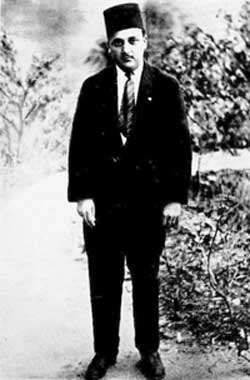
A retelling for children, based on Bahá'í Chronicles, "Muḥammad Labíb," which draws on The Bahá'í World and Labíb's own memoir of his pilgrimage.
Muḥammad Labíb was born in Yazd, in Persia, in 1893. When he was nine years old, in 1903, a mob rose against the Bahá'ís of Yazd. His father was driven out of the city, and the family's shop and home were destroyed. Muḥammad hid for several days in an underground water channel, sitting on his older brother's shoulders, until they found shelter in a friend's house. In 1905 the family moved to Ṭihrán, where he went to the Tarbíyat School for boys.
As a young man he learned Esperanto, a language 'Abdu'l-Bahá had encouraged the friends to learn, and in 1914 he went to teach at the Tavakkul Bahá'í School in Qazvín. There he had the idea of a company in which the schoolchildren could save money for their future. He called it the Nownahálán Company, from a Bahá'í word for young people.
In 1919 he went on pilgrimage for sixty days and told 'Abdu'l-Bahá about the company. 'Abdu'l-Bahá gave it His blessing and put in two gold coins as His own share. The company later moved to Ṭihrán and ran for sixty-three years.
During that pilgrimage a photographer was called one afternoon to take a picture of the group in front of the Master's house. Muḥammad noticed that he made two glass plates, one as a spare. He wanted the spare for the children's company, so he went with Shoghi Effendi to the photographer's studio near the sea to fetch it. While he waited he studied the photographer's equipment. It seems that this was when his interest in photography began.
Cameras then were large and used fragile glass plates. As smaller cameras and roll film came in, Muḥammad took photographs on his many teaching journeys around Persia. He set out to visit and photograph the places connected with the early history of the Faith, including some that were remote and dangerous to reach.
In 1930 Shoghi Effendi, the Guardian, sent the Australian photographer Effie Baker to Persia to photograph these places for his translation of Nabíl's history, The Dawn-Breakers. Because Muḥammad already knew the way to them, the National Spiritual Assembly of Persia chose him to travel with her. It took them eight months to cover the country from north to south and east to west. Some of his photographs appear in The Dawn-Breakers alongside hers.
In later years he wrote many works on Bahá'í history, illustrated with his own photographs. He pioneered to Hiroshima, in Japan, and later to the island of Rhodes, and he died in 1981.
This is a retelling for children. For the fuller account, see "Muḥammad Labíb".
Cite this story
editors, B. C.. *Bahá'í Chronicles*. https://bahaichronicles.org/mu%e1%b8%a5ammad-labib/
Record yourself reading this story
Recording stays on this device only. Nothing is uploaded.
Related stories
The Photographer of Iran's Holy Sites
Muḥammad Labíb survived the 1903 persecution in Yazd, founded a children's savings company that ‘Abdu’l-Bahá blessed, helped Effie Baker photograph the Faith's historic sites in Iran, and later pioneered to Japan and Rhodes.
Louis George Gregory
Born in Charleston to formerly enslaved parents, Louis G. Gregory became a Bahá'í in 1909, was seated by 'Abdu'l-Bahá at His right in Washington, gave decades to teaching and race unity, and was posthumously named a Hand of the Cause.
Vaḥíd Kashfí, Nephew of Vaḥíd
A nephew of Vahid Darabi found certitude after long years of study, visited ‘Abdu’l-Bahá in ‘Akká, taught the Faith in America and Persia, and served the Cause until his passing in 1959.
The Consolation Brought by the Pilgrims
It was through the arrival of these pilgrims, and these alone, that the gloom which had enveloped the disconsolate members of ‘Abdu’l-Bahá’s family was finally dispelled.