Vaḥíd Kashfí, Nephew of Vaḥíd
Bahá'í Chronicles editors, Bahá'í Chronicles · Read original
When in Bahá'í history
Riḍá'iyyih (today: Urmia, Iran)
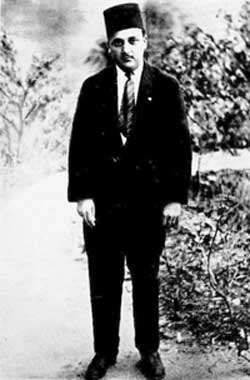
Mirza Yusuf was the nephew of Vahid Darabi. He was born in 1864, fifteen years after the martyrdom of his renowned uncle, in Istahbanat, the youngest of the eight children (six boys and two girls) of Jahan Bagum and Haji Muhammad-Isma‘il. Both his father and grandfather, Haji Muhammad-Taqi, originally of Lar, were merchants of note whose trading activities spread to the surrounding regions. His mother was born and raised in Istahbanat and together with her husband had become a firm believer in course of Vahid’s first visit.
At the age of sixteen he was sent to Shiraz to complete his education under the supervision of one of his father’s relatives in Aqa Baba-Khan school and soon he mastered such branches of learning as Arabic grammar, logic, principles of speech, and wisdom. After a while he also enrolled in the Qavam School where he studied the basics of the philosophy of Mulla Sadra under the tutelage of Mirza Abbas Hakim, one of the foremost students of the celebrated Haji Mulla Hadi Sabzivari. It was there in 1880 that he befriended the renowned Aqa Shaykh Ibrahim Burazjani, known as Fadil Shirazi, and was first introduced to the Faith and learned the details associated with his illustrious maternal uncle, though he continued to remain identified with the religion of his birth.
For his advance studies in the various branches of Islamic sciences he left Shiraz for Yazd where he remained for two years and enrolled in the Khan school. This stay afforded him the opportunity to deepen his knowledge of the Cause through associations with his cousin, Siyyid Ahmad (a son of Vahid) and a resident of the same town. Frequently he also visited Haji Mirza Muhammad-Taqi, the Vakilu’d-Dawlih, from whom he learned many details about the religion of the Báb.
Subsequently, he traveled to Isfahan, visiting his two maternal uncles, Siyyid Sina and Siyyid ‘Isa, and from there to Burujird where another maternal uncle, Siyyid Rayhanu’llah, the youngest brother of Vahid Darabi, had succeeded his father and had acquired the rank of the Hujjatu’l-Islam. He stayed in that town for some six months and benefited from the classes of his uncle at whose encouragement, he traveled to Karbala and for the next two years undertook tuition under such renowned scholars as Aqa Shaykh Zaynu’l-‘Abidin Mazandarani, Haji Mirza Habibu’llah Rashti and Haji Siyyid Husayn Turk. A portion of this time he was enrolled in the classes of various divines in Najaf, such as, Haji Shaykh Muhammad, Fadil Irvani and Shaykh Hadi Najm-Abadi.
Upon completion of his studies, he returned to the native town of the family in Darab, but finding its intellectual environment too stifling, he left after a week for Kirman and Yazd. It was in the former city where he met his cousin, Siyyid Muhammad, who had accompanied Vahid on the historic journey to Nayriz, and from this cousin learned much more about the Faith. Though in the course of his conversations he was unable to attain certitude, as a result of further exposure to the sacred Writings he was deeply moved.
In 1884 from Yazd he proceeded to Mashhad where he stayed for about a year and a half. In order to satisfy his internal agitation, he decided after performance of each morning’s obligatory prayer to recite a special prayer known as Du‘a Davazdah Imam. On the fortieth morning, his biographers note, upon reciting the phrase “…the divinely hidden Personage…” all veils of earthly knowledge were lifted and immediately he stood to recite a special Tablet of Visitation revealed by Bahá’u’lláh in honor of his uncle, Vahid. Thereupon spiritual certitude was his.
In 1887 he proceeded to Tihran and arrived at the home of his cousin, Tuba Khanum, and through her and her brother, Siyyid Muhsin, was able to deepen his knowledge in the Faith of Bahá’u’lláh and began his life-long path of service. It was during this time that he became closely connected with a number of government officials and solidified his reputation as a wise and learned counsel.
Two years later, Jalalu’d-Dawlih, a son of Zillul’s-Sultan, was appointed governor of the province of Yazd and decided to take Mirza Yusuf Kashfi with him. On learning that Mirza Yusuf had refused this offer, Jalalu’d-Dawlih informed him that, if necessary, he would be taken to Yazd in chains. In an effort to distance himself from the crazed Prince, he immediately accepted a position in the newly established American College in Tihran, teaching Arabic and Persian courses. Seizing the opportunity, he also began to study English language and the history of Church and was able to acquire certificate of completion some nine months later. By now he had attracted the attention of the College administrators and was appointed the supervisor of the school’s expansion program, including its construction activities. On a number of occasions, including the time when the monarch, Nasiri’d-Din Shah, visited the College, Mirza Yusuf was asked to represent the school to the government officials or to intercede on behalf of the Mission.
In 1890, Mirza Yusuf married a daughter of Tuba Khanum, the daughter of Vahid Darabi. It was soon thereafter that the American Mission launched efforts to establish a school in Ridaiyyih and for this purpose Miss Green arrived from the United States and another missionary worker, Dr. Cochron, was recalled from Ridayyih to report on the progress towards establishing this enterprise. On meeting Mirza Yusuf, both were greatly impressed with his abilities and asked him to assist with the Ridaiyyih facility. He readily accepted and with his family proceeded there, but his stay was short-lived and he returned to Tihran. It was then that his wife passed away and was buried in Imam-zadih Yahya, next to her mother.
In the early months of 1892, he decided to attain the presence of Bahá’u’lláh and proceeded towards ‘Akka. However upon reaching Tabriz, he learned of His Ascension and deeply grieved, decided against completion of the journey and remained in Ridaiyyih for a year, and from there he returned to Tihran.
In 1894, once again the American Protestant Missionary in Tihran appointed him the principal of their College in Ridaiyyih. It was there that he married again, formed a family, and through hard work, expanded his estate.
Much like his uncle, Mirza Yusuf possessed an uncanny ability for cultivating relations with the ruling class and since Tabriz traditionally served as the seat for the heir to the Qajar throne, he established important contacts in that town. The most beneficial of his relations, as it turned out, was with the governor of Tabriz, Prince Imam-Quli Mirza, who introduced him to Prince Muzaffaru’d-Din Mirza. On meeting Mirza Yusuf and hearing him make a representation on behalf of Imam-Quli Mirza, the royal prince was enchanted with his personality and knowledge, thereby honored him with the title “Lisan-i Huzur” (the sanctified tongue).
In 1895, he traveled to the Ottoman region and remained for some six months as a tutor of Siyyid Tah, a son of Shaykh Sadiq, the religious leader of Naqshbandi tribe. Years later, around 1919-20, both this student together with another Naqshbandi leader, Shaykh ‘Abdu’llah, visited Mirza Yusuf in Ridaiyyih and both accepted the Message of Bahá’u’lláh.
In the same year, subsequent to the assassination of Nasiri’d-Din Shah, Prince Muzaffaru’d-Din Mirza came to the throne and his son Muhammad-Ali Mirza was named his heir and established himself in Tabriz. A few years later, in 1319 A.H./1901, the young Prince paid an official visit to Ridaiyyih in course of which he came to the American Protestant Mission and through the Nazimu’l-Kukama was introduced to Mirza Yusuf. Some days later, Mirza Yusuf was called to Tabriz and after detailed discussions with the Prince about the Faith, in the presence of many high-ranking officials, the title of “Lisan-i Huzur” was reconfirmed and he was granted the honorary rank of Army Colonel.
In 1902, he met Siyyid Assadu’llah Qumi who wrote of him to ‘Abdu’l-Bahá in response to which Mirza Yusuf received a moving Tablet which starts with the words “O seeker of the Beloved of the worlds”. In the course of this Tablet, the Master noted, “The field of service is wide open.” As such, he decided to resign his post, sell his belongings and undertake a number of teaching journeys. On hearing his plans for visiting ‘Abdu’l-Bahá in the Holy Land and the subsequent travels to Europe and the North America, Prince Muhammad-Ali Mirza issued three royal commands to the Iranian embassies in Istanbul, London and Washington, to ensure his comfort and needs. However, Mirza Yusuf never approached the Iranian officials with any request.
After receiving permission from ‘Abdu’l-Bahá to make such a journey, he hastened to ‘Akka to attain his heart’s desire. During the nineteen days that he remained there he drank his fill from the life-giving draught of the presence of the Master and on daily basis paid homage to the Sacred Shrine of Bahá’u’lláh. Because of his fluency in English, ‘Abdu’l-Bahá instructed him to visit the United States, which he accomplished via Port Said, Cairo, Alexandria, Italy, Paris, London, Liverpool, and eventually arrived at Quebec and then proceed to Boston. From there, he went to New York and met with Mirza Abu’l-Fadl and Ali-Kuli Khan. After consultation with local Bahá’ís, he traveled extensively for a period of over a year in the eastern States, including Pennsylvania, Maryland, and some of the mid-western regions such as the State of Missouri – everywhere assisting with deepening and consolidation efforts. During these days, from very early in the morning until several hours into the night, he would exert himself and do all he could in promotion of the Faith. At the conclusion of his journey, he traveled to Maine and stayed at Green Acre for a while. During this period, he regularly gave lectures on the teachings of the Cause, its history and the station of ‘Abdu’l-Bahá that resulted in many enrolling under the banner of the Faith. In so doing, in effect, he was preparing the community for the arrival of the Master in a few years time. After a stay of two years in the States, due to adverse weather and the deterioration of his health, and following consultation with Mirza Abu’l-Fadl and upon ‘Abdu’l-Bahá’s approval, he returned to Ridaiyyih and resumed his earlier career.
Though initially he was disappointed for not being able to stay longer in the North America, soon he received a Tablet from the Master urging him to serve in his native country and to readily accept what God had ordained. From pursuing this Tablet, Mirza Yusuf set aside all caution and openly taught the Faith to everyone he encountered, including his own classes in the Missionary College. Soon several of his students embraced the Faith, which caused great uproar among the school administrators who decided upon termination of his appointment. They also complained to the authorities, who because of Mirza Yusuf’s standing in the community, ignored their plea. The school officials however combined their forces with certain fanatical elements and one day rushed and plundered his home. Since ‘Abdu’l-Bahá had instructed him to be resigned to the will of God, Mirza Yusuf did not approach the officials to redress his case.
Upon hearing the details, ‘Abdu’l-Bahá urged him to travel and teach in Adharbayjan. As such, he spent a period of time promoting the Cause until he eventually settled in the village of Shishvan, on the outskirts of Ridaiyyih Lake. For the next seven months he served as a tutor for the four sons of the Prince Imam-Quli Mirza and was granted an annual stipend of one hundred tumans and a ton of wheat. During this time, he continued with his intense teaching work that resulted in several individuals, including his four students, recognizing the Faith.
In 1923 he left that region for Tihran where he accepted a position at the Tarbiyat Bahá’í School in addition to his post of the English-Persian translator for the Commerce Ministry. Three years later he left for Qazvin and served for a year and a half as the principal of Hamdu’llah Mustawfi School, after which for the next five years he administered Tavvakul Bahá’í school of the same town.
In 1929, when Martha Root was visiting Iran, he accompanied her to Adharbayijan and served as her translator. After which he returned to Qazvin and resumed his teaching work and service to the Cause. Again some four years later when the American travel teacher, Keith Ransom-Kehler, visited Iran he served as her translator during her two-year journeys to Gilan, Khurasan and Mazandaran. It was after her untimely passing in Isfahan that he decided to complete her tour by himself and for the next four years traveled extensively in various regions of the country, assisting the community with learning the basics of administration and Bahá’í organizational structure. When in 1938 Mildred Mottahedeh visited Iran, bearing messages from Shoghi Effendi, Mirza Yusuf assisted her as a translator in her tour of the eastern provinces.
In total Mirza Yusuf married four times. He had divorced his first wife prior to his conversion to the Bahá’í Faith and had married again, this time his spouse had died prematurely. His third union resulted in a son, ‘Atau’llah, who became an agricultural engineer and served the Faith with great distinction. On passing of this wife, Mirza Yusuf married again which resulted in daughter named Khujastih.
Much like his celebrated uncle, Vahid Darabi, he possessed an unusual command of Islamic sciences and traditions and in course of his teaching activities was able to draw upon this fount of knowledge with great facility. In addition to his deep Bahá’í knowledge, his command of several languages, such as, English, Arabic, French, and Turkish enabled him to promote the Faith in many regions beyond his immediate environ. He was recipient of numerous Tablets from the Center of the Covenant, which eloquently testify to his life-long services, particularly in the region of Adharbayijan where he lived for well over three decades. In one of the many Tablets that he received from ‘Abdu’l-Bahá, he was titled Vahid as a remembrance of his illustrious uncle, Vahid Darabi. The Master in this Tablet enjoined upon him service to the Cause with the same degree of sacrifice and self-renunciation manifested a generation earlier by his uncle.
During the ministry of the Guardian, he continued to be a source of encouragement and a pillar of the faith to the community and was frequently blessed by receiving letters from Shoghi Effendi. In his latter days, he devoted much time to organizing deepening activities for the younger generation.
He passed away on October 3, 1959, at the age of 94, and was buried at Tihran Bahá’í cemetery and indeed the community of Iran was robbed of one of its ablest promoters. The Hands of the Cause of God residing in the Holy Land instructed the Iranian Bahá’í community to commemorate his passing by holding meetings in his honor throughout the country, and their cable to the community reads:
Deeply saddened news passing distinguished servant Cause God renowned scholar Vahid. Assure his family fervent prayers sacred threshold progress his noble soul. Organize befitting memorial gatherings. Hands Cause.
Source: Ahang Rabbani, “The Family of Vahid Darabi” (2004), section C.8, “Mirza Yusuf Vahid Kashfi,” bahai-library.com (https://bahai-library.com/rabbani_family_vahid_darabi), as reproduced by Bahá'í Chronicles (https://bahaichronicles.org/mirza-yusuf-vahid-kashfi/).
Cite this story
editors, B. C.. *Bahá'í Chronicles*. https://bahaichronicles.org/mirza-yusuf-vahid-kashfi/
Record yourself reading this story
Recording stays on this device only. Nothing is uploaded.
Related stories
Louis George Gregory
Born in Charleston to formerly enslaved parents, Louis G. Gregory became a Bahá'í in 1909, was seated by 'Abdu'l-Bahá at His right in Washington, gave decades to teaching and race unity, and was posthumously named a Hand of the Cause.
The Teacher Promised a Long Life
Hájí Muhammad-Tahir of Yazd begged Bahá’u’lláh for martyrdom and was told he would live long to teach the Cause. He served for decades as a teacher, historian and protector of the families of Yazd’s martyrs.
The Photographer of Iran's Holy Sites
Muḥammad Labíb survived the 1903 persecution in Yazd, founded a children's savings company that ‘Abdu’l-Bahá blessed, helped Effie Baker photograph the Faith's historic sites in Iran, and later pioneered to Japan and Rhodes.
The Forty Mornings of Mirza Yusuf
Mirza Yusuf, nephew of the martyr Vahid, searched for years before becoming a Bahá'í. In 1902 'Abdu'l-Bahá sent him to teach in America, and later gave him his uncle's name.