The Photographer of Iran's Holy Sites
Bahá'í Chronicles editors, Bahá'í Chronicles · Read original
When in Bahá'í history
Tihrán (today: Tehran, Iran)
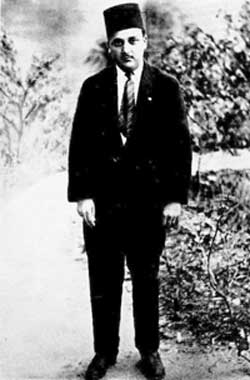
Among millions of Bahá’ís and Bábís who lived and left this ephemeral world, there are a great number who served this Faith selflessly, achieved tremendous work then traveled to the world beyond without any recognition and often without any trace. Fortunately, Muḥammad Labíb’s name came up while collecting documents for a project on the historical sites where the Báb stayed on His journeys from Shíráz into exile.
Muḥammad’s father, known as ‘Aṭṭár (spice dealer), was a renowned Shaykhí before he joined the Bahá’í Faith. During the upheaval of Yazd in 1903, the population rose against the large Bahá’í community of that city and Muḥammad’s parents were an obvious target of the mob. His father was expelled from the city and his shop and home were looted and demolished. His mother was beaten to the point of death by a crowd and thrown into a dark and damp prison for three days. Muḥammad, who was only nine years old, had to hide inside an underground water canal for several days sitting on the shoulders of his older brother until they found refuge in a friend’s house. He moved to Tihrán in 1905 since the family could not stay in Yazd. Muḥammad attended the Tarbíyat School for boys.
In the early 1900s the Esperanto language became popular amongst the Persian Bahá’ís, and ‘Abdu’l-Bahá encouraged the friends to learn it. Muḥammad showed a keen interest to learn and master this language. He moved to Qazvín, the birthplace of Ṭáhirih, to teach at the Tavakkul Bahá’í School in 1914. In 1916 he was nominated as the official representative of the World Esperanto Movement. While in Qazvín, he had the idea of establishing a trust fund in which the children attending his school could save money for their future life. He called it the Nownahálán Company (Nownahálán is a Bahá’í term used for youngsters). When Muḥammad presented his idea of establishing such a company during his sixty days’ pilgrimage in 1919, ‘Abdu’l-Bahá gave His blessing and even contributed two gold coins as His ‘share’ in the company.
In later years, the company’s headquarters was established in Tihrán, and it operated for sixty-three years before it was confiscated by the Iranian government.
It seems Muḥammad’s interest in photography began while on pilgrimage with his father in Haifa. Apparently, the Master had ordered a tent to be brought from India to Haifa. One day the tent was pitched near the Shrine of the Báb and some thirty pilgrims were invited to attend a feast. Shoghi Effendi was in Haifa during this period and asked permission from the Master to distribute sweets and fruits amongst the friends on behalf of the youngsters of the Nownahálán Company. Late one afternoon, a photographer was called to take a photograph of the group in front of the Master’s House. Muḥammad noticed that the photographer took two plates, one for backup in case the first one was not good. Muḥammad wished to keep one of the plates at the Nownahálán Company, so he went with Shoghi Effendi to the photographer’s studio near the seashore and obtained the plate. While waiting for the photographer to come out from his lab, Muḥammad spent a good deal of time studying the photographic equipment there.
In the years that followed, Muḥammad took photographs during his many travel-teaching trips all over Iran. He visited and photographed the Bahá’í holy sites in Persia, prepared a valuable photo album of them, and became familiar with the dangerous and hard-to-reach areas of the country. Later he prepared a detailed manuscript of over a thousand pages explaining the location and architectural details of important Bahá’í sites associated with the Central Figures of the Faith.
Effie Baker (1880–1968) was an Australian photographer and the second Australian to become a Bahá’í, accepting the Faith in 1922 while attending a public talk given by Hyde Dunn in Melbourne. She came to Haifa on pilgrimage in 1925 and stayed on to serve there. In 1930 Shoghi Effendi asked her to travel to Persia and photograph the Bahá’í holy sites for his translation of The Dawn-Breakers. The Guardian was himself a keen photographer who took the 1919 photo of the Greatest Holy Leaf included as the frontispiece of The Bahá’í World, Volume V. Before her departure from Haifa, the Guardian mentioned that he wished Effie to photograph “as many relics of the Báb” as possible. She took two cameras: a No. 1A Kodak with a wide-angle lens and a half-plate camera.
When Effie reached Tihrán, Muḥammad was chosen by the National Spiritual Assembly of Persia to accompany her as translator and photographic assistant on her arduous and dangerous task. Effie was away from Haifa for six months, from July 1930 to January 1931, and they travelled to the north, south, east and west of that vast country to cover the most important locations. Photographs from that journey illustrate the pages of Nabíl’s Narrative, The Dawn-Breakers.
In 1955 Muḥammad pioneered to Japan and settled in Hiroshima. He taught Esperanto there and used that language as his only means of communication with friends. He served on the first Local Spiritual Assembly of Hiroshima, formed in 1957. Later, in 1963, he pioneered to the island of Rhodes and taught the Faith there. Esperanto was the only language he used during most of his pioneering.
Muḥammad is the author of a large number of works dealing with the history of the Faith, copiously illustrated with his photographs. The Seven Martyrs of Hurmuzak is the only one translated into English; it was published in 1981.
Although blind and physically infirm during the last years of his life, Muḥammad Labíb retained an active mind until his passing on March 14, 1981. A cable from the Universal House of Justice dated March 23 eulogizes his many services to the Faith:
SADDENED NEWS PASSING DEVOTED SERVANT SACRED THRESHOLD MUHAMMAD LABIB. HIS DEDICATED LONG STANDING RECORD SERVICES IRAN REMEMBERED WITH DEEP LOVE APPRECIATION. ASSURE RELATIVES FERVENTLY PRAYING SHRINES PROGRESS HIS SOUL ABHA KINGDOM.
Sources: The Bahá’í World, vol. XVIII (1979–1983), In Memoriam; Graham Hassall, Ambassador at the Court: The Life and Photography of Effie Baker (1999), ch. 9–10; Barbara Sims, Traces That Remain (Hiroshima Assembly, 1957); as compiled by Bahá'í Chronicles (https://bahaichronicles.org/mu%e1%b8%a5ammad-labib/).
Cite this story
editors, B. C.. *Bahá'í Chronicles*. https://bahaichronicles.org/mu%e1%b8%a5ammad-labib/
Record yourself reading this story
Recording stays on this device only. Nothing is uploaded.
Related stories
Vaḥíd Kashfí, Nephew of Vaḥíd
A nephew of Vahid Darabi found certitude after long years of study, visited ‘Abdu’l-Bahá in ‘Akká, taught the Faith in America and Persia, and served the Cause until his passing in 1959.
The Teacher Promised a Long Life
Hájí Muhammad-Tahir of Yazd begged Bahá’u’lláh for martyrdom and was told he would live long to teach the Cause. He served for decades as a teacher, historian and protector of the families of Yazd’s martyrs.
The Photographer of the Holy Places
Muḥammad Labíb started a savings company for schoolchildren that 'Abdu'l-Bahá blessed. Later he travelled across Persia with Effie Baker as she photographed the places of early Bahá'í history.
The Life of ‘Abdu’l-Bahá
A biography of ‘Abdu’l-Bahá, from His childhood in Tehran and long years of exile and imprisonment to His ministry as Center of the Covenant, His journeys to the West, His writings and His passing in Haifa in 1921.