The Most Vital and Challenging Issue
Shoghi Effendi, The Advent of Divine Justice, (1939), Bahá'í Publishing Trust
When in Bahá'í history
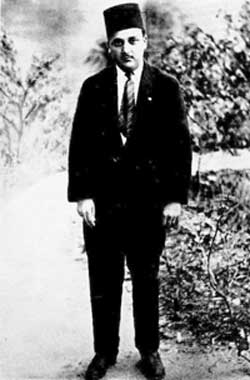
A retelling based on Shoghi Effendi's letter The Advent of Divine Justice, quoting its own words.
On 25 December 1938 Shoghi Effendi wrote a long letter to the Bahá'ís of the United States and Canada. It was published in 1939 as The Advent of Divine Justice. In it he set out the spiritual qualities the American Bahá'í community would need in order to carry out the work 'Abdu'l-Bahá had entrusted to it.
One of these was freedom from racial prejudice, "the corrosion of which, for well-nigh a century, has bitten into the fiber, and attacked the whole social structure of American society." The Guardian wrote that it "should be regarded as constituting the most vital and challenging issue confronting the Bahá'í community at the present stage of its evolution."
Both races, he wrote, had their part. To the white believers he said:
Let the white make a supreme effort in their resolve to contribute their share to the solution of this problem, to abandon once for all their usually inherent and at times subconscious sense of superiority, to correct their tendency towards revealing a patronizing attitude towards the members of the other race…
He asked the Black believers for "a corresponding effort," to show "the warmth of their response, their readiness to forget the past, and their ability to wipe out every trace of suspicion that may still linger in their hearts and minds." And to both he wrote: "Let neither think that the solution of so vast a problem is a matter that exclusively concerns the other."
He went further. Every Bahá'í community, he wrote, should regard it as "its first and inescapable obligation to nurture, encourage, and safeguard every minority belonging to any faith, race, class, or nation within it." He then gave a concrete rule:
So great and vital is this principle that in such circumstances, as when an equal number of ballots have been cast in an election, or where the qualifications for any office are balanced as between the various races, faiths or nationalities within the community, priority should unhesitatingly be accorded the party representing the minority, and this for no other reason except to stimulate and encourage it, and afford it an opportunity to further the interests of the community.
He added that nothing short of "genuine love, extreme patience, true humility, consummate tact, sound initiative, mature wisdom, and deliberate, persistent, and prayerful effort" could succeed in removing the stain that this evil had left on the name of their country.
A retelling based on The Advent of Divine Justice. For the fuller account, see the original.
Cite this story
Effendi, S.. (1939). *The Advent of Divine Justice*. Bahá'í Publishing Trust.
Record yourself reading this story
Recording stays on this device only. Nothing is uploaded.
Related stories
Father Dunn, Pioneer to Australia
In 1920 Hyde Dunn, then in his sixties, and his wife Clara answered 'Abdu'l-Bahá's call and settled in Australia. Working as a travelling salesman, he carried the Bahá'í message to hundreds of towns, and the couple became known as "Father" and "Mother" Dunn.
Four Times Around the World
From 1919 until her death in Honolulu in 1939, Martha Root travelled four times around the world teaching the Bahá'í Faith, from South American cities to the palace of Queen Marie of Romania. Shoghi Effendi called her the foremost Hand of the first Bahá'í century.
The Life of ‘Abdu’l-Bahá
A biography of ‘Abdu’l-Bahá, from His childhood in Tehran and long years of exile and imprisonment to His ministry as Center of the Covenant, His journeys to the West, His writings and His passing in Haifa in 1921.
Louis George Gregory
Born in Charleston to formerly enslaved parents, Louis G. Gregory became a Bahá'í in 1909, was seated by 'Abdu'l-Bahá at His right in Washington, gave decades to teaching and race unity, and was posthumously named a Hand of the Cause.