Martha Root and Queen Marie of Romania
Shoghi Effendi, God Passes By, (1944), Bahá'í Publishing Trust · Read original
When in Bahá'í history
Bucharest (today: Bucharest, Romania)
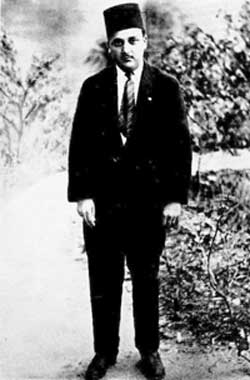
A retelling based on God Passes By by Shoghi Effendi, which records Queen Marie's recognition of the Faith and Martha Root's part in it. Words in quotation marks are quoted from that book, including the Queen's own words as it gives them.
Martha Root was the first to arise, in 1919, in response to 'Abdu'l-Bahá's Tablets of the Divine Plan. For twenty years she travelled almost without a break, four times around the globe, carrying the Message of Bahá'u'lláh to kings, queens, presidents, professors and people of every kind. Shoghi Effendi calls her "that archetype of Bahá'í itinerant teachers."
When she arrived in Bucharest in January 1926, she sent a note to Queen Marie of Romania, together with a copy of Bahá'u'lláh and the New Era. The Queen, a granddaughter of Queen Victoria, read the book into the small hours of the morning. Two days later, on 30 January 1926, she received Martha Root at Controceni Palace, and in that audience she said she believed that "these teachings are the solution for the world's problems." It was the first of eight audiences between them over the next ten years.
The Message reached the Queen at a hard time in her life. "It came," she later wrote, "as all great messages come, at an hour of dire grief and inner conflict and distress, so the seed sank deeply."
That same year, on her own initiative, Queen Marie published three testimonies to the Faith. They appeared in nearly two hundred newspapers in the United States and Canada and were later translated and published in Europe, China, Japan, Australia and the Near East. In the first she wrote that the writings of Bahá'u'lláh and 'Abdu'l-Bahá are "a great cry toward peace, reaching beyond all limits of frontiers, above all dissensions about rites and dogmas." She urged her readers: "If ever the name of Bahá'u'lláh or 'Abdu'l-Bahá comes to your attention, do not put their writings from you." In a later appreciation she wrote: "The Bahá'í teaching brings peace to the soul and hope to the heart."
She went on reading, and she knew that some disapproved. "Some of those of my caste," she wrote in a personal letter, "wonder at and disapprove my courage to step forward pronouncing words not habitual for crowned heads to pronounce, but I advance by an inner urge I cannot resist." On a visit to the Near East she passed through Haifa with her youngest daughter, Princess Ileana, intending to visit the Bahá'í Shrines, but was denied the pilgrimage she had planned. In June 1931 she wrote to Martha Root: "Both Ileana and I were cruelly disappointed at having been prevented going to the holy Shrines." At an audience in 1936 she spoke to Martha Root of the Kitáb-i-Íqán and of Gleanings from the Writings of Bahá'u'lláh, which she called a wonderful book.
Shoghi Effendi writes that, of all Martha Root's services to the Cause, this response of the Queen was "the most superb and by far the most momentous." He adds that she "may well deserve to rank as the first of those royal supporters of the Cause of God who are to arise in the future." She died in July 1938.
This is a retelling. For the fuller account, see God Passes By by Shoghi Effendi.
Cite this story
Effendi, S.. (1944). *God Passes By*. Bahá'í Publishing Trust. https://www.bahai.org/library/authoritative-texts/shoghi-effendi/god-passes-by/
Record yourself reading this story
Recording stays on this device only. Nothing is uploaded.
Related stories
Four Times Around the World
From 1919 until her death in Honolulu in 1939, Martha Root travelled four times around the world teaching the Bahá'í Faith, from South American cities to the palace of Queen Marie of Romania. Shoghi Effendi called her the foremost Hand of the first Bahá'í century.
The Tablets of the Divine Plan
During the First World War 'Abdu'l-Bahá wrote fourteen Tablets to the Bahá'ís of the United States and Canada, giving them a mission to carry the Faith to every land. They were unveiled in New York in April 1919.
Mírzá Ḥaydar-'Alí, Angel of the Believers
In a 1922 talk printed in the Star of the West, Martha Root remembered Mírzá Ḥaydar-'Alí, who endured years of prison, set out as a very old man from the Holy Land for Persia without even a donkey, and was called the Angel of the believers.
The Dunns Carry the Faith to Australia
Moved by the Tablets ‘Abdu’l-Bahá sent to America in 1919, Mr. and Mrs. Hyde Dunn left California for Australia with barely fifteen dollars. Martha Root later found Bahá'í centers wherever they had lived, and was struck by their humility and faith.