The Crumbling of Religious Orthodoxy
Shoghi Effendi, The Promised Day Is Come, (1941), Bahá'í Publishing Trust
When in Bahá'í history
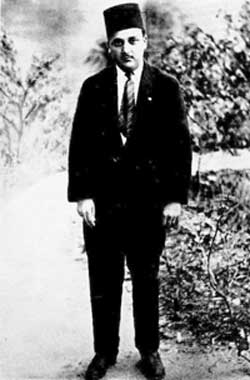
A retelling based on The Promised Day Is Come by Shoghi Effendi. The words in quotation marks are his.
In The Promised Day Is Come, the long letter Shoghi Effendi addressed on 28 March 1941 to the Bahá'ís of the West, a section titled "The Crumbling of Religious Orthodoxy" follows his survey of the fall of kings. "The decline in the fortunes of the crowned wielders of temporal power," he writes, "has been paralleled by a no less startling deterioration in the influence exercised by the world's spiritual leaders."
He sums up the parallel in a single line: "The glory of the former has been eclipsed, the power of the latter irretrievably lost."
The ecclesiastical leaders, like the sovereigns, had been "appealed to, warned, and reproved by Bahá'u'lláh." And they, "more particularly the heads of Muslim ecclesiastical orders," had joined with despots in assailing the Faith. The Guardian lays the heaviest responsibility on the divines of Persia, "the first who hoisted the standard of revolt," who instigated the banishments, executions and massacres that fill its early history. It was these divines, he writes, who by these very acts "sowed the seeds of the disintegration of their own institutions."
He then traces the process through its principal cases. In Persia, the Shí'ih hierarchy that had once "held in thrall" the Faith of God found itself the prey of a superior civil authority; its mujtahids were reduced to "a deplorably insignificant number," and its clerics were forced to exchange their turbans and robes for European dress. In Turkey, the Caliphate that had been joined to the Ottoman Sultanate for more than four hundred years was extinguished, and the ex-caliph was driven into exile.
In Christendom, he recalls Bahá'u'lláh's Tablet to Pope Pius IX and the loss, in 1870, of Rome and the Papal States, after which Pius IX became "the first prisoner of the Vatican." The Lateran Treaty had restored only a temporal sovereignty "practically confined to the miniscule City of the Vatican." He enumerates further blows: the separation of Church and state in France; the assault in Soviet Russia on the Greek Orthodox Church, which "pulled down, closed, or converted into museums, theatres and warehouses, thousands upon thousands of churches, monasteries, synagogues and mosques"; the dismemberment of the Austro-Hungarian Monarchy; the divorce of the Spanish state from the Church; the persecution of the Church in Mexico; and the heavy blows dealt to "Catholic, Anglican, and Presbyterian Missions in Persia, Turkey, and the Far East."
This process, he writes, "is still operating with undiminished force." He saw the war then raging, with "Anglicans pitted against Lutherans, Catholics against Greek Orthodox," as "a sorry spectacle of impotence and disruption" to those already perceiving "the bankruptcy of the institutions that claim to speak in the name, and to be the custodians, of the Faith of Jesus Christ."
A retelling based on The Promised Day Is Come. For the fuller account, see the original.
Cite this story
Effendi, S.. (1941). *The Promised Day Is Come*. Bahá'í Publishing Trust.
Record yourself reading this story
Recording stays on this device only. Nothing is uploaded.
Related stories
The Fall of the Monarchies
In The Promised Day Is Come, Shoghi Effendi surveys the fall of the great monarchies of Europe and the Middle East between 1870 and 1925, reading the collapses in the light of the warnings Bahá'u'lláh had sent to those same sovereigns from Adrianople and 'Akká.
A Tempest Sweeping the Earth
In The Promised Day Is Come, written in 1941 during the Second World War, Shoghi Effendi described the upheaval of his time as a judgment of God, at once a punishment and a cleansing, and as the birth pangs of a new Order.
The Most Vital and Challenging Issue
In The Advent of Divine Justice, Shoghi Effendi called racial prejudice the most vital and challenging issue before the American Bahá'ís, asked both races for a supreme effort, and gave minorities priority when votes or qualifications were equal.
Epilogue: The Faith from 1951 to 1979
Under the inspired guidance of Shoghi Effendi the Bahá’í Cause grew steadily in size and in the establishment of its Administrative Order, so that by 1951 there were eleven functioning National Spiritual Assemblies.