A Tempest Sweeping the Earth
Shoghi Effendi, The Promised Day Is Come, (1941), Bahá'í Publishing Trust
When in Bahá'í history
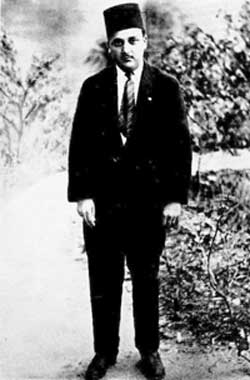
A retelling based on The Promised Day Is Come by Shoghi Effendi. The words in quotation marks are quoted from that book.
On March 28, 1941, during the Second World War, Shoghi Effendi wrote a long letter "to the beloved of God and the handmaids of the Merciful throughout the West." It was published as The Promised Day Is Come, and it opens:
A tempest, unprecedented in its violence, unpredictable in its course, catastrophic in its immediate effects, unimaginably glorious in its ultimate consequences, is at present sweeping the face of the earth.
Humanity, he writes, "can neither perceive its origin, nor probe its significance, nor discern its outcome." He calls the upheaval a judgment of God, "both a retributory calamity and an act of holy and supreme discipline." Mankind was "being simultaneously called upon to give account of its past actions, and is being purged and prepared for its future mission."
Shoghi Effendi writes that the followers of Bahá'u'lláh "know full well whence it comes, and what it will ultimately lead to." They "ardently pray for the mitigation of its severity, intelligently labor to assuage its fury, and anticipate, with undimmed vision, the consummation of the fears and the hopes it must necessarily engender."
He describes the age as one witnessing "a dual phenomenon." One part is "the death pangs of an order, effete and godless," which had refused, despite the signs and portents of "a century-old Revelation," to attune itself to that Faith's precepts. The other is "the birth pangs of an Order, divine and redemptive," that will take its place.
Much of the letter recalls how Bahá'u'lláh had addressed the rulers of His day, among them Napoleon III, Pope Pius IX, Czar Alexander II, Queen Victoria, William I of Germany, Francis Joseph of Austria, Sulṭán 'Abdu'l-'Azíz and Náṣiri'd-Dín Sháh, as well as the religious leaders of Islám and Christendom, and traces what befell them and their institutions.
The letter also looks ahead. Shoghi Effendi quotes Bahá'u'lláh's words that "these great oppressions" are "preparing it for the advent of the Most Great Justice," and adds that this is the Justice upon which "the structure of the Most Great Peace can alone, and must eventually, rest."
This is a retelling. For the fuller account, see The Promised Day Is Come by Shoghi Effendi.
Cite this story
Effendi, S.. (1941). *The Promised Day Is Come*. Bahá'í Publishing Trust.
Record yourself reading this story
Recording stays on this device only. Nothing is uploaded.
Related stories
The Fall of the Monarchies
In The Promised Day Is Come, Shoghi Effendi surveys the fall of the great monarchies of Europe and the Middle East between 1870 and 1925, reading the collapses in the light of the warnings Bahá'u'lláh had sent to those same sovereigns from Adrianople and 'Akká.
The Crumbling of Religious Orthodoxy
In The Promised Day Is Come, Shoghi Effendi traces the loss of power of the religious hierarchies of Islám and Christendom, which he sees as paralleling the fall of the kings whom Bahá'u'lláh had also addressed.
The Most Vital and Challenging Issue
In The Advent of Divine Justice, Shoghi Effendi called racial prejudice the most vital and challenging issue before the American Bahá'ís, asked both races for a supreme effort, and gave minorities priority when votes or qualifications were equal.
Epilogue: The Faith from 1951 to 1979
Under the inspired guidance of Shoghi Effendi the Bahá’í Cause grew steadily in size and in the establishment of its Administrative Order, so that by 1951 there were eleven functioning National Spiritual Assemblies.