The Cloak Off His Own Back: 'Abdu'l-Bahá and the Hostile Official
Lady Blomfield, The Chosen Highway, (1940), Bahá'í Publishing Trust
When in Bahá'í history
'Akká (today: Acre, Israel)
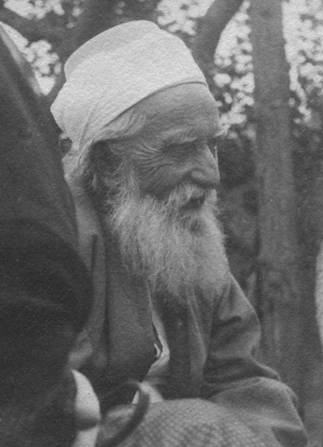
A retelling based on The Chosen Highway by Lady Blomfield, which preserves the recollections of the Holy Family and of those who lived near 'Abdu'l-Bahá in the years of His confinement. The lines in quotation marks are words preserved in that history.
Among the many burdens 'Abdu'l-Bahá carried through the long decades of His imprisonment in 'Akká was a particular kind of trial that no walls or chains could account for: the cruelty of certain individuals who held office over Him and chose to use their position to make His captivity as bitter as they could. Some of the officials set over the prisoners were just men, and a few were even kind. But others listened more readily to the Master's enemies than to His friends, and one such man — an official whose office gave him real power over the conditions of the confinement — set himself to harass 'Abdu'l-Bahá by every means within his reach.
This man's hostility was not a passing mood. The Chosen Highway records that he worked steadily against the Master: bringing false accusations, spreading slander, tightening the rules of the prison so that life grew harder for everyone within it, and stationing soldiers to watch all those who tried to approach 'Abdu'l-Bahá, so as to prevent them from reaching Him. To meet such a man with patience over weeks and months is a discipline of its own; to meet him with positive kindness, while the persecution is still in full course, is something rarer.
It must be remembered what 'Abdu'l-Bahá's circumstances were in those years. He had been a prisoner since boyhood, swept up at the age of nine into the exile of His Father and never since restored to freedom. The walls of 'Akká were His whole world; the officials who governed the city governed the conditions of His existence. A hostile man in such a post could make the difference between a captivity that was merely hard and one that was cruel — could cut the prisoners off from the friends who sustained them, could choke the trickle of resources on which the household depended, could poison the minds of higher authorities with false reports. It was no small thing, then, to have such an official set against Him. And yet, across all the recollections preserved of those years, there is no trace of the Master meeting that enmity in kind. The bitterness was all on one side. From His side came, again and again, only forbearance — and, when the occasion offered, generosity.
It was in the midst of this campaign of harassment that the official made a remarkable demand. He let it be known that he wanted one of the Master's cloaks — an 'abá, the long outer garment that a man in that country wore against the cold and the sun. 'Abdu'l-Bahá's answer was disarming in its simplicity. "I have only this 'abá, which I am wearing," He told him, "I will gladly give it to you." He owned but the one. He kept little for Himself — a single coat, the plainest of provision — so that whatever could be spared might go to others. And the one He had, He offered freely to the very man who was working to make His life unbearable.
But the official was not satisfied. He replied that he did not care for that 'abá — it was not fine enough — and that he wanted a better one. The Master answered with the same gentleness: "I do not possess a better one, but if you wish, I will give you money to buy a good 'abá for yourself." Even this did not content the man. And so 'Abdu'l-Bahá promised to send and buy a new cloak for him — and, in the meantime, let him keep the only one He had. The Master would go without, that His persecutor might be clothed twice over.
Such was the Master's kindness, the account observes — disregarding always the bitter persecution that was being directed against Himself. There is something almost bewildering in the arithmetic of it. The man had given 'Abdu'l-Bahá nothing but slander and obstruction; he had hardened the prison rules, set guards to keep the friends away, and accused Him falsely before the authorities. By every ordinary reckoning, he had earned nothing from the Master but a closed door. What he received instead was the coat off 'Abdu'l-Bahá's own back, and the promise of a finer one besides.
This was not naïveté on the Master's part, as though He failed to understand what the man was doing. He understood perfectly; the persecution was plain, and it continued without pause even as the kindness was extended. The forgiveness was a deliberate act, offered with eyes open. 'Abdu'l-Bahá forgave all the evil that was done to Himself. The wrong aimed at His own person He simply set aside, again and again, refusing to let the malice of another govern His own conduct.
It is worth noticing where the Master's forgiveness stopped — for it reveals that this was mercy with understanding, not mere indifference to wrongdoing. The people of the surrounding region were not so ready as 'Abdu'l-Bahá to overlook the official's behavior. In time the man's own conduct undid him. While he was busy working evil against the Master, the account relates, he gave offense to a fellow official, who in turn denounced him to the Vali — the governor — of Beirut, charging him with treacheries. Among the accusations was the strange claim that he possessed a book by which he professed to foretell future events, and that he had used it to prophesy that the Sultanate itself would not endure beyond two years. Such a charge was bound to rouse the suspicions of the authorities. The Vali sent an escort of soldiers to arrest the faithless servant, to seize all his possessions and papers — including the supposed book of prophecies — and to bring him and his belongings to Beirut. So the man who had set guards to watch the Master found soldiers at last sent to fetch himself.
When his downfall came, the people did not mourn it; they rejoiced. They had seen his cruelty and were glad to be rid of him. The Master's response was different in kind. He had forgiven the evil done to Himself; that was His own to forgive, and He had let it go entirely. The harm the man had done to others, and the justice that finally overtook him through the ordinary workings of the government he had served so badly, belonged to a different reckoning — one that 'Abdu'l-Bahá did not need to pursue, because He had never been seeking revenge in the first place. He had not lifted a finger against the man; He had only given him a cloak.
What the episode of the cloak preserves, in a single small transaction over a garment, is the whole shape of the Master's mercy in the prison years. He did not wait for His enemies to deserve kindness before He showed it. He did not measure out His generosity according to how He was being treated. He met persecution with gifts, slander with patience, and the demand of a hostile man with an open hand — giving away the only cloak He owned, and promising more, to the very person laboring to make His captivity a torment. The man went on speaking evil of Him afterward; the kindness had not bought him off, and was never meant to. It was simply what 'Abdu'l-Bahá was — the kind of heart that, asked for its coat by an enemy, hands it over with the words, "I will gladly give it to you."
This is a retelling. For the fuller account, see The Chosen Highway by Lady Blomfield.
Cite this story
Blomfield, L.. (1940). *The Chosen Highway*. Bahá'í Publishing Trust.
Record yourself reading this story
Recording stays on this device only. Nothing is uploaded.
Related stories
The Master and the Sultan's Commission
When a commission of the Ottoman government arrived in 'Akká empowered to recommend His exile or execution, 'Abdu'l-Bahá met the threat without a trace of fear. He declared His readiness to submit to any sentence they chose, refused a consul's offer of escape, and went on planting trees and presiding at a wedding feast — until the empire that menaced Him collapsed and He was set free.
Good for Evil: The Master and Those Who Wronged Him
Through the long years in 'Akká, 'Abdu'l-Bahá was surrounded not only by friends but by enemies — men who slandered Him, plotted against Him, and even schemed for His death. The recollections preserved in The Chosen Highway show how He answered them: with unfailing courtesy, with help sent quietly to their households, and with kindness returned for every injury — the perfection of a character that would not let another's evil change its own goodness.
SOME OF THE EXPERIENCES OF HIS FORTY YEARS IMPRISONMENT
In an apartment in Cadogan Gardens sits a spiritually illumined Oriental, whose recent advent in London marks the latest junction of the East and…
MAN AND NATURE
From the time of the creation of Adam to this day there have been two pathways in the world of humanity; one the natural or materialistic, the other the religious or spiritual. The pathway of nature is the pathway of the animal realm.…