The Clergyman's Long Question: George Townshend
Bahá'í Chronicles editors, Bahá'í Chronicles · Read original
When in Bahá'í history
Dublin (today: Dublin, Ireland)
A retelling drawn from Bahá'í Chronicles, which gathers the accounts of the servants of the Faith. Phrases in quotation marks are words or titles preserved in that record.
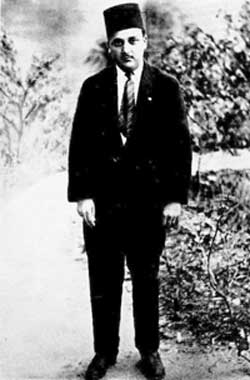
George Townshend was, by any worldly measure, a man who had arrived. Born in Dublin into a respected family, educated at Oxford, he had taken holy orders in the Anglican Church and risen steadily through its ranks. He served as a parish incumbent in the Irish countryside, became Archdeacon of Clonfert, and was made a Canon of St. Patrick's Cathedral in Dublin — the cathedral of Jonathan Swift. He was a gifted writer and a thoughtful student of scripture. He had a settled vocation, an honoured station, and the security that comes with both. He had, in short, every reason to leave well enough alone.
But Townshend was a man who took his own faith seriously enough to keep asking questions of it — and the central question of his life was a daring one for a Christian clergyman to entertain. The Gospels promised the return of Christ, the coming of the Kingdom, a Day of God at the end of the age. Townshend believed this promise. The question that would not let him go was simply: what if it has already happened? What if the long-awaited Day, prayed for in every church across the centuries, had actually dawned in the world — and the churches had not noticed?
He came upon the Bahá'í teachings and studied them with the care of a scholar and the seriousness of a believer. And what he found persuaded him. As early as 1921 George Townshend was, in his own heart and understanding, a Bahá'í — convinced that Bahá'u'lláh was indeed the Promised One of all ages, the fulfilment of the very prophecies he had preached from the pulpit. The question he had carried for years had, intellectually, been answered.
And yet — here is the hard, human heart of his story — knowing the answer and acting on it openly proved to be two very different things, separated by decades. For Townshend was not a free agent. He was an ordained minister of the Church, with a living, a family to support, and a public position bound up entirely with his clerical office. To declare himself a Bahá'í would mean surrendering all of it. So for many years he occupied a quiet, painful middle ground: serving the Church outwardly while believing, inwardly, that the Day it still awaited had already come. He worked, all the while, in secret service to the Faith — from 1926 he acted as a literary adviser to Shoghi Effendi, and his pen helped shape some of the most important Bahá'í books in English, including the introductions to Nabíl's The Dawn-Breakers and to God Passes By.
But a question honestly answered will not stay buried forever. It works on the conscience. And at last, in old age — when he was seventy years old — George Townshend did what he had long known he must do. He renounced his orders in the Anglican Church and stepped fully and openly into the Faith he had embraced in his heart a quarter of a century before. As his act of resignation he wrote a pamphlet addressed to all Christians, The Old Churches and the New World-Faith, laying out plainly the conclusion he had reached: that the promised Day had come, and that the churches were called to recognize it. He gave up rank, security, and the only public vocation he had ever known — to declare, at last and without reservation, the truth he had long held in silence.
The Faith honoured him. In 1951 Shoghi Effendi named George Townshend a Hand of the Cause of God. His later books — among them The Heart of the Gospel, The Promise of All Ages, and Christ and Bahá'u'lláh, the last of which he laboured to complete as he was dying — became cherished bridges for Christian seekers asking the very question he had once asked himself.
This is the searching that the Feast of Masá'il sets before us in its more demanding form. Some questions are answered in three days; some take a lifetime to live out. Townshend's mind was satisfied early, but his courage had to catch up to his conviction — and the long, costly distance he finally crossed, from private certainty to open avowal, is itself a kind of answer. It reminds us that to seek the truth honestly is only half the task. The other half is to obey it, however late, however dear the price.
This is a retelling. For the fuller account, see Bahá'í Chronicles.
Cite this story
editors, B. C.. *Bahá'í Chronicles*. https://bahaichronicles.org/george-townshend/
Record yourself reading this story
Recording stays on this device only. Nothing is uploaded.
Related stories
The Physician Who Did His Homework: Dr. Esslemont and the New Era
A Scottish doctor heard of the Bahá'í Faith in 1914 and did what a careful physician does with any new claim: he investigated it methodically. He read, he learned Persian, he wrote out what he understood — and then he travelled to Haifa and laid his manuscript before 'Abdu'l-Bahá Himself for correction. The book that resulted, Bahá'u'lláh and the New Era, has since carried answers to seekers in some sixty languages.
A Minister's Doubts: Howard Colby Ives and the Questions That Burned
Howard Colby Ives was a Unitarian minister with a restless, questioning mind and a heart full of unanswered longing. When he first encountered 'Abdu'l-Bahá in 1912, he did not believe — he struggled, argued inwardly, and held back for months. His memoir, Portals to Freedom, is the honest record of a thinking man's doubts slowly giving way, not to argument, but to a love that answered the questions beneath his questions.
Three Days of Questions: Thomas Breakwell in Paris
A young Englishman on his way to America stopped in Paris in the summer of 1901, was introduced to a Bahá'í teacher, and spent three days asking everything he needed to ask. His questions answered, he wrote a two-line letter of belief to 'Abdu'l-Bahá — and then faced one more question, about the source of his own income, that turned his new faith into action.
Louis George Gregory
Gregory was instrumental in arranging for two major speaking engagements for ‘Abdu’l-Bahá in Washington DC to an audience of more than a thousand in Rankin Chapel at Howard University, and that evening to a large gathering of the Bethel…