The Mother Temple of the West
Shoghi Effendi, God Passes By, (1944), Bahá'í Publishing Trust · Read original
When in Bahá'í history
Wilmette (today: Wilmette, Illinois, USA)
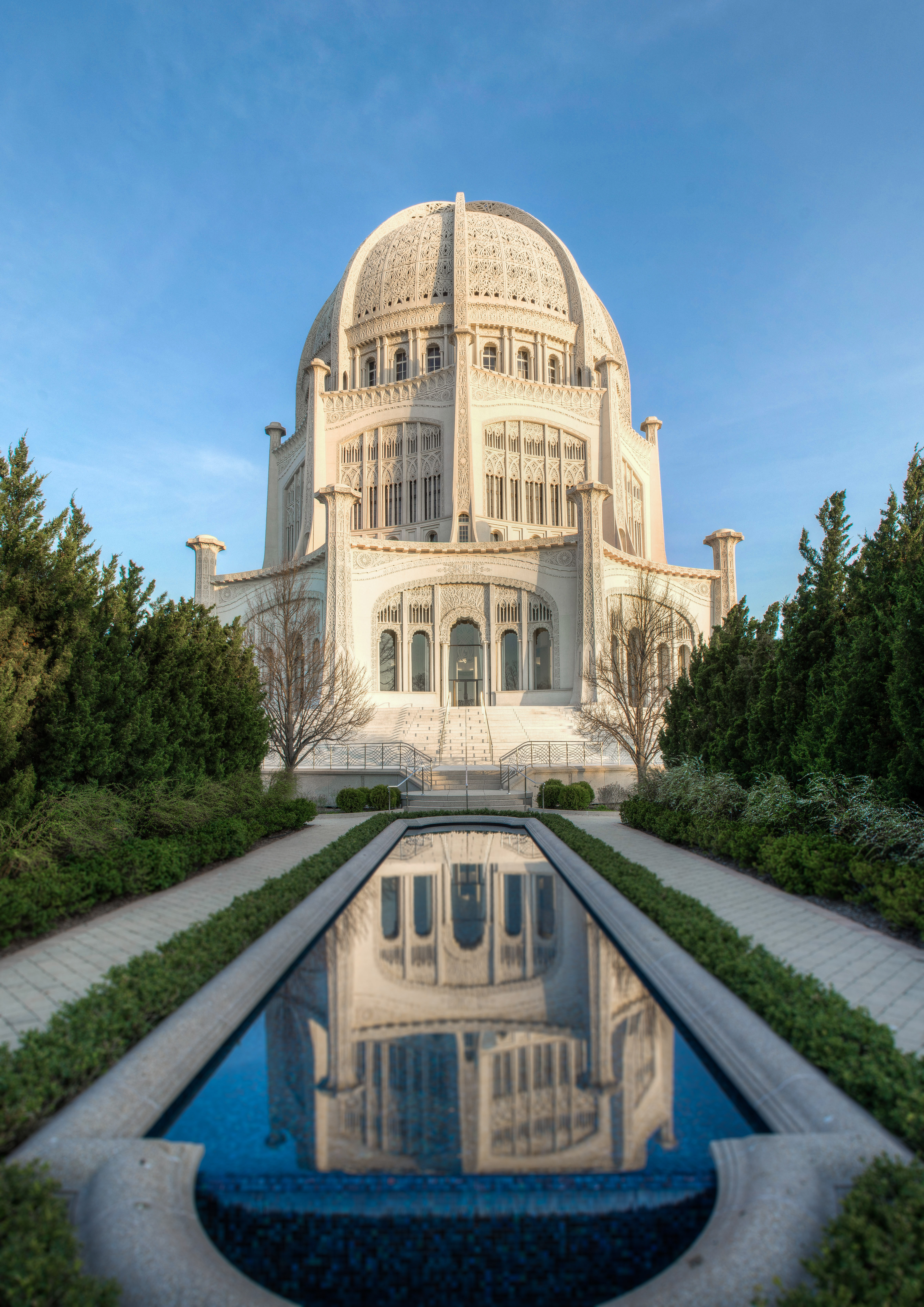
A retelling based on God Passes By by Shoghi Effendi, which tells the history of the first Mashriqu'l-Adhkár of the West up to 1944. Words in quotation marks are quoted from that book.
In March 1903 the House of Spirituality of the Bahá'ís of Chicago wrote to 'Abdu'l-Bahá asking permission to build a House of Worship. They had been inspired by the believers of 'Ishqábád, in Russian Turkistán, who had already begun the first Mashriqu'l-Adhkár of the Bahá'í world. In a Tablet revealed in June of that year 'Abdu'l-Bahá gave His approval, and the Chicago Bahá'ís, Shoghi Effendi writes, arose "despite the smallness of their numbers and their limited resources."
In November 1907 representatives of the American believers met in Chicago and appointed a committee of nine to find a site. By April 1908 two thousand dollars had been paid for two building lots near the shore of Lake Michigan. In March 1909 thirty-nine delegates from thirty-six cities met in Chicago and formed the Bahá'í Temple Unity to hold the property and raise the Temple. They met on the very day that 'Abdu'l-Bahá laid the remains of the Báb to rest on Mount Carmel.
In May 1912, during His journey through America, 'Abdu'l-Bahá visited the site and laid the dedication stone with His own hands. "Thousands of Mashriqu'l-Adhkárs," He declared, "... will be built in the East and in the West, but this, being the first erected in the Occident, has great importance." Of this House of Worship He also stated: "This organization of the Mashriqu'l-Adhkár will be a model for the coming centuries, and will hold the station of the mother."
The purchase of the land was completed in 1914. In 1920 the Convention chose the design of Louis Bourgeois, and 'Abdu'l-Bahá confirmed the choice. Nine great caissons were sunk to rock 120 feet below the ground. In August 1930, during an economic crisis and a time of unemployment "unparalleled in American history," the contract for the superstructure was placed. It was finished by 1 May 1931, and on that day, the nineteenth anniversary of 'Abdu'l-Bahá's dedication of the grounds, the first devotional service was held in the new building.
The ornamentation followed stage by stage: the dome from 1932 to 1934, the clerestory by 1935, the gallery by 1938, and the main story, begun in 1940 after the outbreak of war, by July 1942. The eighteen circular steps were in place by December 1942, forty years after the Chicago believers' petition. The building cost over a million dollars and was paid for by the American Bahá'í community, helped at times by believers in East and West of Christian, Muslim, Jewish, Zoroastrian, Hindu and Buddhist background.
Shoghi Effendi describes it as "a pure white nonagonal building," its ornamentation "cast into a design as delicate as lace." It has nine entrances, one of them facing 'Akká, each with a quotation from the writings of Bahá'u'lláh above it. It is consecrated to worship alone, "devoid of all ceremony and ritual," and is to be joined in time by institutions of service around it: an orphanage, a hospital, a dispensary for the poor, a home for the incapacitated, a hostel for travelers and a college for the study of arts and sciences.
This is a retelling. For the fuller account, see God Passes By by Shoghi Effendi.
Cite this story
Effendi, S.. (1944). *God Passes By*. Bahá'í Publishing Trust. https://www.bahai.org/library/authoritative-texts/shoghi-effendi/god-passes-by/
Record yourself reading this story
Recording stays on this device only. Nothing is uploaded.
Related stories
No Golden Trowel
At the dedication of the Wilmette Temple site on 1 May 1912, ‘Abdu’l-Bahá set aside the golden trowel He was given and broke the ground with an ordinary axe and shovel.
The Temple Is Already Built
At the dedication of the Temple site in Wilmette on 1 May 1912, the golden trowel could not break the ground, so ‘Abdu’l-Bahá swung an axe. Women and people of many races then dug, and He declared the Temple already built.
Nettie Tobin's Stone
Nettie Tobin had no money to give, so she brought a stone the builders did not want to the land for a House of Worship. On May 1, 1912, 'Abdu'l-Bahá set her stone in the ground with His own hands.
The Golden Trowel
On a field beside a great lake, 'Abdu'l-Bahá dug the earth for the first stone of a House of Worship that still stands today, and friends from many lands took turns digging after Him.