A Question Outside the Khan
Rúhíyyih Khánum, The Priceless Pearl, (1969), Bahá'í Publishing Trust
When in Bahá'í history
How this story reached us
- 1.The Priceless Pearl, Chapter 1 "The Childhood and Youth of Shoghi Effendi", pp. 1-4, quoting the diary of Dr Yúnis Khán (narr/khanum_priceless_pearl.txt; wrapped copy narr/wrapped/khanum_priceless_pearl.txt lines 13-79)
A retelling based on The Priceless Pearl by Rúhíyyih Khánum, which quotes the diary of Dr Yúnis Khán. Words in quotation marks are as that book gives them.
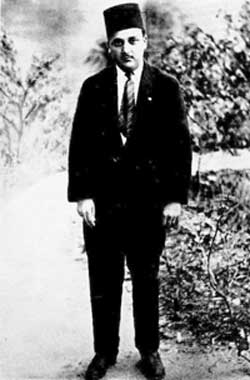
In 1897 Dr Yúnis Khán spent three months in 'Akká with 'Abdu'l-Bahá. It was a time when the clouds of Covenant-breaking were gathering ever thicker about the Master.
Perhaps because news had reached the West that a grandson had been born to 'Abdu'l-Bahá, a believer in America had written to Him about the verse in Isaiah, "a little child shall lead them." Did it mean, she asked, a real, living child? 'Abdu'l-Bahá had answered her in a Tablet: "Verily, that child is born and is alive and from him will appear wondrous things that thou wilt hear of in the future."
Yúnis Khán knew nothing of this. There was very little contact between the believers of East and West in those days, and Tablets passed among the American friends by copy or by word of mouth. He wrote in his diary that he heard of that Tablet only many years later. So when a letter reached him from America with a question to put to 'Abdu'l-Bahá, Yúnis Khán did not know what lay behind it.
He wrote: "'Abdu'l-Bahá was walking in front of the khan," the building in 'Akká where many of the believers used to stay. "I approached and told Him 'someone has written to me from America that we have heard the Master has said that the one whose appearance will follow me has recently been born and is in this world. If this is so we are answered, but if this is not so then -?"
"After waiting a moment, with a look full of meaning and secret exaltation, He said: 'Yes, this is true.'"
Yúnis Khán's soul rejoiced. He felt sure, he wrote, that the Covenant-breaking would come to naught and the Cause of God would triumph throughout the world. But what 'Abdu'l-Bahá meant by "appearance" was hard for him to understand, and remained a mystery to him. Seeking more, he asked: "Does this mean a revelation?"
A yes or a no, he wrote, would have created more complications and raised more questions. But the answer was "such as to silence any questioner." In even clearer words 'Abdu'l-Bahá said: "The triumph of the Cause of God is in his hands!"
Yúnis Khán wrote this answer to the believer in America. Then for many years he shared it with no one, and even in his own mind he refused to consider what it implied, or to ask himself whether the child was in 'Akká or somewhere else. He gave two reasons: Bahá'u'lláh, in the Book of His Covenant, had directed that all eyes must be turned to the Centre of the Covenant, 'Abdu'l-Bahá; and there was the mischief that for two generations had disrupted the family of the Manifestation of God.
His diary also records his first sight of the Master's eldest grandson, Shoghi Effendi.
"For many days the occupants of the Pilgrim House had begged the Afnan [Shoghi Effendi's father] to see Shoghi Effendi. One day, unexpectedly, this child of four months was brought to the biruni [reception room of the Master]. The believers approached him with joy and I too had this privilege, but I said to myself 'only look upon him as a Bahá'í child'. However I could not control my feelings because an inner force obliged me to bow low before him and for a moment I was bewitched by the beauty of this suckling child. I kissed the soft hair of his head and sensed such a power in him that I can find no words to express it, but only say he looked like the babe one sees in the arms of the Blessed Virgin."
For several days the child's face stayed before him; then gradually he forgot it. He had the same feeling twice more, once when the boy was nine and once when he was eleven. Only after he had seen, through Shoghi Effendi's babyhood and early childhood, the signs of his spirituality and unique character did Yúnis Khán confide to an old and trustworthy believer the words he had heard from 'Abdu'l-Bahá.
Until 'Abdu'l-Bahá passed away in November 1921, and His Will and Testament was found in His safe and opened and read, no one in the Bahá'í world knew that Shoghi Effendi had been appointed as His successor.
This is a retelling. For the fuller account, see The Priceless Pearl by Rúhíyyih Khánum.
Cite this story
Khánum, R.. (1969). *The Priceless Pearl*. Bahá'í Publishing Trust.
Record yourself reading this story
Recording stays on this device only. Nothing is uploaded.
Related stories
The Appointment of Shoghi Effendi as Guardian
In November 1921 Shoghi Effendi, a student at Oxford, learned in London that 'Abdu'l-Bahá had passed away. In January 1922 the Master's Will was read, naming him Guardian of the Cause of God.
The Young Guardian
Shoghi Effendi was a student in England when 'Abdu'l-Bahá passed away. He hurried home to Haifa, and his grandfather's Will named him Guardian of the Bahá'í Faith.
Sad News in London
While studying in England, Shoghi Effendi learned that his grandfather 'Abdu'l-Bahá had passed away; back home in Haifa, he learned from the Master's Will that he had been chosen as Guardian.
The Cable in London
In November 1921 Shoghi Effendi, a student at Oxford, learned from a cable in a London office that 'Abdu'l-Bahá had passed away; back in Haifa, the Master's Will told him he had been appointed Guardian.