Sutherland Maxwell's Recovery
bahaistories.com archive · Read original
When in Bahá'í history
Haifa (today: Haifa, Israel)
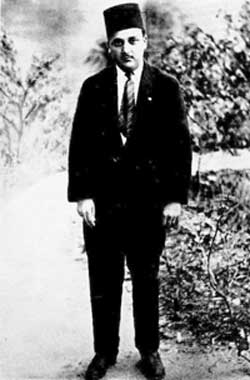
Rúḥíyyih Khánum writes of her father, Sutherland Maxwell, the architect of the Shrine of the Báb:
When my father fell desperately ill in the winter of 1949-50 his condition was despaired of by his doctors. He reached a point where he seemed to have no conscious mind left, could not recognize me, his only and idolized child, at all, and had no more control over himself than if he were six months old. If I had needed any convincing on the subject of whether man has a soul or not I received conclusive proof of its existence at that time. When Shoghi Effendi would come in to see my father, although he could not speak, and gave no conscious sign whatever of the Guardian's nearness, a flutter, a tremor, some reaction wholly ephemeral but nevertheless visible, would pass over him because of the very presence of Shoghi Effendi. It was so extraordinary and so evident that his nurse (the best in Haifa) also noticed it was greatly puzzled by it. It went against all laws of the mind, which, as it fades, remembers the distant past more vividly than the immediate past. Shoghi Effendi determined my father should not die. At his insistence, when no one, including me, had the slightest hope, we took him with his nurse to Switzerland, where he rapidly recovered under the care of our own doctor, a recovery so complete that a few weeks later, when his new Swiss nurse and I took him for his first drive and he caught sight of a cafe in the midst of a garden, he promptly invited us to go in and have tea with him - an offer I accepted with feelings of wonder and gratitude that are indescribable. It was after this healing had taken place that the Guardian, in a message to America sent in July 1950, reporting progress in the construction of the Shrine of the Báb, was moved to allude to these events: "My gratitude is deepened by the miraculous recovery of its gifted architect, Sutherland Maxwell, whose illness was pronounced hopeless by physicians."
Source: Rúhíyyih Khánum, The Priceless Pearl, pp. 155–156.
Collected from bahaistories.com (Subject: miracles).
Cite this story
Various. *bahaistories.com archive*. https://bahaistories.com/subject/miracles
Record yourself reading this story
Recording stays on this device only. Nothing is uploaded.
Related stories
Amatu’l-Bahá Rúḥíyyih Khánum
Mary Maxwell of Montreal married Shoghi Effendi on 25 March 1937 in a simple, private wedding; as Rúḥíyyih Khánum she later served as a Hand of the Cause and travelled to 185 countries and territories.
William Sutherland Maxwell
The Montreal architect William Sutherland Maxwell, husband of May Maxwell, spent his last years serving Shoghi Effendi in Haifa and designed the superstructure of the Shrine of the Báb.
Mary Maxwell's Quiet Wedding
Mary Maxwell, who grew up in Montreal, married Shoghi Effendi in Haifa in 1937 with no celebration and no elaborate ceremony. Known afterwards as Rúḥíyyih Khánum, she served the Faith for the rest of her life.
A Secret Wedding in Haifa
In 1937 Mary Maxwell of Montreal married Shoghi Effendi in Haifa. Almost no one knew beforehand, and there was no celebration, no wedding dress and no reception.