The Guardian's Simple Wedding
bahaistories.com archive · Read original
When in Bahá'í history
Haifa (today: Haifa, Israel)
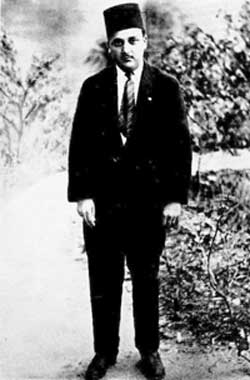
Amatu’l-Bahá Rúḥíyyih Khánum recalled her marriage to Shoghi Effendi, the Guardian, on 25 March 1937:
Surely the simplicity of the marriage of Shoghi Effendi — reminiscent of the simplicity of ‘Abdu’l-Bahá’s own marriage in the prison-city of ‘Akká — should provide a thought-provoking example to the Bahá’ís everywhere. No one, with the exception of his parents, my parents and a brother and two sisters of his living in Haifa, knew it was to take place. He felt strongly urged to keep it a secret, knowing from past experience how much trouble any major event in the Cause invariably stirred up. It was therefore a stunning surprise to both the servants and the local Bahá’ís when his chauffeur drove him off, with me beside him, to visit the Holy Tomb of Bahá’u’lláh on the afternoon of 25 March 1937. His heart drew him to that Most Sacred Spot on earth at such a moment in his life. I remember I was dressed, except for a white lace blouse, entirely in black for this unique occasion, and was a typical example of the way oriental women dressed to go out into the streets in those days, the custom being to wear black. Although I was from the West Shoghi Effendi desired me to fit into the pattern of the life in his house — which was a very oriental one — as naturally and inconspicuously as possible and I was only too happy to comply with his wishes in every way.
When we arrived at Bahjí and entered the Shrine he requested me to give him his ring, which I was still wearing concealed about my neck, and this he placed on the ring-finger of my right hand, the same finger that corresponded to the one of his own on which he himself had always worn it. This was the only gesture he made. He entered the inner Shrine, beneath the floor of which Bahá’u’lláh is interred, and gathered up in a handkerchief all the dried petals and flowers that the keeper of the Shrine used to take from the threshold and place in a silver receptacle at the feet of Bahá’u’lláh. After he had chanted the Tablet of Visitation we came back to Haifa and in the room of the Greatest Holy Leaf our actual marriage took place, as already mentioned.
Except for this visit, the day he told me he had chosen to confer this great honour on me, and one or two brief moments in the Western Pilgrim House when he came over for dinner, I had never been alone with the Guardian.
There was no celebration, no flowers, no elaborate ceremony, no wedding dress, no reception. His mother and father, in compliance with the laws of Bahá’u’lláh, signified their consent by signing our marriage certificate and then I went back to the Western Pilgrim House across the street and joined my parents (who had not been present at any of these events), and Shoghi Effendi went to attend to his own affairs. At dinner-time, quite as usual, the Guardian appeared, showering his love and congratulations on my mother and father. He took the handkerchief, full of such precious flowers, and with his inimitable smile gave them to my mother, saying he had brought them for her from the inner Shrine of Bahá’u’lláh. My parents also signed the marriage certificate and after dinner and these events were over I walked home with Shoghi Effendi, my suitcases having been taken across the street by Fujita while we were at dinner. We sat for a while with the Guardian’s family and then went up to his two rooms which the Greatest Holy Leaf had had built for him so long ago.
Source: Rúḥíyyih Khánum, The Priceless Pearl, pp. 151–152.
Collected from bahaistories.com (Subject: shoghi-effendi-marriage).
Cite this story
Various. *bahaistories.com archive*. https://bahaistories.com/subject/shoghi-effendi-marriage
Record yourself reading this story
Recording stays on this device only. Nothing is uploaded.
Related stories
Amatu’l-Bahá Rúḥíyyih Khánum
Mary Maxwell of Montreal married Shoghi Effendi on 25 March 1937 in a simple, private wedding; as Rúḥíyyih Khánum she later served as a Hand of the Cause and travelled to 185 countries and territories.
A Secret Wedding in Haifa
In 1937 Mary Maxwell of Montreal married Shoghi Effendi in Haifa. Almost no one knew beforehand, and there was no celebration, no wedding dress and no reception.
The Guardian's Quiet Wedding
Rúḥíyyih Khánum recalls her marriage to Shoghi Effendi on 25 March 1937: a visit to the Shrine of Bahá'u'lláh, a simple ceremony in the room of the Greatest Holy Leaf, and no celebration at all.
Rúḥíyyih Khánum First Meets the Guardian
On her first pilgrimage in 1923, the twelve-year-old Mary Maxwell stood guard at the door of her sleeping mother, May Maxwell, only to learn that the visitor she had challenged was Shoghi Effendi.