Dedicating the Temple Grounds at Wilmette
'Abdu'l-Bahá, The Promulgation of Universal Peace, (1922), Bahá'í Publishing Trust · Read original
When in Bahá'í history
Wilmette (today: Wilmette, Illinois, USA)
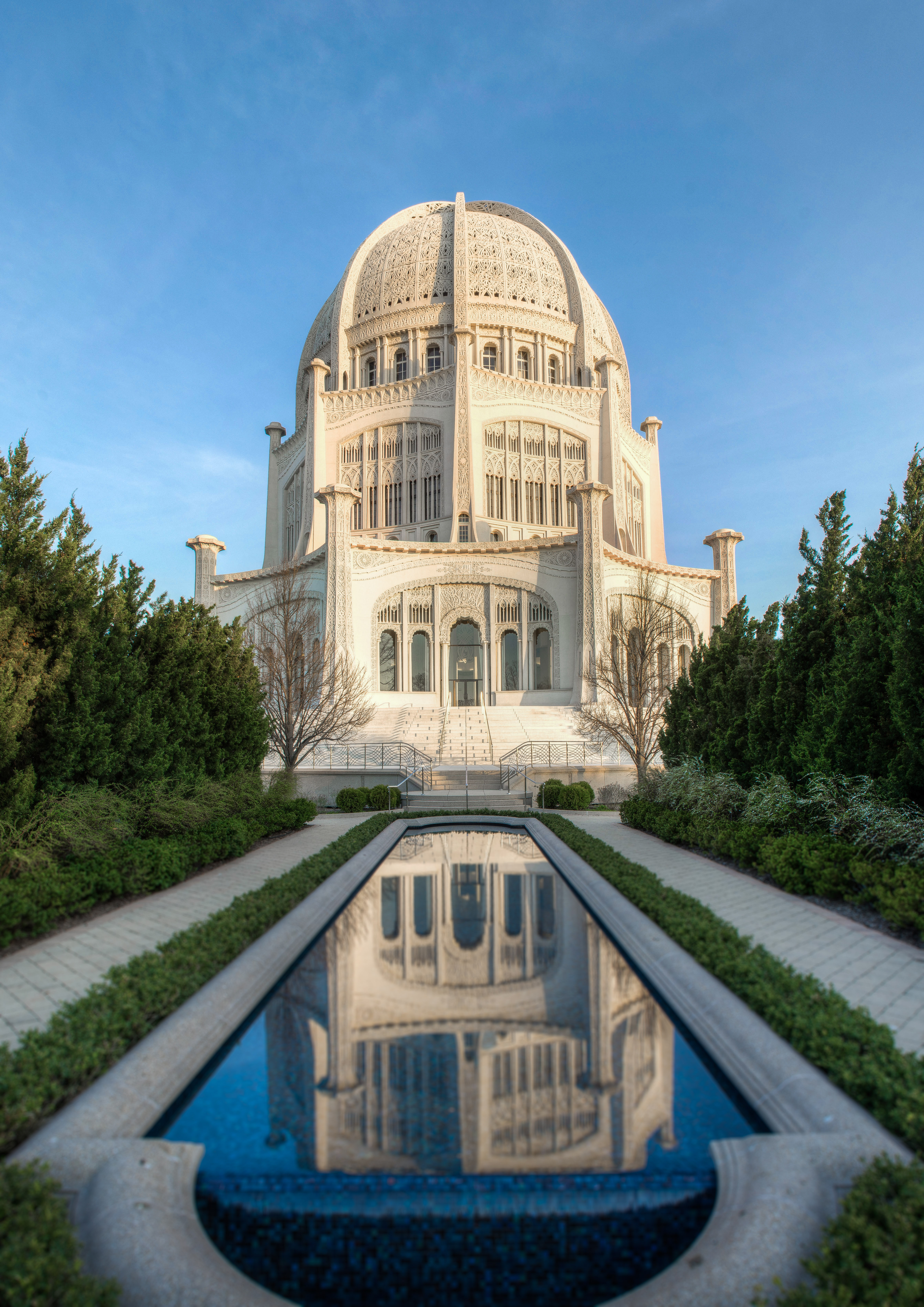
On May 1, 1912, ‘Abdu’l-Bahá addressed the friends who had gathered in a large tent on the land bought for the Mashriqu’l-Adhkár at Wilmette, Illinois, north of Chicago. Before entering the tent He drove around the site, inspecting its boundaries. After the talk He dug the earth for the foundation with a golden trowel, and when the digging was done He set in place, with His own hand, the stone that Nettie Tobin had brought.
The talk was taken down by Joseph H. Hannen. He began with the weather and the power that had brought the friends out in it.
The power which has gathered you here today notwithstanding the cold and windy weather is, indeed, mighty and wonderful.
He went on:
Thousands of Mashriqu’l-Adhkárs, dawning points of praise and mention of God for all religionists will be built in the East and in the West, but this, being the first one erected in the Occident, has great importance.
It had, He said, the same importance as the Mashriqu’l-Adhkár in ‘Ishqábád, the first one built, which was then almost completed. He described its design: nine avenues, nine gardens, nine fountains, all arranged according to the principle and proportion of the number nine. Around it, He said, they were now building a hospital, a school for orphans, a home for the disabled, a hospice and a large dispensary. I hope the Mashriqu’l-Adhkár in Chicago will be like this.
He closed with one specific instruction. The friends were to endeavor to make the grounds circular, adjusting and exchanging plots if possible.
The Mashriqu’l-Adhkár cannot be triangular in shape. It must be in the form of a circle.
The House of Worship at Wilmette was dedicated in 1953.
A retelling based on The Promulgation of Universal Peace (talk of 1 May 1912 at the Dedication of the Mashriqu’l-Adhkár Grounds, Wilmette, Illinois; notes by Joseph H. Hannen), with details from Mahmúd’s Diary and H. M. Balyuzi’s ‘Abdu’l-Bahá: The Centre of the Covenant. For the fuller account, see the original.
Cite this story
'Abdu'l-Bahá. (1922). *The Promulgation of Universal Peace*. Bahá'í Publishing Trust. https://www.bahai.org/library/authoritative-texts/abdul-baha/promulgation-universal-peace/
Record yourself reading this story
Recording stays on this device only. Nothing is uploaded.
Related stories
The Stone Refused by the Builder
Nettie Tobin, who was not well off, brought a builder's rejected stone to the Wilmette Temple site by baby carriage, streetcar and a borrowed wagon, and the Master used it at the dedication of the land.
No Golden Trowel
At the dedication of the Wilmette Temple site on 1 May 1912, ‘Abdu’l-Bahá set aside the golden trowel He was given and broke the ground with an ordinary axe and shovel.
The Temple Is Already Built
At the dedication of the Temple site in Wilmette on 1 May 1912, the golden trowel could not break the ground, so ‘Abdu’l-Bahá swung an axe. Women and people of many races then dug, and He declared the Temple already built.
Nettie Tobin's Stone
Unable to give money for the Temple, the Chicago seamstress Nettie Tobin hauled a discarded building stone to the Temple site in 1908; on May 1, 1912, ‘Abdu’l-Bahá used it when He dedicated the ground.