The Hand Upon My Head
Howard Colby Ives, Portals to Freedom, (1937), George Ronald · Read original
When in Bahá'í history
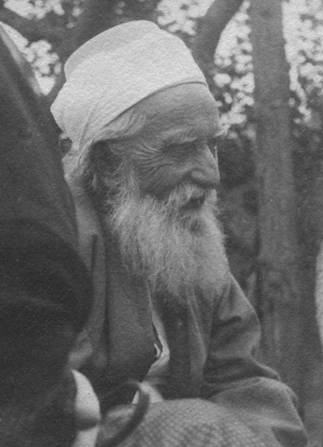
A retelling based on Portals to Freedom by Howard Colby Ives (George Ronald, 1937), chapter 14. The narrative is retold in our own words; the words in quotation marks are Ives's own. Read the full text for his telling.
On the morning of December 5, 1912, the S.S. Celtic lay in her slip in New York harbor, ready to carry 'Abdu'l-Bahá away from America. At least a hundred of the friends crowded into a large, low-ceilinged saloon cabin to say goodbye. The Persians who had travelled with Him stood grouped behind Him.
When the Master had finished a brief talk, He asked everyone to come to Him so that He might take their hands in parting. They passed in front of Him one by one. To each He gave a handful of the flowers massed near Him, until none were left, and to each He spoke a few words of love and encouragement.
Howard Colby Ives had come to know 'Abdu'l-Bahá in New York that year. When his turn came, he thought only that he would never see Him or hear His voice again in this world. He dropped to one knee, raised the Master's hand with his own and placed it on his head. He wrote:
"Never shall I forget the relaxation of that arm and hand. It made no move of itself. It was a dead weight in my clasp. But His face was illumined with transcendent light."
For Ives, this was his "final, indelible impression of that supreme humility, evanescence, servitude and love" that he had seen in everything 'Abdu'l-Bahá did.
The friends then gathered on the wharf and watched as the ship moved slowly out into the river. 'Abdu'l-Bahá stood at the rail, the breeze moving His white hair and beard, the rosary He always carried in His hand. Ives could read His lips: "Alláh'u'Abhá!" God the Most Glorious.
This account is retold for the Bahai Story Library; it is a paraphrase, not the original text. The quoted words are from Portals to Freedom (Howard Colby Ives, George Ronald, 1937), chapter 14. See the source for Ives's complete telling.
Cite this story
Ives, H. C.. (1937). *Portals to Freedom*. George Ronald. https://bahai-library.com/ives_portals_freedom
Record yourself reading this story
Recording stays on this device only. Nothing is uploaded.
Related stories
The Heart That Speaks
Howard Colby Ives wished he could meet 'Abdu'l-Bahá alone, without even an interpreter. At a crowded New York hotel, 'Abdu'l-Bahá called him over, sent everyone out, and sat with him in silence.
The Hand That Did Not Move
Saying goodbye to 'Abdu'l-Bahá on the ship that took Him from America, Howard Colby Ives knelt and placed the Master's hand on his head. He never forgot how still that hand lay.
The Minister the Master Beckoned
Howard Colby Ives, an unhappy minister, met 'Abdu'l-Bahá in New York in 1912. Months of study and turmoil followed, and when his Brotherhood Church had to close, 'Abdu'l-Bahá wrote to him that it had happened to free him to call people to the Kingdom.
The Master at the Brotherhood Church
On May 19, 1912, 'Abdu'l-Bahá spoke on brotherhood at the Brotherhood Church in Jersey City, where Howard Colby Ives was the unpaid minister. Ives, who had named the church, felt ashamed of how little he had lived the word.