On the night of 20 August, a horrifying young man came to a meeting at the Kinney's house
bahaistories.com archive · Read original
When in Bahá'í history
'Akká (today: Acre, Israel)
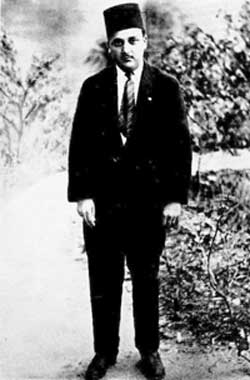
On the night of 20 August, a horrifying young man came to a meeting at the Kinney's house. From head to foot he was covered with soot. His blue eyes stared out from a dark gray face. This was Fred Mortensen, a reformed criminal. When he was young Fred had got into all kinds of trouble, determined to be "as tough as any". One day, Fred and his gang saw some bananas in a shop window and thought that they looked really good. Fred later wrote, "About this time I heard a dog barking inside the store, and looking in, I saw a large bulldog. That seemed to aggravate me, and, to show my contempt for the watchdog . . . I broke the window, took the bananas, and passed them around . . . It cost me $16 to pay for broken Windows, to keep out of jail." But in 1904, Fred's brothers and gang decided to rob a train. Fred's younger brother stole a big bag of mail. Then Fred spotted the police racing up, so the gang split in all directions. Fred didn't think his younger brother could outrun the police while carrying the bag of mail, so he took it and ran. His brother escaped, but that left the police to chase him. "In my haste to get away from them, I leaped over a 35 foot wall, breaking my leg, to escape the bullets whizzing around about and wound up in the garden at the feet of the Beloved". At Fred's trial he was defended by Albert Hall, who introduced him to the Faith: "It was he who brought me from out the dark prison house; it was he who told me, hour after hour, about the great love of ‘Abdu’l-Bahá for all his children and that he was here to help us show that love for our fellowmen. Honestly, I often wondered then what Mr. Hall meant when he talked so much about love, God's love, Bahá’u’lláh's love, ‘Abdu’l-Bahá's love, love for the Covenant, love for us, from us to God, to his prophets, etc. I was bewildered.
Fred's great-grandson, Justin Penoyer writes: Because Fred could not read at this time, Hall gave him a dictionary to use in order to read a Bahá’í book, also provided by Hall. With these new books, Fred taught himself how to read. For reasons even he did not completely understand that the time, Fred's experience in jail had a profound impact. However, as soon as he was able to walk, Fred decided it was time to leave. While in jail, he lured the guard close enough to his cell to take him by the neck, strangle him to unconsciousness, and take the keys. Fred spent the next four years as a fugitive. He fled first to California, where he worked for the Oakland paper. After experiencing the great earthquake of 1906 . . . Fred decided the Midwest was a far safer region. He then toured the Dakotas, moving from town to town, occasionally finding employment with local papers. It was during this time that Fred rediscovered the book given to him by Albert Hall. Yet unlike four years prior, . . . His mind became fixated upon the words of ‘Abdu’l-Bahá. Though faced with possible arrest, in 1910, he returned to Minneapolis to visit Hall . . . to learn more about the Bahá’í Faith: "I returned to become more bewildered, so I thought; and I wondered why." Fred was in regular communication with Albert Hall who, despite his status as an attorney, did not turn them into the police. This, combined with Fred's surprise that a complete lack of attention given by the authorities, gave the impression that he need no longer fear prosecution for his jailbreak. No longer a fugitive, Fred moved to Minneapolis. When he heard that ‘Abdu’l-Bahá was at Green Acre, and that he might go back to his home (Palestine) and not come West, I immediately determined to go and see him. I wasn't going to miss meeting ‘Abdu’l-Bahá after waiting so long to see Him . . . So I left home, going to Cleveland. Despite his enthusiasm, Fred was anxious about meeting ‘Abdu’l-Bahá. After all, who was he, a poor man with dubious history, to meet one such as ‘Abdu’l-Bahá? Yet the night before he left Cleveland, Fred had a dream: I was ‘Abdu’l-Bahá's guest; that I Sat at a long table, and many others were there, too, and of how He walked up and down telling stories, emphasizing with His hand. This, later, was fulfilled and He looked just as I saw Him in Cleveland. Because his funds were low, Fred had to hobo his way to Green Acre. Trains ran, at this time, on coal power; coated with soot and grime, were filthy outside the travelers compartments. This was not only most unpleasant, but also dangerous and exhausting. "Riding the rods", as it was known, Fred hopped a coal train on the Nickel Plate Railway from Cleveland to Buffalo, New York. He arrived around midnight, where he then jumped a train headed for Boston, arriving around nine next morning. Fred continues the story: "The Boston and Maine railway was the last link between ‘Abdu’l-Bahá, and the outside world so it seemed to me, and when I crawled off from the top of one of its passenger trains at Portsmouth, New Hampshire, I was exceedingly happy. A boat ride, a street car ride, and there I was, at the gate of Paradise. My heart beating double time . . . I had a letter of introduction from Mr. Hall to Mr. Lunt, and in searching for him, I met Mrs. Edward Kinney, who, dear soul, was kind enough to offer me a bed. She awakened me next morning about six o'clock, saying I'd have to hurry if I wished to see ‘Abdu’l-Bahá. Arriving at the hotel, I found quite a number of people . . . on the same mission, to see ‘Abdu’l-Bahá. Being one of the last arrivals, I was looking around when someone exclaimed, "Here he comes, now". When Ahmad [Sohrab] introduced me to him, to my astonishment he looked at me and only said, "Ugh!Ugh!", not offering to shake hands with me. Coming as I had, and feeling as I did, I was very much embarrassed. After greeting several others Ahmad was about to go to His room, he suddenly turned to me and said in a gruff voice "Sit down", and pointed to a chair. I meekly obeyed, feeling rebellious over what had happened. Such a welcome, after making that difficult trip! My mind was in a whirl. It seemed but a minute until Ahmad came down and said; "‘Abdu’l-Bahá wishes to see Mr. Mortensen." Why, I nearly wilted. I wasn't ready. I hadn't expected to be called until the very last thing . . . He welcomed me with a smile and a warm hand clasp. His first words were "Welcome! Welcome! You are very welcome", then, "Are you happy?" Which was repeated three times. I Thought, "why do you ask me that so many times? Of course I am happy"
Then, Where did you come from?
Answer: from Minneapolis.
Question: Do you know Mr. Hall?
Answer: Yes, he told me about the Cause.
Question. Did you have a pleasant journey?
Of all the questions I wished to avoid this was the one! I dropped my gaze to the floor and again He put the question. I lifted my eyes to His and His were as two black, sparkling jewels, which seemed to look into my very depths. I knew He knew and I must tell.
Answer: Riding under and on top of railway cars.
Question: Explain how.
Now as I looked into the eyes of ‘Abdu’l-Bahá, I saw they had changed and a wondrous light seemed to pour out. It was the light of love and I felt relieved and very much happier. I explained to Him how I rode on the trains, after which He kissed both my cheeks, gave me much fruit, and kissed the dirty Hat I wore . . . When He was ready to leave Green Acre I stood nearby to say goodbye and to my astonishment He ordered me to get into the automobile with Him. After a week with Him at Malden, Massachusetts, I left for home with never-to-be-forgotten memories of the wonderful event the meeting of God's Covenant.
Fred story was far from over, for he became a very different person. After this time with ‘Abdu’l-Bahá, Fred later recollected his experience: "These events are engraved upon the tablet of my heart and I love every moment of them. The words of Bahá’u’lláh are my food, my drink, and my life. I have no other aim than to be of service in His pathway and to be obedient to His Covenant. ‘Abdu’l-Bahá referred to Fred as "My son", yet because of his appearance and the attention ‘Abdu’l-Bahá had shown him, certain Bahá’ís became jealous and this resulted in Fred's near expulsion from the early Bahá’í community.
But just a year later, Fred received a tablet from ‘Abdu’l-Bahá: "That trip of mine from Minneapolis to Green Acre will never be forgotten. It's mention will be recorded eternally in books and works of history. Therefore, be thou happy that, praise be to God, thou hast an illumined heart, a living spirit, and art vivified with merciful breath. As Fred's great-grandson writes, 32 years later . . . The Guardian of the Bahá’í Faith included Fred's story in God Passes By, and on his passing in 1946, cabled to his family: "Grief passing beloved Fred. Welcome assured in the Abhá Kingdom by Master. His name is forever inscribed Bahá’í history." Hand of the Cause Louis Gregory called him "Frederick the Great."
Source: Earl Redman, ‘Abdu’l-Bahá in Their Midst, p. 168-172
Collected from bahaistories.com (Subject: transformation).
Cite this story
Various. *bahaistories.com archive*. https://bahaistories.com/subject/transformation
Record yourself reading this story
Recording stays on this device only. Nothing is uploaded.
Related stories
‘Abdu’l-Bahá Abbas
‘Abdu’l-Bahá spent His early years in an environment of privilege, wealth, and love. ** ‘Abdu’l-Bahá…
Louis George Gregory
Gregory was instrumental in arranging for two major speaking engagements for ‘Abdu’l-Bahá in Washington DC to an audience of more than a thousand in Rankin Chapel at Howard University, and that evening to a large gathering of the Bethel…
Mírzá Mihdí
"he that was created by the light of Bahá" L: Mirza Mihdi with his brother ‘Abdu’l-Baha **Mírzá…
41: It is clear how that most dire of calamities
164 It is clear how that most dire of calamities, that most great disaster which was the ascension of ‘Abdu’l-Bahá, may our souls be sacrificed for His meekness, has set our hearts on fire and dissolved our very limbs and members in…