The Master Among the Poor of Paris
Lady Blomfield, The Chosen Highway, (1940), Bahá'í Publishing Trust
When in Bahá'í history
Paris (today: Paris, France)
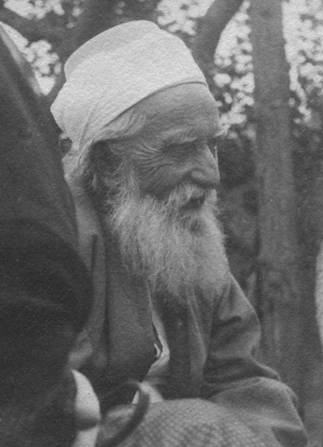
A retelling based on the chapter "'Abdu'l-Bahá in Paris" in The Chosen Highway by Lady Blomfield, who was with Him in Paris in 1911 and took notes of His talks there. Words in quotation marks are as she recorded them.
In the autumn of 1911, at the close of His first visit to London, 'Abdu'l-Bahá went on to Paris. His friends Monsieur and Madame Dreyfus-Barney had found Him an apartment at 4 Avenue de Camoens, where a flight of steps led down into the Trocadéro Gardens. He stayed in the city for nine weeks.
Every morning He explained the teachings of Bahá'u'lláh to whoever came, "the learned and the unlearned." Lady Blomfield lists Theosophists, agnostics, materialists, Christian Scientists, social reformers, Hindus, Sufis, Muslims, Buddhists and Zoroastrians among His visitors. People who worked in humanitarian societies to relieve the hardships of the poor came often, and "these received special sympathy and blessing." One man told Him that he had spent sixteen years in the French Congo trying to ease the hardships of the people there. 'Abdu'l-Bahá answered: "It was a great comfort to me in the darkness of my prison to know the work which you were doing."
One Sunday morning He addressed a very poor congregation in a mission hall, at the invitation of its pastor. On His way from the hall He walked into a crowd of men and women in the street, a group Lady Blomfield describes as "inclined to be rowdy." At the front a big man was shouting and dancing, waving a long loaf of bread. Seeing 'Abdu'l-Bahá, the man stood still. Then he began clearing a path with the loaf, crying, "Make way, make way! He is my Father, make way!" The crowd fell silent and saluted Him respectfully as He passed through. "Thank you, my dear friends, thank you," He said, smiling at them. Lady Blomfield adds: "The poor were always His especially beloved friends. He was never happier than when surrounded by them, the lowly of heart."
Another day a widow in deep mourning came to the apartment. She was weeping so bitterly that she could not say a word. 'Abdu'l-Bahá wiped the tears from her face. "Do not weep," He said. "Do not weep. Be happy! It will be well with the boy. Bring him to see me in a few days." Only on her way out did she tell the others what her trouble was: her son was to undergo a dangerous operation that same day. A few days later she brought the boy to the Master, perfectly well.
Children, too, came up to Him on the steps to the gardens and held on to His cloak. He gave them the roses He was carrying and lifted them one after another in His arms.
This is a retelling. For the fuller account, see The Chosen Highway by Lady Blomfield.
Cite this story
Blomfield, L.. (1940). *The Chosen Highway*. Bahá'í Publishing Trust.
Record yourself reading this story
Recording stays on this device only. Nothing is uploaded.
Related stories
'Abdu'l-Bahá at the Bowery Mission
In April 1912 'Abdu'l-Bahá spoke at the Bowery Mission in New York to about four hundred poor men, telling them that Jesus Himself had been poor and that the poor are very dear to God. Then He stood at the door and gave each man a coin.
The Master's Last Friday
On the Friday before His passing in November 1921, 'Abdu'l-Bahá went to the noonday prayer and afterward, despite great fatigue, gave alms to the poor of Haifa as was His custom.
The Tenderness of the Greatest Holy Leaf
Bahíyyih Khánum, daughter of Bahá'u'lláh, knew poverty and exile from early childhood. Shoghi Effendi recalls her kindness in 'Akká, her care for the hungry who came to 'Abdu'l-Bahá's house during the First World War, and the support she gave him after 'Abdu'l-Bahá's passing.
Quarters for the Bowery Mission
Juliet Thompson's diary records how, in April 1912, 'Abdu'l-Bahá had her change a thousand-franc note into quarters for the men of New York's Bowery Mission, and how He gave the coins that were left to a hotel chambermaid.