The Shepherd Who Grieved With the Flock: Shoghi Effendi's Compassion
Rúhíyyih Khánum, The Priceless Pearl, (1969), Bahá'í Publishing Trust
When in Bahá'í history
Haifa (today: Haifa, Israel)
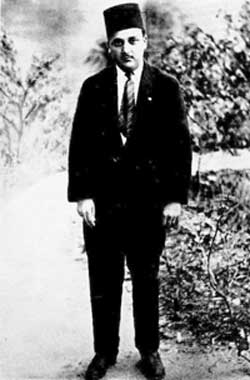
A retelling based on The Priceless Pearl by Rúhíyyih Khánum (Rúhíyyih Rabbání), her biography of her husband, Shoghi Effendi, Guardian of the Bahá'í Faith. The narrative is retold in our own words from the portrait she preserves of his life and character.
When 'Abdu'l-Bahá passed away in November of 1921, the leadership of the Bahá'í Faith descended, by the provisions of His Will, upon a young man not yet twenty-five years old — Shoghi Effendi, His grandson, then a student at Oxford. The grief of that loss nearly broke him, and the weight of what had been laid upon his shoulders would have crushed most men. He was now the Guardian of a worldwide community, answerable for its protection, its unity, and its growth, with no precedent to follow and no one above him to share the load. For the next thirty-six years he carried that burden, and the account his wife has left of those years reveals that at the center of all his labor — the building, the translating, the guiding of a global community — lay a deep and costly compassion for the believers in his care.
The Priceless Pearl gives one of the most intimate portraits in all the Bahá'í literature of how the Guardian actually worked. He had no great secretariat, no machinery of officials to stand between himself and the friends. He had, instead, a small office in the house in Haifa — a desk, a typewriter, a shelf of dictionaries, a lamp that burned late into the night. From that single room he corresponded with the Bahá'í world. And the striking thing, the thing his wife returns to again and again, is how personal it all remained. The cares of an entire planet reached him there, soul by soul, and he answered them soul by soul. The pleas, the questions, the confessions of weakness, the reports of trouble in distant communities — all of it came to him, and he took it upon himself. He did not delegate his heart.
This was the form his mercy most often took: not the dramatic gesture, but the patient, unseen labor of love, sustained for decades at the cost of his own strength and rest. He worked himself, year after year, to the very edge of his endurance, because he would not hold the believers at a safe distance. He let their burdens become his burdens. When trouble or sorrow came upon the friends, it came upon him too; he felt their grief as his own and spent himself to lift it. The compassion was not an occasional warmth he could summon when convenient. It was the daily atmosphere of a life poured out for others.
His wife records how acutely he felt the sufferings of the believers — how the persecution of the friends in one land, the bereavement of a devoted soul in another, the failures and discouragements of the community he was trying to build up, all reached him personally and weighed on him. He was, in her telling, a shepherd who could not be indifferent to the flock, who grieved when they grieved and rejoiced when they were faithful, and who carried in himself, privately, far more of their pain than they ever knew.
His mercy showed itself, too, in the way he dealt with the weaknesses and mistakes of the friends. He was building a worldwide community out of imperfect and often inexperienced people, scattered across continents, learning as they went; and he might easily have governed such a community with severity, breaking the bruised reed and quenching the smoking flax. He did not. Those who served him and those who corresponded with him remarked on his patience with human frailty, his readiness to encourage rather than to crush, his care that a devoted soul should never be needlessly discouraged. When the friends erred, he corrected; but the correction came wrapped in love, and behind it always stood his evident longing for them to succeed, to grow, to become what the Cause needed them to be. He praised generously where praise was due. He saw the smallest sincere effort and valued it. A heart genuinely trying to serve found in him not a stern judge but a warm and hopeful champion. This, too, is a form of mercy — perhaps the form most needed by people who are trying and failing and trying again — and he extended it, year after year, to a community of human beings who gave him, along with their love, a steady supply of occasions to be disappointed. The tenderness with which he could comfort a stricken heart was famous among those who experienced it. When one whom he loved was struck by a terrible loss, he did not offer a distant or formal consolation; he came near, he held the grief with the mourner, and he spoke of the radiant station of the departed in the next world until the weeping was turned, gently, toward hope. He had a way of dispelling sorrow not by denying it but by lifting the mourner's eyes beyond it — and of doing so with such patience and such warmth that those he comforted never forgot it.
There was a particular generosity in the way he treated the pilgrims who came to Haifa, often from very far away and at great sacrifice, to be in his presence. However exhausted he was — and he was very often exhausted — he gave them himself. He sat with them in the evenings and unfolded to them the vision of the Cause; he fed their souls; he sent them home strengthened and aflame. To each he gave the impression, which was no illusion, that he had time for them, that their small lives mattered supremely to the man on whom the whole structure of the Faith depended. It is one of the marks of a truly merciful heart that it makes the least person before it feel like the most important, and this the Guardian did, again and again, with souls who had nothing to offer him but their love.
What makes this compassion the more moving is the price it exacted. Rúhíyyih Khánum does not hide what those decades cost her husband. The unrelenting labor, the refusal to spare himself, the way he absorbed the troubles of a worldwide community into his own sensitive spirit — all of it wore upon him. He could have governed from behind a protective distance; many a leader has. He chose instead the harder road of nearness, of letting himself be touched, of carrying the sorrows of the friends rather than holding them at arm's length. His mercy was not the cheap kind that costs the giver nothing. It was the kind that is paid for out of one's own life.
And so the portrait that emerges from The Priceless Pearl is not chiefly of an administrator, though he administered a global community with extraordinary skill, nor only of a builder, though he raised up institutions and gardens and shrines that endure. It is, at its heart, the portrait of a shepherd — a man who felt the flock's every wound, who answered each soul that turned to him as if that soul were the only one, who comforted the grieving with infinite gentleness, and who spent himself without stint, for thirty-six years, in the unseen, unglamorous, endlessly repeated work of caring for people. The cares of a whole world passed across that small desk in Haifa. He met them, one by one, with mercy.
This is a retelling. For the fuller portrait of the Guardian's life and character, see The Priceless Pearl by Rúhíyyih Khánum.
Cite this story
Khánum, R.. (1969). *The Priceless Pearl*. Bahá'í Publishing Trust.
Record yourself reading this story
Recording stays on this device only. Nothing is uploaded.
Related stories
The Call to Persia: Keith Ransom-Kehler
Keith Ransom-Kehler was a gifted American lecturer who could have spent her later years in comfort. When the Guardian asked her to undertake a long, hard teaching journey to Persia on behalf of her persecuted fellow believers, she accepted at once — with no Persian, no pioneering experience, and not in robust health. She gave the rest of her life to it, dying in Iṣfáhán in 1933, and Shoghi Effendi named her the first American Bahá'í martyr.
The Globe Her Parish: Martha Root in Service to the World
A slight, quiet newspaperwoman from western Pennsylvania, Martha Root gave the last twenty years of her life to a single errand of service — carrying the message of Bahá'u'lláh to the whole world. Between 1919 and her death in 1939 she circled the globe four times, living out of a suitcase, often ill, often with little money, planting the Cause in lands where it had never been heard. Shoghi Effendi called her the foremost Hand raised up in the West in His time.
The Most Vital and Challenging Issue: Shoghi Effendi on Race
In *The Advent of Divine Justice* (1939), Shoghi Effendi laid before the American Bahá'ís the work that would prove central to their century: the task of overcoming racial prejudice. White believers were called to abandon their inherited sense of superiority; minority members were to be unhesitatingly given priority — not for sentiment, but for the health of the Faith.
The First Bahá'ís of South Africa
Bahá'í Chronicles records the establishment of the South African Bahá'í community in the early 1950s — when Shoghi Effendi's Ten Year Crusade brought pioneers to the apartheid-era cities, and the first declarations were made by a handful of Black, white, and Indian South Africans who had found in the Faith the answer to the racial question their country had not yet faced.