Louis Bourgeois and the Temple Design
Star of the West Editors, Star of the West, (1921), Bahai News Service · Read original
When in Bahá'í history
Wilmette (today: Wilmette, Illinois, USA)
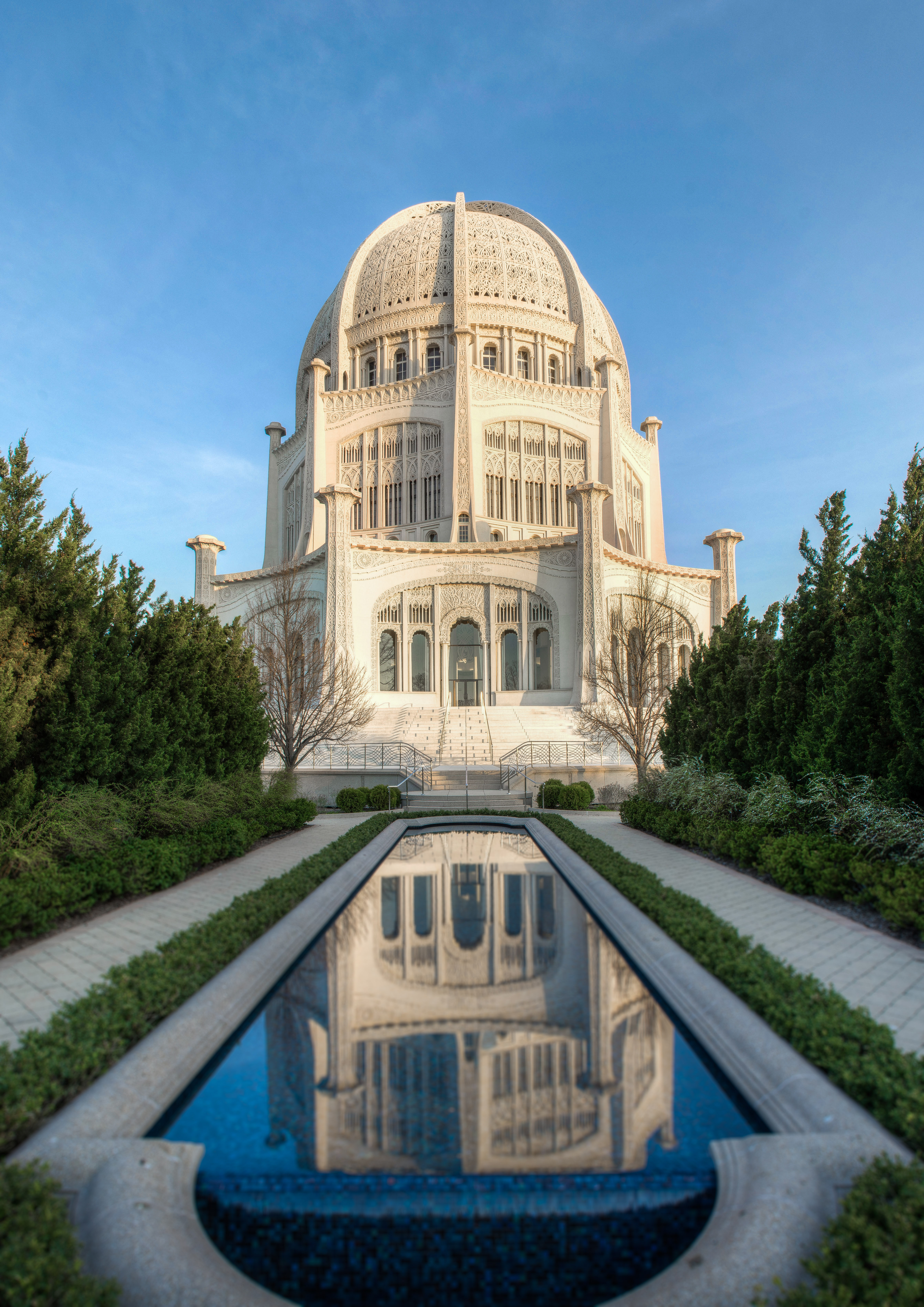
A retelling based on reports in the Star of the West (vol. 11, no. 5, June 1920; vol. 12, no. 4, May 1921), together with Shoghi Effendi's account of the building of the Temple in God Passes By. Words in quotation marks are from those reports.
Louis Bourgeois was a French-Canadian architect and sculptor who lived with his wife in West Englewood, New Jersey. A New York newspaper report of 1920, reprinted in the Star of the West, says that he had had the Temple in mind for nine years, but that it began to take shape only after he attended a Bahá'í convention in Boston. He sketched the lower story in an hour. He had expected to finish the model in three months; it took three years. While he worked, his wife kept a small store in West Englewood, selling ice cream and candy, so that the family had an income. Once, out of money for plaster, he filled her clothes basket with roses from their garden, carried them to New York, and sold them for five dollars. He said his wife was really the "Temple builder."
'Abdu'l-Bahá had directed the American believers to choose a design for their House of Worship. At the Temple Unity convention held in New York in April 1920, the forty-nine delegates chose Bourgeois's design from among those submitted, and 'Abdu'l-Bahá later confirmed the choice. The same report quotes the president of the Architectural League, H. Van Buren Magonigle, who had studied the models without knowing the delegates' preference: "It is the first new idea in architecture since the thirteenth century. I want to see it erected." Bourgeois said of it: "It is BAHA'O'LLAH'S Temple. I am only the channel through which it came!"
Before the next convention Bourgeois went on pilgrimage to show his drawings to 'Abdu'l-Bahá. At the convention in Chicago in April 1921 he described what happened. "I showed him the design of the large Temple in color. He examined it carefully and said, 'It is very beautiful, very beautiful.' Many times he repeated these words, 'Very beautiful.' 'The most beautiful in the world. It was given to you from the Kingdom,' he said." 'Abdu'l-Bahá also told him: "All the troubles around you will be removed. You have been confirmed in this work." Bourgeois had planned the rooms around the dome for teaching, a room for each language. 'Abdu'l-Bahá told him: "No, you will give a room to every religion so that each may worship in its own way."
Bourgeois explained that his design brought together the religious architecture of the world, since the purpose of the Bahá'í teachings is to unify the religions. In the ornament he wove the symbols of different religions, among them Buddhist and Vedantist symbols, the seal of Solomon, the Christian cross, the crescent and five-pointed star, and a nine-pointed star for the Bahá'í Revelation.
Work on the foundations began in 1920. Bourgeois died in 1930. The superstructure was completed by 1 May 1931, when the first devotional service was held in it, and the ornamentation of the dome was finished in 1934. The House of Worship was dedicated in 1953.
This is a retelling. For the fuller account, see the Star of the West, vol. 11, no. 5 and vol. 12, no. 4, and Shoghi Effendi's God Passes By.
Cite this story
Editors, S. O. T. W.. (1921). *Star of the West*. Bahai News Service. https://bahai.works/Star_of_the_West/Volume_12/Issue_4
Record yourself reading this story
Recording stays on this device only. Nothing is uploaded.
Related stories
Corinne True and the Temple Fund
As financial secretary of Bahai Temple Unity, Corinne True of Chicago gathered gifts from across America and the East for the House of Worship at Wilmette. She lived to see it dedicated in 1953 and was known as the Mother of the Temple.
Sarah Farmer and Green Acre
In 1894 Sarah Farmer opened Green Acre in Eliot, Maine, as a summer platform for speakers of every religion. After her pilgrimage to 'Akká in 1900 she offered it to the Bahá'ís, and in 1912 'Abdu'l-Bahá spent a week there and prayed for her.
The Founding of Bahá'í Temple Unity
In March 1909 thirty-nine delegates from thirty-six cities met in Chicago and formed Bahá'í Temple Unity, the national body that would hold the land and raise the funds for the first House of Worship in the West.
The Laying of the Wilmette Temple Cornerstone
On 1 May 1912 'Abdu'l-Bahá dedicated the site of the first Bahá'í House of Worship in the West at Wilmette, laying as its first stone a discarded block brought by Nettie Tobin.