The Mystery of God and the Servant of Bahá
Shoghi Effendi, The World Order of Bahá'u'lláh, (1938), Bahá'í Publishing Trust
When in Bahá'í history
'Akká (today: 'Akká, Israel)
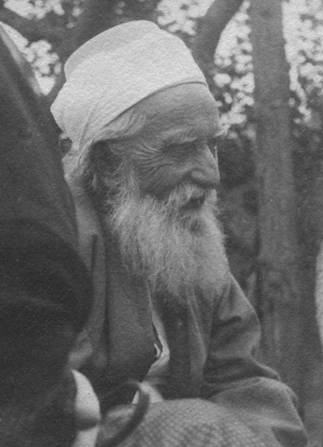
A retelling drawn from The World Order of Bahá'u'lláh by Shoghi Effendi (the letter known as "The Dispensation of Bahá'u'lláh"), with details from his God Passes By and from H. M. Balyuzi's 'Abdu'l-Bahá: The Centre of the Covenant. The narrative is in our own words; words in quotation marks are quoted from those books.
'Abdu'l-Bahá was the eldest son of Bahá'u'lláh, born in Tihrán in 1844. Balyuzi writes: "He was eight years old when He was taken to the dungeon of Tihran and saw His beloved Father bent under the weight of chains." From then on He shared His Father's exiles, to Baghdád, Constantinople, Adrianople and 'Akká.
Bahá'u'lláh gave Him titles He gave to no one else. In the Súriy-i-Ghuṣn, the Tablet of the Branch, revealed in Adrianople, He called Him "this sacred and glorious Being, this Branch of Holiness." In the Kitáb-i-'Ahd, the Book of His Covenant, He wrote that His family must "turn, one and all, their faces towards the Most Mighty Branch." Shoghi Effendi records in God Passes By that "He alone had been accorded the privilege of being called 'the Master,' an honor from which His Father had strictly excluded all His other sons." And upon Him, Shoghi Effendi writes, Bahá'u'lláh "had chosen to confer the unique title of 'Sirru'lláh' (the Mystery of God)."
In The Dispensation of Bahá'u'lláh Shoghi Effendi explains that 'Abdu'l-Bahá is not a Manifestation of God, yet the words of Bahá'u'lláh about Him "invest 'Abdu'l-Bahá with a power, and surround Him with a halo, which the present generation can never adequately appreciate." He calls Him "the stainless Mirror of His light, the perfect Exemplar of His teachings, the unerring Interpreter of His Word, the embodiment of every Bahá'í ideal, the incarnation of every Bahá'í virtue," and then turns to the title of mystery:
He is, above and beyond these appellations, the "Mystery of God"--an expression by which Bahá'u'lláh Himself has chosen to designate Him, and which, while it does not by any means justify us to assign to Him the station of Prophethood, indicates how in the person of 'Abdu'l-Bahá the incompatible characteristics of a human nature and superhuman knowledge and perfection have been blended and are completely harmonized.
After Bahá'u'lláh passed away in 1892, the leadership of the Faith passed to Him. Balyuzi writes that "once the mantle of authority came to rest on His shoulders, He chose to be known as 'Abdu'l-Bahá -- the Servant of Baha." Shoghi Effendi notes that all His other titles "find their truest, their highest and fairest expression in the magic name 'Abdu'l-Bahá." In a letter to believers in America, quoted in The Dispensation of Bahá'u'lláh, 'Abdu'l-Bahá Himself wrote:
My name is 'Abdu'l-Bahá. My qualification is 'Abdu'l-Bahá. My reality is 'Abdu'l-Bahá. My praise is 'Abdu'l-Bahá. Thraldom to the Blessed Perfection is my glorious and refulgent diadem, and servitude to all the human race my perpetual religion... No name, no title, no mention, no commendation have I, nor will ever have, except 'Abdu'l-Bahá.
He lived by that name. During the First World War, when misgovernment and locusts brought the Holy Land near to famine, He had lands in the Jordan Valley and by the Sea of Galilee cultivated for food, and sent wheat to 'Akká to be given out, with lists of the names and the quantities each was to receive. In 1920 the British conferred a knighthood on Him in recognition of that work. Balyuzi writes that He "accepted the honour as the gift of a 'just king' but never used the title." At the opening of his book, Balyuzi sums up His life in these words: "From that tender age to His seventy-seventh year when, His work done, He left His mortal frame, 'Abdu'l-Bahá lived a life of total self-abnegation, of unbroken, unqualified service to God and to man."
This is a retelling. For the fuller account, see "The Dispensation of Bahá'u'lláh" in The World Order of Bahá'u'lláh by Shoghi Effendi.
Cite this story
Effendi, S.. (1938). *The World Order of Bahá'u'lláh*. Bahá'í Publishing Trust.
Record yourself reading this story
Recording stays on this device only. Nothing is uploaded.
Related stories
The Ascension of Bahá'u'lláh
Thus simply and serenely did Bahá’u’lláh pass the evening of His life on earth until, after an attack of fever, He passed away on the 29th of May, 1892, at the age of seventy-five.
The Marriage of ‘Abdu’l-Bahá
The following particulars regarding the marriage of ‘Abdu’l-Bahá were kindly supplied to the writer by a Persian historian of the Bahá’í Faith:— During the youth of ‘Abdu’l-Bahá the question of a suitable marriage for Him was naturally one …
The Journey from Tihrán to Baghdád, Winter 1853
The Greatest Holy Leaf tells Lady Blomfield of her family's winter exile from Tihrán to Baghdád: her father still ill from the Síyáh-Chál, the youngest child left behind, and her mother riding a jolting mule through the snow.
The Reading of the Covenant
On the ninth day after Bahá'u'lláh's passing, His Book of the Covenant was unsealed and read aloud at His Tomb. In it He directed His family and followers to turn to 'Abdu'l-Bahá.