Hájí Amín, the Trusted One
Bahá'í Chronicles editors, Bahá'í Chronicles · Read original
When in Bahá'í history
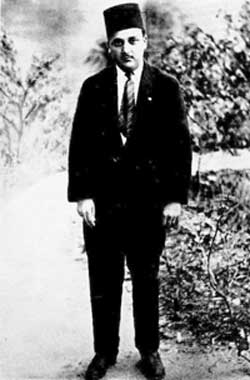
A retelling for children based on Bahá'í Chronicles, which follows Moojan Momen's article "Haji Abu'l-Hasan Amin"; some details are also in Adib Taherzadeh's The Revelation of Bahá'u'lláh, volume 3.
Abu'l-Hasan was born in about 1831 in Ardikan, a town north of Yazd in Persia. His father was a farmer who owned his own land.
He married into a family of Bábís. His wife's father and uncles tried to teach him about the Báb, but at first he would not listen. Around 1851, after meeting a Bábí teacher named Mullá Muḥammad-Riḍá, he became sure that the Báb's message was true.
Later he read the writings of Bahá'u'lláh and learned of His station, and he believed at once. Because his wife's family was one of the most respected Bábí families, the other old Bábí families welcomed him. He travelled among them all over Persia and told them of Bahá'u'lláh, and many of them accepted His Faith.
In time he became the assistant of Ḥájí Sháh-Muḥammad, whom Bahá'u'lláh had put in charge of the Ḥuqúqu'lláh, the Right of God, an offering the believers make to the Head of their Faith. Abu'l-Hasan went from town to town collecting the offerings and the believers' letters to Bahá'u'lláh. A single journey could last more than a year. He paid his way by trading, and by writing letters for believers who could not read or write.
In 1869 he reached ‘Akká, where Bahá'u'lláh was a prisoner, but he could not get into the citadel to see Him. Outside it he handed the money and letters to Bahá'u'lláh's secretary, and then went back to Persia. The believers there had been anxious for news, and he was the first to tell them where Bahá'u'lláh was and that He was being held captive in ‘Akká.
When he came back to ‘Akká, Bahá'u'lláh told him to go to the public bath at the hour when He Himself made His weekly visit there. That is how Abu'l-Hasan met Bahá'u'lláh. He was among the very first believers from outside to reach Him in ‘Akká.
He made the long journey to ‘Akká several more times. On the way home from one of them, he and Ḥájí Sháh-Muḥammad were caught up in a Kurdish uprising in north-western Persia. Ḥájí Sháh-Muḥammad was killed, and Abu'l-Hasan was shot in the leg. He reached Tabríz and stayed there until he recovered.
Bahá'u'lláh then made Abu'l-Hasan the Trustee of the Ḥuqúqu'lláh in Ḥájí Sháh-Muḥammad's place. From that time the believers called him Hájí Amín. Amín means the trusted one, and he was also known as Amín-i-Iláhí, the Trustee of God.
In April 1891 he and another believer, Ḥájí Ákhúnd, were arrested. The Sháh had ordered the arrest of men who were calling for political reform. The Bahá'ís had nothing to do with it, but the two were kept in prison in Tihrán and Qazvín for two years.
By the time he was freed, Bahá'u'lláh had passed away. Hájí Amín went back to his travels, collecting the Ḥuqúqu'lláh and explaining the Covenant of Bahá'u'lláh to the believers. In 1911 he travelled to Haifa to visit 'Abdu'l-Bahá.
As he grew old he travelled less. In 1916 he chose a Tihrán merchant, Ḥájí Ghulám-Riḍá, to help him, and 'Abdu'l-Bahá approved. Little by little Hájí Amín handed over his work to him. He died in Tihrán in the spring of 1928, at more than ninety years of age. Shoghi Effendi later named him a Hand of the Cause of God, and he is counted among the Apostles of Bahá'u'lláh.
This is a retelling for children. For the fuller account, see "Haji Mirza Abu’l-Hasan Ardikani aka Haji Amin".
Cite this story
editors, B. C.. *Bahá'í Chronicles*. https://bahaichronicles.org/haji-mirza-abul-hasan-ardikani-haji-amin/
Record yourself reading this story
Recording stays on this device only. Nothing is uploaded.
Related stories
Ḥájí Amín, Trustee of the Ḥuqúqu’lláh
For decades Ḥájí Abu’l-Ḥasan Ardikání carried the Ḥuqúqu’lláh and the believers’ letters to Bahá’u’lláh, met Him in the public bath at ‘Akká, became trustee of the Ḥuqúqu’lláh, and served on into the ministry of ‘Abdu’l-Bahá.
Memorial of Muḥammad-Muṣṭafá Baghdádí
Muḥammad-Muṣṭafá was a blazing light.
Memorial of Sulaymán Khán-i-Tunúkábání
Sulaymán Khán was the emigrant and settler who was given the title of Jamálí’d-Dín.
Memorial of Zaynu’l-Muqarrabín
This distinguished man was one of the greatest of all the Báb’s companions and all the loved ones of Bahá’u’lláh.